
Ask questions which are clear, concise and easy to understand.
Ask QuestionPosted by Ash Sunil 6 years, 8 months ago
- 0 answers
Posted by Ash Sunil 6 years, 8 months ago
- 1 answers
Posted by Ash Sunil 6 years, 8 months ago
- 0 answers
Posted by Tushar Agrawal 6 years, 4 months ago
- 1 answers
Sia ? 6 years, 4 months ago
Suppose {tex}\sqrt2{/tex} is a rational number. That is , {tex}\sqrt2{/tex} = {tex}\frac{p}{q}{/tex} for some p{tex}\in{/tex}Z and q {tex}\in{/tex}Z. We can assume the fraction is in lowest fraction, That is p and q shares no common factors.
Then {tex}\sqrt2q=p{/tex}
Squaring both side we get,
{tex}2q^2=p^2{/tex}
So {tex}p^2{/tex} is a multiple of 2,
let's assume {tex}p=2m{/tex}
Then, {tex}2q^2=\left(2m\right)^2{/tex}
{tex}2q^2=4m^2{/tex}
Or {tex}q^2=2m^2{/tex}
So {tex}q^2{/tex} is a multiple of 2,
{tex}\therefore{/tex} q is multiple of 2
Thus p and q shares a common factor.This is contradiction.
{tex}\Rightarrow {/tex}{tex}\sqrt { 2 }{/tex} is an irrational number.
Posted by Abhi Rana 6 years, 8 months ago
- 0 answers
Posted by Vaishnavi Chopade 6 years, 8 months ago
- 0 answers
Posted by Gracy Mehar 6 years, 8 months ago
- 2 answers
Apurva Vats 6 years, 8 months ago
Posted by Harpreet Singh 6 years, 8 months ago
- 0 answers
Posted by Arshiya Khan 6 years, 8 months ago
- 1 answers
Posted by Abhishek Kumar 6 years, 4 months ago
- 1 answers
Sia ? 6 years, 4 months ago
Let Salim's present age be x years and his daughter's age be y years.
Two years ago,
Salim's age = (x - 2) years
Daughter's age = (y - 2) years
As per given condition
Two years ago, Salim was thrice as old as his daughter .
x - 2 = 3(y - 2)
x - 2 = 3y - 6
{tex}\Rightarrow{/tex} x - 3y = -4 .........(i)
Six years hence,
Salim's age = (x + 6) years
Daughter's age = (y + 6) years
As per second condition
Six years later, he will be four years older than twice her age.
x + 6 = 2(y + 6) + 4
x + 6 = 2y + 12 + 4
{tex}\Rightarrow{/tex} x - 2y = 10 ...........(ii)
Subtracting (i) from (ii), we have
x - 2y - x + 3y =10 - ( -4)
y = 14
Put y = 14 in (i)
{tex}\Rightarrow{/tex} x - 3(14) = -4
{tex}\Rightarrow{/tex} x - 42 = - 4
{tex}\Rightarrow{/tex} x = 38
Therefore, the present age of Salim is 38 years and that of his daughter is 14 years.
Posted by Tushar Khatkar 6 years, 8 months ago
- 0 answers
Posted by Rohan Saini 6 years, 8 months ago
- 0 answers
Posted by Patel Tirth 6 years, 8 months ago
- 0 answers
Posted by Yadvinder Aulakh 6 years, 8 months ago
- 1 answers
Gaurav Seth 6 years, 8 months ago
Let no at ones= x
Let no. at tens=10(x+3)
=10x+ 30
New no.
Let no. at ones place x+3
let no. ta tens place 10x
10x +30+x + 10x + x +3= 121
22x=88
x=88/22
x=4
the original no. is 74
the new no. is 47
Posted by Samyak Jain 6 years, 4 months ago
- 1 answers
Sia ? 6 years, 4 months ago
Let us suppose that the numbers are x and y.
According to question it is given that
The sum of the two numbers is 1000.
Thus, we have x + y = 1000
The difference between the squares of the two numbers is 256000.
Therefore, we have x2 - y2 = 256000
{tex} \Rightarrow{/tex} (x + y)(x - y) = 256000
{tex}\Rightarrow{/tex} 1000(x - y) = 256000
{tex}\Rightarrow x - y = \frac{{256000}}{{1000}}{/tex}
{tex}\Rightarrow{/tex} x - y = 256
Therefore, we have two equations
x + y = 1000 ......(1)
x - y = 256 .....(2)
Here x and y are unknowns.
We have to solve the above equations for x and y.
Adding equation (1) and (2), we get
(x + y) + (x - y) = 1000 + 256
{tex}\Rightarrow{/tex} x + y + x - y = 1256
{tex}\Rightarrow{/tex} 2x = 1256
{tex}\Rightarrow x = \frac{{1256}}{2}{/tex}
x = 628
Substituting the value of x in the equation (1) we get,
628 + y = 1000
{tex}\Rightarrow{/tex} y = 1000 - 628
{tex}\Rightarrow{/tex} y = 372
Therefore the numbers are 628 and 372.
Posted by Mandeep Kharb 6 years, 8 months ago
- 0 answers
Posted by Vidit Jain 6 years, 8 months ago
- 0 answers
Posted by Abhinav Singh 6 years, 4 months ago
- 1 answers
Sia ? 6 years, 4 months ago
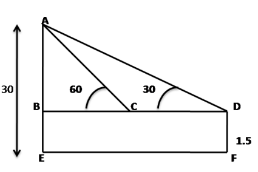
Let AE is the Length of the building.
So AE = 30
Again BE = DF = 1.5
AB = AE - BE = 30 - 1.5 = 28.5
Now in triangle ABC,
tan60 = {tex}\frac{AB}{BC}{/tex}
{tex}\Rightarrow {/tex} √3 = {tex}\frac{28.5}{BC}{/tex}
{tex}\Rightarrow {/tex} BC = {tex}\frac{28.5}{\sqrt 3}{/tex}
Again in triangle ABD
tan30 = {tex}\frac{AB}{BD}{/tex}
{tex}\sqrt{1}{\sqrt3}=\frac{28.5}{BD}{/tex}
{tex}\Rightarrow {/tex} BD = 28.5{tex}\times{/tex}√3
{tex}\Rightarrow {/tex} BC + CD = 28.5√3
{tex}\Rightarrow {/tex} 28.5/√3 + CD = 28.5√3
{tex}\Rightarrow {/tex} CD = {tex}\frac{28.5}{\sqrt 3}{/tex}- {tex}\frac{28.5}{\sqrt 3}{/tex}
{tex}\Rightarrow {/tex} CD = {tex}\frac{28.5\times3-28.5}{\sqrt3}{/tex}
{tex}\Rightarrow {/tex} CD = {tex}\frac{28.5(3-1)}{\sqrt3}{/tex}
{tex}\Rightarrow {/tex} CD = {tex}\frac{(28.5\times 2)}{\sqrt3}{/tex}
{tex}\Rightarrow {/tex} CD = {tex}\frac{(57)}{\sqrt3}{/tex}
{tex}\Rightarrow {/tex} CD = {tex}\frac{(57\sqrt3)}{\sqrt3\times\sqrt3}{/tex} (Multiply √3 in numerator and denominator)
{tex}\Rightarrow {/tex} CD = {tex}\frac{57\sqrt3}{3}{/tex}
{tex}\Rightarrow {/tex} CD = 19√3
The distance he walked towards the building is 19√3 m
Posted by Arpit Patel 6 years, 8 months ago
- 4 answers
Posted by Aastha ?? 6 years, 8 months ago
- 4 answers
Posted by Shubham Yadav 6 years, 4 months ago
- 1 answers
Sia ? 6 years, 4 months ago
Two digit numbers which are divisible by 7 are 14,21,28,.....98.
It forms an A.P.
{tex}a = 14, d = 7, a_n = 98{/tex}
{tex}a_n = a + (n - 1)d{/tex}
{tex}98 = 14 + (n - 1)7{/tex}
{tex}98 -14 = 7n - 7{/tex}
{tex}84 + 7 = 7n{/tex}
or, {tex}7n = 91{/tex}
or, {tex}n = 13{/tex}
Posted by Fun Fact 6 years, 4 months ago
- 1 answers
Sia ? 6 years, 4 months ago
{tex}\frac{x}{2} + \frac{{2y}}{3} = - 1{/tex} ....(1)
{tex}x - \frac{y}{3} = 3{/tex} ...(2)
- Elimination method: Multiplying equation (2) by 2, we get (3)
{tex}2x - \frac{2}{3}y = 6{/tex} ....(3)
{tex}\frac{x}{2} + \frac{{2y}}{3} = - 1{/tex} ....(1)
Adding (3) and (1), we get
{tex}\frac{5}{2}x = 5{/tex}
⇒ x =2
Putting value of x in (2), we get
2− {tex}\frac{y}{3}{/tex}= 3
⇒ y =−3
Therefore, x =2 and y =−3 - Substitution method:{tex}\frac{x}{2} + \frac{{2y}}{3} = - 1{/tex} ....(1)
{tex}x - \frac{y}{3} = 3{/tex} ....(2)
From equation (2), we can say that {tex}x = 3 + \frac{y}{3} = \frac{{9 + y}}{3}{/tex}
Putting this in equation (1), we get
{tex}\frac{{9 + y}}{6} + \frac{2}{3}y = - 1{/tex}
{tex} \Rightarrow \;\frac{{9 + y + 4y}}{6} = - 1{/tex}
⇒ 5y +9=−6
⇒ 5y =−15
⇒ y =−3
Putting value of y in (1), we get
{tex}\frac{x}{2} + \frac{2}{3}( - 3) = - 1{/tex}
⇒ x = 2
Therefore, x =2 and y =−3.
Posted by Meenu Tiwari 6 years, 8 months ago
- 2 answers
Yogita Ingle 6 years, 8 months ago
y2 + 92y + 1920
= y2 + 32y + 60y + 1920
= y( y+ 32 ) + 60(y + 32)
= (y+ 32) (y + 60)
=> y = -32 and y = -60
Posted by Nidhi Rathore; 6 years, 8 months ago
- 0 answers
Posted by Bishwajit Kumar 6 years, 4 months ago
- 1 answers
Sia ? 6 years, 4 months ago
The given system of equations may be written as
x + y = a - b
So, x + y -(a - b)=0 ......... (i)
and ax - by = a2 + b2
So, ax - by -(a2 + b2)=0 ........ (ii)
By cross-multiplication, using (i) and (ii) , we have
{tex}\frac { x } { - \left( a ^ { 2 } + b ^ { 2 } \right) - b ( a - b ) } = \frac { y } { - a ( a - b ) + \left( a ^ { 2 } + b ^ { 2 } \right) } = \frac { 1 } { - b - a }{/tex}
{tex}\Rightarrow \quad \frac { x } { - a ^ { 2 } - a b } = \frac { y } { a b + b ^ { 2 } } = \frac { 1 } { - b - a }{/tex}
{tex}\Rightarrow \quad \frac { x } { - a ( a + b ) } = \frac { y } { b ( a + b ) } = \frac { 1 } { - ( a + b ) }{/tex}
{tex}\Rightarrow \quad x = \frac { - a ( a + b ) } { - ( a + b ) } = a \text { and } y = \frac { b ( a + b ) } { - ( a + b ) } = - b{/tex}
Hence, x = a, y = -b is the solution of the given system of equations.
Posted by Vaibhav Sharma 6 years, 4 months ago
- 1 answers
Sia ? 6 years, 4 months ago
Let n be any positive integer. Applying Euclids division lemma with divisor = 5, we get
{tex}\style{font-family:Arial}{\begin{array}{l}n=5q+1,5q+2,5q+3\;and\;5q+4\;\\\end{array}}{/tex}
Now (5q)2 = 25q2 = 5m, where m = 5q2, which is an integer;
{tex}\style{font-family:Arial}{\begin{array}{l}(5q\;+\;1)^{\;2}\;=\;25q^2\;+\;10q\;+\;1\;=\;5(5q^2\;+\;2q)\;+\;1\;=\;5m\;+\;1\\where\;m\;=\;5q^2\;+\;2q,\;which\;is\;an\;integer;\\\;(5q\;+\;2)^2\;=\;25q^2\;+\;20q\;+\;4\;=\;5(5q^2\;+\;4q)\;+\;4\;=\;5m\;+\;4,\\\;where\;m\;=\;5q^2\;+\;4q,\;which\;is\;an\;integer;\\\;(5q\;+\;3)^{\;2}\;=\;25q^2\;+\;30q\;+\;9\;=\;5(5q^2\;+\;6q+\;1)\;+\;4\;=\;5m\;+\;4,\\\;where\;m\;=\;5q^2\;+\;6q\;+\;1,\;which\;is\;an\;integer;\\\;(5q\;+\;4)^2\;=\;25q^2\;+\;40q\;+\;16\;=\;5(5q^2\;+\;8q\;+\;3)\;+\;1\;=\;5m\;+\;1,\;\\where\;m\;=\;5q^2\;+\;8q\;+\;3,\;which\;is\;an\;integer\\\end{array}}{/tex}
Thus, the square of any positive integer is of the form 5m, 5m + 1 or 5m + 4 for some integer m.
It follows that the square of any positive integer cannot be of the form 5m + 2 or 5m + 3 for some integer m.
Posted by Priya Punia 6 years, 8 months ago
- 3 answers
Gaurang Varshney 6 years, 8 months ago

myCBSEguide
Trusted by 1 Crore+ Students

Test Generator
Create papers online. It's FREE.

CUET Mock Tests
75,000+ questions to practice only on myCBSEguide app
