
Ask questions which are clear, concise and easy to understand.
Ask QuestionPosted by Vivek Kumar 6 years, 8 months ago
- 0 answers
Posted by Hitman Lover......❤️❤️❤️??? 6 years, 8 months ago
- 4 answers
Posted by Shaireen Khan 6 years, 8 months ago
- 3 answers
Posted by Ajay Rathor 6 years, 7 months ago
- 1 answers
Sia ? 6 years, 7 months ago
{tex}\frac { x + 1 } { 2 } + \frac { y - 1 } { 3 } = 9{/tex}
or, 3(x + 1) + 2(y -1) = 54
or, 3x + 3 + 2 y - 2 = 54
or, 3x + 2y +1 = 54
or, 3x + 2y = 53..........(i)
and {tex}\frac { x - 1 } { 3 } + \frac { y + 1 } { 2 } = 8{/tex}
or, 2(x -1 ) + 3 (y + 1) = 48
or, 2x - 2 + 3y + 3 = 48
or, 2x + 3y +1 = 48
or, 2x +3y = 47........(ii)
Multiply eqn.(i) by 3, multiply eqn.(ii) by 2 and subtracting both eqn
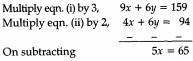

{tex}\therefore {/tex} {tex}x = \frac { 65 } { 5 } = 13{/tex}
Substitute the value of x in eqn. (ii),
2(13) + 3y = 47
or, 26 + 3y = 47
3y = 47-26 = 21
{tex}\therefore {/tex} {tex}y = \frac { 21 } { 3 } = 7{/tex}
Hence x = 13, y = 7.
Posted by Aditya Raj 6 years, 8 months ago
- 1 answers
Dream Girl 6 years, 8 months ago
Posted by Hitman Lover......❤️❤️❤️??? 6 years, 8 months ago
- 3 answers
Posted by Anamika Gupta 6 years, 8 months ago
- 1 answers
Posted by Darshan Chaudhari 6 years, 8 months ago
- 2 answers
Posted by Sumit Pandey 6 years, 8 months ago
- 0 answers
Posted by Dev Kapasia 6 years, 8 months ago
- 1 answers
Ram Kushwah 6 years, 8 months ago
{tex}\angle A=90{/tex}
{tex}\begin{array}{l}\sin B\cos C+\cos B\sin C=\sin(B+C)\\=\sin(180-A)\\=\sin A\\=\sin90=1\\\end{array}{/tex}
Posted by Ajay Rathor 6 years, 7 months ago
- 1 answers
Sia ? 6 years, 7 months ago
The given equations are
kx + 3y - (k - 3) = 0 ......... (i)
12x + ky - k = 0 ........... (ii)
The system of linear equations is in the form of
a1x + b1y + c1 = 0
a2x + b2y + c2 = 0
Compare (i) and (ii), we get
a1= k ,b1= 3, c1 = -(k - 3),
a2=12 ,b2= k ,c2 = -k
For a unique solution, we must have
{tex}\frac { a _ { 1 } } { a _ { 2 } } \neq \frac { b _ { 1 } } { b _ { 2 } }{/tex}
{tex}\frac { k } {1 2 } \neq \frac { 3 } { k }{/tex}
{tex}\Rightarrow k ^ { 2 } \neq 36 {/tex}
{tex}\Rightarrow k \neq \pm 6{/tex}
Thus, for all real value of k other than {tex}\pm 6{/tex}, the given system of equations will have a unique solution.
Posted by Navneesh Goyal 6 years, 8 months ago
- 0 answers
Posted by Bhavesh Ko Mulani 6 years, 8 months ago
- 0 answers
Posted by Chinmay Mathur 6 years, 8 months ago
- 0 answers
Posted by Aanchal ????? 6 years, 8 months ago
- 3 answers
Posted by Deekshith Reddy 6 years, 8 months ago
- 1 answers
Paulo Dybala 6 years, 8 months ago
Posted by Pankaj Kumar Behera 6 years, 8 months ago
- 3 answers
Paulo Dybala 6 years, 8 months ago
Posted by ☆☞Manuj Rajput☜☆ 6 years, 7 months ago
- 1 answers
Sia ? 6 years, 7 months ago
x + y = 14 ....(1)
x - y = 4 ....(2)
x = 4 + y from equation (2)
Putting this in equation (1), we get
4+y +y =14
⇒ 2y =10
⇒ y = 5
Putting value of y in equation (1), we get
x + 5 = 14
⇒ x = 14 - 5 = 9
Therefore, x =9 and y =5
Posted by Rowdy(Khushi)? ?Hk? 6 years, 8 months ago
- 2 answers
Posted by D.R Reshma 6 years, 8 months ago
- 2 answers
Tanisha Gupta 6 years, 8 months ago
Posted by Vandu Sharma 6 years, 8 months ago
- 2 answers
Posted by Simar Dhaliwal 6 years, 8 months ago
- 1 answers
Ramesh Kumar 6 years, 8 months ago
Posted by Hitman Lover......❤️❤️❤️??? 6 years, 8 months ago
- 2 answers
Posted by Hitman Lover......❤️❤️❤️??? 6 years, 8 months ago
- 2 answers
Posted by Hitman Lover......❤️❤️❤️??? 6 years, 8 months ago
- 5 answers
Posted by Shivam Kumar 6 years, 8 months ago
- 2 answers
Gaurav Seth 6 years, 8 months ago
Let us assume that √3 is a rational number.
That is, we can find integers a and b (≠ 0) such that √3 = (a/b)
Suppose a and b have a common factor other than 1, then we can divide by the common factor, and assume that a and b are coprime.
√3b = a
⇒ 3b2=a2 (Squaring on both sides) → (1)
Therefore, a2 is divisible by 3
Hence ‘a’ is also divisible by 3.
So, we can write a = 3c for some integer c.
Equation (1) becomes,
3b2 =(3c)2
⇒ 3b2 = 9c2
∴ b2 = 3c2
This means that b2 is divisible by 3, and so b is also divisible by 3.
Therefore, a and b have at least 3 as a common factor.
But this contradicts the fact that a and b are coprime.
This contradiction has arisen because of our incorrect assumption that √3 is rational.
So, we conclude that √3 is irrational.
Now
√2 = 1.4142...
√3 = 1.7321...
1.45, 1.5, 1.55, 1.6, 1.65, 1.7 lies between √2 and √3.
Hence the rational numbers between √2 and √3 are:
145/100, 15/10, 155/100, 16/10, 165/100 and 17/10
Khushi Agrawal 6 years, 8 months ago
Posted by Hitman Lover......❤️❤️❤️??? 6 years, 8 months ago
- 3 answers
Posted by Krishna Shivamurti 6 years, 8 months ago
- 0 answers
Posted by Sumit Agnihotri 6 years, 8 months ago
- 1 answers

myCBSEguide
Trusted by 1 Crore+ Students

Test Generator
Create papers online. It's FREE.

CUET Mock Tests
75,000+ questions to practice only on myCBSEguide app
