
Ask questions which are clear, concise and easy to understand.
Ask QuestionPosted by D.R Reshma 6 years, 4 months ago
- 1 answers
Posted by Sohan Singh 6 years, 8 months ago
- 1 answers
Gaurav Seth 6 years, 8 months ago
Given:
Equation: kx²-14x+8= 0
Also, One root of this Equation is 2
Substitute the Given value in Equation!
kx²-14x+8 = 0
k(2)² -14(2)+8 = 0
k4-28+8 = 0
4k-20 = 0
4k= 20
•°• k = 20/4
=> k = 5
Posted by Sanjeev Sharma 6 years, 8 months ago
- 0 answers
Posted by Amit Kr Verma 6 years, 8 months ago
- 1 answers
Posted by Apeksha Kaushik 6 years, 8 months ago
- 0 answers
Posted by Pragnil Savjani 6 years, 8 months ago
- 0 answers
Posted by Harprit Kaur 6 years, 8 months ago
- 0 answers
Posted by Varshini Bhushan 6 years, 7 months ago
- 1 answers
Sia ? 6 years, 7 months ago
Let a be the first term and d be the common difference of the given AP. Then,
Sm = n {tex}\Rightarrow{/tex} {tex}\frac{m}{2}{/tex}[2a + (m-1)d] = n
{tex}\Rightarrow{/tex} 2am + m(m- 1)d - 2n ...... (i)
And, Sn = m {tex}\Rightarrow{/tex}{tex}\frac{n}{2}{/tex}[2a + (n - 1)d] = m
{tex}\Rightarrow{/tex} 2an + n(n - 1)d = 2m ...... (ii)
On subtracting (ii) from (i), we get
2a(m-n) + [(m2 - n2) - (m - n)]d = 2(n - m)
{tex}\Rightarrow{/tex} (m - n)[2a + (m + n - 1)d] = 2(n - m)
{tex}\Rightarrow{/tex} 2a + (m + n- 1)d = -2 ..... (iii)
Sum of the first (m + n) terms of the given AP
= {tex}\frac{{(m + n)}}{2}{/tex}{tex}\cdot{/tex}{2a + (m + n - 1)d}
{tex}= \frac { ( m + n ) } { 2 } \cdot ( - 2 ) = - ( m + n ){/tex} [using (iii)].
Hence, the sum of first (m + n) terms of the given AP is -(m + n).
Posted by Hemamalini T. S. 6 years, 8 months ago
- 1 answers
Posted by Srajan Shivhare 6 years, 7 months ago
- 1 answers
Sia ? 6 years, 7 months ago
No. of members in army contingent = 616
No. of members in an army band = 32
Maximum number of columns = HCF of (616, 32)
Now Let us find HCF of 616 and 32
By Euclid’s division lemma
{tex}\begin{array}{l}616=32\times19+8\\32=8\times4\\So\;HCF(616,32)\;is\;8\\\end{array}{/tex}
Hence maximum number of columns = 8
Posted by Kumar Rustam 6 years, 8 months ago
- 1 answers
Posted by Shreya Choudhary 6 years, 8 months ago
- 2 answers
Posted by Mehak Jain 6 years, 8 months ago
- 1 answers
Posted by Ankit Yadav 6 years, 8 months ago
- 2 answers
Posted by The Kickers 6 years, 8 months ago
- 1 answers
Posted by Sabir Ali 6 years, 8 months ago
- 2 answers
Posted by Aakash Singh 6 years, 8 months ago
- 1 answers
Posted by Simran Kumari 6 years, 8 months ago
- 2 answers
Posted by Nikita Soni 6 years, 7 months ago
- 1 answers
Sia ? 6 years, 7 months ago
You can get them in the revision notes of the chapters : <a href="https://mycbseguide.com/cbse-revision-notes.html">https://mycbseguide.com/cbse-revision-notes.html</a>
Posted by Jansi Tripathi 6 years, 8 months ago
- 1 answers
Sia ? 6 years, 7 months ago
Let a be the positive integer and b = 4.
Then, by Euclid’s algorithm, a = 4q + r for some integer q ≥ 0 and r = 0, 1, 2, 3 because 0 ≤ r < 4.
So, a = 4q or 4q + 1 or 4q + 2 or 4q + 3.
{tex}(4q)^3\;=\;64q^3\;=\;4(16q^3){/tex}
= 4m, where m is some integer.
{tex}(4q+1)^3\;=\;64q^3+48q^2+12q+1=4(\;16q^3+12q^2+3q)+1{/tex}
= 4m + 1, where m is some integer.
{tex}(4q+2)^3\;=\;64q^3+96q^2+48q+8=4(\;16q^3+24q^2+12q+2){/tex}
= 4m, where m is some integer.
{tex}(4q+3)^3\;=\;64q^3+144q^2+108q+27{/tex}
=4×(16q3+36q2+27q+6)+3
= 4m + 3, where m is some integer.
Hence, The cube of any positive integer is of the form 4m, 4m + 1 or 4m + 3 for some integer m.
Posted by Adharsh Anilkumar 6 years, 8 months ago
- 2 answers
Yogita Ingle 6 years, 8 months ago
No.
Justification:
Let a be any positive integer.
Then by Euclid’s division lemma, we have a
= bq + r, where 0 ≤ r < b
For b = 3, we have
a = 3q + r, where 0 ≤ r < 3 ...(i)
So, The numbers are of the form 3q, 3q + 1 and 3q + 2.
So, (3q)2 = 9q2 = 3(3q2)
= 3m, where m is a integer.
(3q + 1)2 = 9q2 + 6q + 1
= 3(3q2 + 2q) + 1
= 3m + 1, where m is a integer.
(3q + 2)2 = 9q2 + 12q + 4, which cannot be expressed in the form 3m + 2.
Therefore, Square of any positive integer cannot be expressed in the form 3m + 2.
Posted by Vishal Bhatt 6 years, 8 months ago
- 1 answers
Yogita Ingle 6 years, 8 months ago
tan
i) Tanθ = opposite side/adjacent side
ii) Tan θ = sinθ/cos θ
cot
i) Cot θ = adjacent side/opposite sidr
ii) Cot θ = cosθ/ sin θ
Posted by Ãïsh ,,, 6 years, 8 months ago
- 2 answers
Posted by Hitman Lover......❤️❤️❤️??? 6 years, 8 months ago
- 4 answers
Amira ❤ 6 years, 8 months ago
Posted by Subhashini Subha 6 years, 8 months ago
- 2 answers
Aravind Chidambaram 6 years, 8 months ago
Posted by Hitman Lover......❤️❤️❤️??? 6 years, 8 months ago
- 3 answers
Posted by Yaaro Ka Yaar????? 6 years, 8 months ago
- 4 answers
Posted by Rajeev Singh 6 years, 8 months ago
- 1 answers

myCBSEguide
Trusted by 1 Crore+ Students

Test Generator
Create papers online. It's FREE.

CUET Mock Tests
75,000+ questions to practice only on myCBSEguide app

Sia ? 6 years, 4 months ago
if -2 and -1 are zeros of f(x) = 2x4 + x3 - 14x2 - 19x - 6
x+2 and x+1 are factors of f(x)
So (x + 2)(x + 1) = x2 + x + 2x + 2 = x2 + 3x + 2 is a factor of f(x)
On long division of f(x) by x2 + 3x + 2 we get
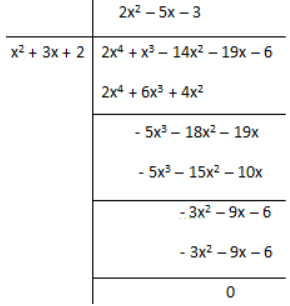
f(x) = 2x4 + x3 - 14x2 - 19x - 6 = (2x2 - 5x - 3)(x2 + 3x + 2)
= (2x + 1)(x - 3)(x + 2)(x + 1)
Therefore, zeroes of the polynomial = {tex}\frac{{ - 1}}{2}{/tex}, 3, -2, -1.
0Thank You