
Ask questions which are clear, concise and easy to understand.
Ask QuestionPosted by Kartik Kartik 6 years, 8 months ago
- 1 answers
Posted by Sumit Gupta 6 years, 8 months ago
- 0 answers
Posted by Ragul Ukkravel 6 years, 8 months ago
- 1 answers
Posted by Prashant Choudhary 6 years, 8 months ago
- 0 answers
Posted by ??.Dil Lagi Kudi Agra Di.?? 6 years, 8 months ago
- 2 answers
Posted by Priyanshi Sharma 6 years, 4 months ago
- 1 answers
Sia ? 6 years, 4 months ago
{tex}abx^2 + (b^2 - ac)x - bc = 0 {/tex}
{tex}\Rightarrow{/tex} {tex}abx^2 + b^2x - c(ax + b) = 0 {/tex}
{tex}\Rightarrow{/tex} {tex}bx(ax + b) - c(ax + b) = 0 {/tex}
{tex}\Rightarrow{/tex}{tex}(bx - c)(ax + b) = 0 {/tex}
x = {tex}\frac{c} {b}{/tex}, {tex}\frac{-b}{a}{/tex}
Posted by Hardev Singh Khosa 6 years, 4 months ago
- 1 answers
Sia ? 6 years, 4 months ago
LHS=(cosecA - cotA)2 = {tex}\left( \frac { 1 } { \sin A } - \frac { \cos A } { \sin A } \right) ^ { 2 }{/tex}
{tex}= \left( \frac { 1 - \cos A } { \sin A } \right) ^ { 2 }{/tex}
{tex}= \frac { ( 1 - \cos A ) ^ { 2 } } { \sin ^ { 2 } A }{/tex}
{tex}= \frac { ( 1 - \cos A ) ^ { 2 } } { 1 - \cos ^ { 2 } A }{/tex}
{tex}= \frac { ( 1 - \cos A ) ^ { 2 } } { ( 1 - \cos A ) ( 1 + \cos A ) }{/tex}
{tex}= \frac { 1 - \cos A } { 1 + \cos A }{/tex}
Hence proved
Posted by Bindass Girls ?? 6 years, 8 months ago
- 5 answers
Posted by Bindass Girls ?? 6 years, 8 months ago
- 0 answers
Posted by Vicky Garg 6 years, 8 months ago
- 0 answers
Posted by Purvesh Patil 6 years, 8 months ago
- 0 answers
Posted by Dheeraj Kumar 6 years, 8 months ago
- 1 answers
Posted by Sanjana Sahu 6 years, 8 months ago
- 1 answers
Deepak Mishra 6 years, 8 months ago
Posted by Keshari Unstoppableking 6 years, 4 months ago
- 1 answers
Sia ? 6 years, 4 months ago
Let h is height of big building,here as per the diagram.
AE = CD = 8 m (Given)
BE = AB-AE = (h - 8) m
Let AC = DE = x
Also, {tex}\angle F B D = \angle B D E = 30 ^ { \circ }{/tex}
{tex}\angle F B C = \angle B C A = 45 ^ { \circ }{/tex}
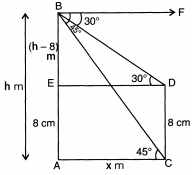
In {tex}\triangle {/tex}ACB, {tex}\angle A = 90 ^ { \circ }{/tex}
{tex}\tan 45 ^ { \circ } = \frac { A B } { A C }{/tex}
{tex}\Rightarrow {/tex} x = h, ...(i)
In {tex}\vartriangle {/tex}BDE, {tex}\angle E = 90 ^ { \circ }{/tex}
{tex}\tan 30 ^ { \circ } = \frac { B E } { E D }{/tex}
{tex}\Rightarrow \quad x = \sqrt { 3 } ( h - 8 ){/tex} .(ii)
From (i) and (ii), we get
{tex}h = \sqrt { 3 } h - 8 \sqrt { 3 }{/tex}
h(√3 - 1) = 8√3
h = {tex}\frac{8\sqrt3}{\sqrt3-1}=\frac{8\sqrt3}{\sqrt3-1}×\frac{\sqrt3+1}{\sqrt3+1}{/tex}
= {tex}\frac{1}{2}×(24+8√3)=\frac{1}{2}×(24+13.84)=18.92 m{/tex}
Hence height of the multistory building is 18.92 m and the distance between two buildings is 18.92 m.
Posted by Malkit Singh 6 years, 8 months ago
- 0 answers
Posted by Pooja Elligari 6 years, 8 months ago
- 1 answers
Posted by ??.Dil Lagi Kudi Agra Di.?? 6 years, 8 months ago
- 0 answers
Posted by Piyush Parekh 6 years, 4 months ago
- 1 answers
Sia ? 6 years, 4 months ago
{tex}\frac{1}{7x}{/tex} + {tex}\frac{1}{6y}{/tex} = 3 .......(i)
and {tex}\frac{1}{2x}{/tex} - {tex}\frac{1}{3y}{/tex} = 5 ...........(ii)
Multiplying equation (ii) by {tex}\frac{1}{2}{/tex}, we get
{tex}\frac{1}{4x}{/tex} - {tex}\frac{1}{6y}{/tex} = {tex}\frac{5}{2}{/tex} ..........(iii)
Adding eq. (i) and (iii), we get
{tex}\frac{1}{4x}{/tex} + {tex}\frac{1}{7x}{/tex} = {tex}\frac{5}{2}{/tex} + 3
{tex}\Rightarrow{/tex} {tex}\frac{7 + 4}{28x}{/tex} = {tex}\frac{11}{2}{/tex}
{tex}\Rightarrow{/tex}{tex}\frac{11}{28x}{/tex} = {tex}\frac{11}{2}{/tex}
{tex}\Rightarrow{/tex} 28x = 2
{tex}\Rightarrow{/tex} x = {tex}\frac{1}{14}{/tex}
Putting the value of x in eq.(i), we get
{tex}\frac{1}{7(\frac1{14})}{/tex} + {tex}\frac{1}{6y}{/tex} = 3
y = {tex}\frac{1}{6}{/tex}
Hence x = {tex}\frac{1}{14}{/tex} and y = {tex}\frac{1}{6}{/tex} is the solution of given system of equations.
Posted by Amira ❤? 6 years, 8 months ago
- 2 answers
Posted by Radhya Agarwal 6 years, 8 months ago
- 1 answers
Posted by Aravind Chidambaram 6 years, 8 months ago
- 0 answers
Posted by Raj Jaiswa 6 years, 8 months ago
- 0 answers
Posted by Jyoti Singh 6 years, 7 months ago
- 1 answers
Sia ? 6 years, 7 months ago
Let f(x)=3x2 + 4x +2k
If -2 is zero of f(x) then f(-2)=0 then f(-2)=0
{tex}\Rightarrow{/tex} 3 × (-2)² + 4 × -2 + 2k = 0
{tex}\Rightarrow{/tex} 12 - 8 + 2k = 0
{tex}\Rightarrow{/tex} 4 + 2k = 0
{tex}\Rightarrow{/tex} 2k = -4
{tex}\Rightarrow{/tex} k = {tex}\frac{{ - 4}}{2}{/tex}
{tex}\Rightarrow{/tex} k = -2
Posted by Jyoti Singh 6 years, 7 months ago
- 1 answers
Sia ? 6 years, 7 months ago
The given polynomial is -x3 + 7x - 6 and let f (x) = -x3 + 7x - 6 .
Since 1 is a zero of f(x), so (x - 1) is a factor of f(x).
Now we divide f(x) = -x3 + 7x - 6 by (x - 1), we obtain
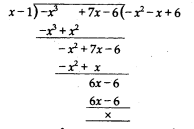
Where quotient = (-x2 - x + 6)
{tex}\therefore{/tex} f(x) = (-x3 + 7x - 6) = (x - 1)(-x2 - x + 6)
{tex}= - ( x - 1 ) \left( x ^ { 2 } + x - 6 \right) = - ( x - 1 ) \left( x ^ { 2 } + 3 x - 2 x - 6 \right){/tex}
{tex}= ( 1 - x ) [ x ( x + 3 ) - 2 ( x + 3 ) ] = ( 1 - x ) ( x + 3 ) ( x - 2 ){/tex}
{tex}\therefore{/tex} f(x) = 0 {tex}\Rightarrow{/tex} {tex}( 1 - x ) ( x + 3 ) ( x - 2 ){/tex} = 0
{tex}\Rightarrow{/tex} (1 - x ) = 0 or (x + 3) = 0 or (x - 2) = 0
{tex}\Rightarrow{/tex} x = 1 or x = -3 or x = 2.
Thus, the other zeros are -3 and 2
Posted by Ansh Raman 6 years, 8 months ago
- 1 answers
Arjun Bhatty 6 years, 8 months ago
Posted by Abhishek Kumar 5 years, 9 months ago
- 2 answers
Saptarshi Ghosh 6 years, 8 months ago
Tanmayee? Hariyan? 6 years, 8 months ago
Posted by Prangik Kakati 6 years, 8 months ago
- 0 answers
Posted by Jiya Kumari 6 years, 7 months ago
- 1 answers
Sia ? 6 years, 7 months ago
Since √2=1.414 and √7=2.646 as
1.414<2<2.646
Thus,there is only one integer (2) between them.
but there are many irrational number between them such as √3 ,√4,√5 and √6.
Posted by Aakanksha Singh 6 years, 8 months ago
- 0 answers

myCBSEguide
Trusted by 1 Crore+ Students

Test Generator
Create papers online. It's FREE.

CUET Mock Tests
75,000+ questions to practice only on myCBSEguide app

Khushman Singh 6 years, 8 months ago
0Thank You