
Ask questions which are clear, concise and easy to understand.
Ask QuestionPosted by Priyashree Gohain 6 years, 7 months ago
- 1 answers
Posted by Tathagat Chavada 6 years, 8 months ago
- 4 answers
Posted by Sumit Kumar 6 years, 7 months ago
- 1 answers
Sia ? 6 years, 7 months ago
{tex}\frac{x}{2} + \frac{{2y}}{3} = - 1{/tex} ....(1)
{tex}x - \frac{y}{3} = 3{/tex} ...(2)
- Elimination method: Multiplying equation (2) by 2, we get (3)
{tex}2x - \frac{2}{3}y = 6{/tex} ....(3)
{tex}\frac{x}{2} + \frac{{2y}}{3} = - 1{/tex} ....(1)
Adding (3) and (1), we get
{tex}\frac{5}{2}x = 5{/tex}
⇒ x =2
Putting value of x in (2), we get
2− {tex}\frac{y}{3}{/tex}= 3
⇒ y =−3
Therefore, x =2 and y =−3 - Substitution method:{tex}\frac{x}{2} + \frac{{2y}}{3} = - 1{/tex} ....(1)
{tex}x - \frac{y}{3} = 3{/tex} ....(2)
From equation (2), we can say that {tex}x = 3 + \frac{y}{3} = \frac{{9 + y}}{3}{/tex}
Putting this in equation (1), we get
{tex}\frac{{9 + y}}{6} + \frac{2}{3}y = - 1{/tex}
{tex} \Rightarrow \;\frac{{9 + y + 4y}}{6} = - 1{/tex}
⇒ 5y +9=−6
⇒ 5y =−15
⇒ y =−3
Putting value of y in (1), we get
{tex}\frac{x}{2} + \frac{2}{3}( - 3) = - 1{/tex}
⇒ x = 2
Therefore, x =2 and y =−3.
Posted by Tathagat Chavada 6 years, 8 months ago
- 3 answers
Posted by Shailendra Singh 6 years, 7 months ago
- 1 answers
Sia ? 6 years, 7 months ago
Let the first term of an A.P be {tex} a{/tex}, common difference {tex}d{/tex},
{tex}d = - 6{/tex}
an = a + (n -1)d
a16 = a + (16 - 1)(- 6)
= a + (15)(- 6)
= a - 90
a12 = a + (12 - 1)(-6 )
= a + 11(-6)
= a - 66
a16 -a12 = (a- 90) - ( a - 66)
= a - 90 - a + 66
= - 24
Posted by Vivek Singh 6 years, 8 months ago
- 2 answers
Posted by Jaya Makholiya 6 years, 7 months ago
- 1 answers
Sia ? 6 years, 7 months ago
More than method: cumulative frequency
| Weight | No. of students | Weight more than | Cumulative frequency |
| 38-40 | 3 | 38 | 35 |
| 40-42 | 2 | 40 | 32 |
| 42-44 | 4 | 42 | 30 |
| 44-46 | 5 | 44 | 26 |
| 46-48 | 14 | 46 | 21 |
| 48-50 | 4 | 48 | 7 |
| 50-52 | 3 | 50 | 3 |
On X-axis plot lower class limits.On Y-axis plot cumulative frequency.
We plot the points (38,35),(40,32),(42,30),(44,26),(46,26),(48,7),(50,3).
Less than method :
| Weight (in kg) | No. of students | Cumulative frequency |
| 36-38 | 0 | 0 |
| 38-40 | 3 | 3 |
| 40-42 | 2 | 5 |
| 42-44 | 4 | 9 |
| 44-46 | 5 | 14 |
| 46-48 | 14 | 28 |
| 48-50 | 4 | 32 |
| 50-0 | 3 | 35 |
On x-axis plot upper class limits.On Y-axis plot cumulative frequency
We plot the points (38,0),(40,3),(42,5),(44,9),(46,4),(48,28),(50,32),(52,35).

We find the two types of curves intersect at a point P. From point P perpendicular PM is draw on x-axis
The verification,
We have
Now, N = 35
{tex}\frac { N } { 2 } = 17.5{/tex}
The cumulative frequency just greater than {tex}\frac {N}{2}{/tex} is 28 and the corresponding class is 46 - 48.
Thus 46 - 48 is the median class such that
L = 46, f = 14, C1 = 14 h = 2
Median {tex}= L + \frac { \frac { N } { 2 } - c _ { 1 } } { f } \times h{/tex}
{tex}= 46 + \frac { 17.5 - 14 } { 14 } \times 2{/tex}
{tex}= 46 + \frac {7}{14}{/tex}
= 46.5
Median = 46.5 kg
Hence verified.
Posted by Seizure Raj 6 years, 8 months ago
- 0 answers
Posted by Harsh Sàìñì 6 years, 8 months ago
- 0 answers
Posted by Anuradha Uikey 6 years, 8 months ago
- 1 answers
Anuradha Uikey 6 years, 8 months ago
Posted by Rishi Sinha 6 years, 8 months ago
- 2 answers
Akarsh Arya 6 years, 8 months ago
Posted by Rishi Sinha 6 years, 7 months ago
- 1 answers
Sia ? 6 years, 7 months ago
x + y = 14 ....(1)
x - y = 4 ....(2)
x = 4 + y from equation (2)
Putting this in equation (1), we get
4+y +y =14
⇒ 2y =10
⇒ y = 5
Putting value of y in equation (1), we get
x + 5 = 14
⇒ x = 14 - 5 = 9
Therefore, x =9 and y =5
Posted by Gargi Banka 6 years, 8 months ago
- 0 answers
Posted by Ias Aspirant??? Khushi 6 years, 8 months ago
- 4 answers
Posted by Amit Bhatia 6 years, 8 months ago
- 1 answers
Gungun Lalwani ? 6 years, 8 months ago
Posted by Sailesh Mohanty 6 years, 7 months ago
- 1 answers
Sia ? 6 years, 7 months ago
tan2θ– sin2θ
{tex} = {\tan ^2}\theta - \frac{{{{\sin }^2}\theta }}{{{{\cos }^2}\theta }} \cdot {\cos ^2}\theta \left[ {\because {{\tan }^2}\theta = \frac{{{{\sin }^2}\theta }}{{{{\cos }^2}\theta }}} \right]{/tex}
= tan2θ– tan2θcos2θ
= tan2θ(1 – cos2θ) {tex}\left[ \because \sin ^ { 2 } \theta = 1 - \cos ^ { 2 } \theta \right]{/tex}
Posted by Rudi 6 6 years, 8 months ago
- 2 answers
Posted by Ranjan Sinha 6 years, 8 months ago
- 0 answers
Posted by Ajay Bhosale 6 years, 8 months ago
- 0 answers
Posted by Aditya Singh 6 years, 8 months ago
- 3 answers
Posted by Sumant Sahu 6 years, 8 months ago
- 3 answers
Shiva?? Garg?? 6 years, 8 months ago
Posted by Vishal Vivek 6 years, 7 months ago
- 1 answers
Posted by Kaushik Dutta 6 years, 8 months ago
- 1 answers
Sahithi Chandolu 6 years, 8 months ago
Posted by Charu Rastogi 6 years, 7 months ago
- 1 answers
Sia ? 6 years, 7 months ago
{tex}2x - 3y + 6 = 0{/tex}
{tex}\Rightarrow y = \frac { 2 x + 6 } { 3 }{/tex}
| x | -3 | 0 |
| y | 0 | 2 |
{tex}2x + 3y - 18 = 0{/tex}
{tex}\Rightarrow y = \frac { 18 - 2x } { 3 }{/tex}
| x | 0 | 3 |
| y | 6 | 4 |
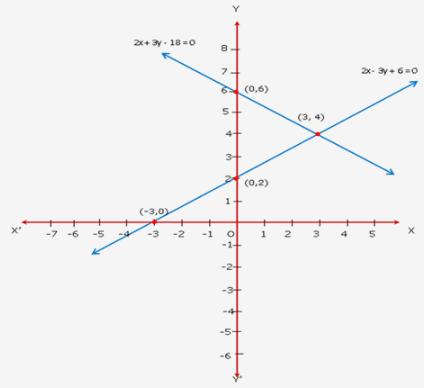
Thus, the two graph lines intersect at (3, 4)
{tex}\therefore{/tex} x = 3 and y = 4 is the solution of given system of equations
The vertices of the triangle formed by these lines and y - axis are (3, 4), (0, 6) and (0, 2)
So, height of the triangle
= distance from (3, 4) to y-axis
= 3 units
Base = 4 units
Area of the triangle = {tex}\frac { 1 } { 2 } \times \text { base } \times \text{height}{/tex}
{tex}= \frac { 1 } { 2 } \times 4 \times 3{/tex}
= 6 sq. units
Posted by Usha Singh 6 years, 8 months ago
- 1 answers
Posted by Raghuveer Singh Meena 6 years, 8 months ago
- 1 answers
Posted by Khushman Singh 6 years, 8 months ago
- 1 answers

myCBSEguide
Trusted by 1 Crore+ Students

Test Generator
Create papers online. It's FREE.

CUET Mock Tests
75,000+ questions to practice only on myCBSEguide app

Sia ? 6 years, 7 months ago
{tex}\begin{array}{l}(2\times5)^{\mathrm n}=2^{\mathrm n}\times5^{\mathrm n}\end{array}{/tex}
{tex}\text{=10}^n{/tex}
{tex}\text{If n=0 then 10}^0\text{=1}{/tex}
{tex}\text{If n>0 then 10}^n\text{ will end with 0 }{/tex}
{tex}\mathrm{If}\;\mathrm n<0\;\mathrm{then}\;10^{\mathrm n}\;\mathrm{ends}\;\mathrm{with}1\;(\mathrm e.\mathrm g.\;0.1,0.01,0.001){/tex}
Hence for all values of n, {tex}2^n\times 5^n{/tex} can never end with 5.
0Thank You