
Ask questions which are clear, concise and easy to understand.
Ask QuestionPosted by Yashwant Seervi 5 years, 9 months ago
- 1 answers
Posted by Andita Sinha 6 years, 7 months ago
- 1 answers
Sia ? 6 years, 7 months ago
Solving the equation g(x) = 0, we get
3 - 6x = 0, which gives us {tex}x = \frac{1}{2}{/tex}
So, {tex}\frac{1}{2}{/tex} is a zero of the polynomial 3 - 6x.
Posted by Jay Kumar Shriwastva 6 years, 8 months ago
- 1 answers
Posted by Saurabh Singh 6 years, 8 months ago
- 0 answers
Posted by Krishna Kumar 6 years, 7 months ago
- 1 answers
Sia ? 6 years, 7 months ago
Suppose {tex}r_1\ and\ r_2{/tex} be the radii of two spheres.
{tex}\therefore{/tex} the ratio of their volumes = {tex}\frac{\frac{4}{3} \pi r_{1}^{3}}{\frac{4}{3} \pi r_{2}^{3}}=\frac{64}{27}{/tex}
{tex}\left(\frac{r_{1}}{r_{2}}\right)^{3}=\left(\frac{4}{3}\right)^{3}{/tex} {tex}\Rightarrow{/tex} {tex}\frac{r_{1}}{r_{2}}{/tex} = {tex}\frac{4}{3}{/tex}
Ratios of surface areas of two spheres = {tex}\frac{4 \pi r_{1}^{2}}{4 \pi r_{2}^{2}}{/tex}
{tex}=\left(\frac{r_{1}}{r_{2}}\right)^{2}{/tex} = ({tex}\frac{4}{3}{/tex})2 = {tex}\frac{16}{9}{/tex}
{tex}\therefore{/tex}Required ratio {tex}= 16: 9.{/tex}
Posted by Prakhar Tripathi 6 years, 8 months ago
- 2 answers
Posted by Shivam Kumar Maurya 6 years, 4 months ago
- 1 answers
Sia ? 6 years, 4 months ago
Let Rohan's present age be x years.
Then, his mother's age is (x + 26) years.
Rohan's age after 3 years = (x + 3) years.
After 3 years the age of Rohan's mother = (x + 26 + 3) years = (x + 29) years.
According to the question,
{tex}{/tex} (x + 3)(x + 29) = 360.
{tex}\Rightarrow{/tex}x2 + 32x - 273 = 0.
This is the required quadratic equation.
Posted by Ramesh Sharma 6 years, 8 months ago
- 0 answers
Posted by Tannu Priya 6 years, 4 months ago
- 1 answers
Sia ? 6 years, 4 months ago
We have 4n where n = 1, 2, 3, 4.......
if n = 1 then 4n = 41 = 4
if n = 2 then 4n = 42 = 16 and so on
If a number ends with zero then it is divisible by 5.
Here, 4 and 16 are not divisible by 5.
Therefore, 4n can never end with zero.
Posted by Preethi Geethakumar 6 years, 4 months ago
- 1 answers
Sia ? 6 years, 4 months ago
n3 - n = n (n2 - 1) = n (n - 1) (n + 1)
Whenever a number is divided by 3, the remainder obtained is either 0 or 1 or 2.
∴ n = 3p or 3p + 1 or 3p + 2, where p is some integer.
If n = 3p, then n is divisible by 3.
If n = 3p + 1, then n – 1 = 3p + 1 –1 = 3p is divisible by 3.
If n = 3p + 2, then n + 1 = 3p + 2 + 1 = 3p + 3 = 3(p + 1) is divisible by 3.
So, we can say that one of the numbers among n, n – 1 and n + 1 is always divisible by 3.
⇒ n (n – 1) (n + 1) is divisible by 3.
Similarly, whenever a number is divided by 2, the remainder obtained is 0 or 1.
∴ n = 2q or 2q + 1, where q is some integer.
If n = 2q, then n is divisible by 2.
If n = 2q + 1, then n – 1 = 2q + 1 – 1 = 2q is divisible by 2 and n + 1 = 2q + 1 + 1 = 2q + 2 = 2 (q + 1) is divisible by 2.
So, we can say that one of the numbers among n, n – 1 and n + 1 is always divisible by 2.
⇒ n (n – 1) (n + 1) is divisible by 2.
Since, n (n – 1) (n + 1) is divisible by 2 and 3.
∴ n (n-1) (n+1) = n3 - n is divisible by 6.( If a number is divisible by both 2 and 3 , then it is divisible by 6)
Posted by Mani Kavitha 6 years, 8 months ago
- 0 answers
Posted by Rashmi Mohapatra 6 years, 8 months ago
- 0 answers
Posted by Ajesh Teotia 6 years, 8 months ago
- 2 answers
Posted by Ajesh Teotia 6 years, 8 months ago
- 2 answers
Posted by Pooja Mehra 6 years, 8 months ago
- 1 answers
Khushi Singh 6 years, 8 months ago
Posted by Hemal Ravrani 6 years, 4 months ago
- 1 answers
Sia ? 6 years, 4 months ago
Since {tex}\alpha , \beta{/tex} are the zeros of the polynomial f(x) = x2 - 5x + m.
Compare f(x) = x2 - 5x + m with ax2 + bx + c.
So, a = 1 , b = -5 and c = m
{tex}\alpha + \beta = - \frac { ( - 5 ) } { 1 }{/tex} = 5
{tex}\alpha \beta = \frac { mk } { 1 } = m{/tex}
Given, {tex}\alpha - \beta{/tex} = 1
Now, {tex}( \alpha + \beta ) ^ { 2 } = ( \alpha - \beta ) ^ { 2 } + 4 \alpha \beta{/tex}
{tex}\Rightarrow{/tex} (5)2 = (1)2 + 4m
{tex}\Rightarrow{/tex} 25 = 1 + 4m
{tex}\Rightarrow{/tex} 4m = 24
{tex}\Rightarrow{/tex} m = 6
Hence the value of m is 6.
Posted by Sujal Mohapatra 6 years, 8 months ago
- 2 answers
Khushi Singh 6 years, 8 months ago
Sahil Sharma 6 years, 8 months ago
Posted by Ramdhan Verma 6 years, 8 months ago
- 2 answers
Posted by Tanisha Daftary 6 years, 8 months ago
- 2 answers
Ansh Khandelwal 6 years, 8 months ago
Posted by Komal Srivastav 6 years, 8 months ago
- 0 answers
Posted by Khushboo Singh 6 years, 8 months ago
- 0 answers
Posted by Tamanna Rathee 6 years, 8 months ago
- 1 answers
Gaurav Seth 6 years, 8 months ago
For ΔABC
a = 4 cm
b = 5 cm
c = 3 cm
∵ a2 + c2 = b2
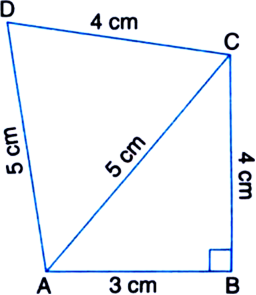
∴ ΔABC is right angled with ∠B = 90°.
∴ Area of right triangle ABC

For ΔACD
a = 4 cm b = 5 cm
c = 5 cm

∴ Area of the ΔACD

= 2 x 4.6 cm2 (approx.)
= 9.2 cm2 (approx.)
∴ Area of the quadrilateral ABCD
= Area of ΔABC + Area of ΔACD
= 6 cm2 + 9.2 cm2
= 15.2 cm2, (approx.)
Posted by Nayanika Mallick 6 years, 8 months ago
- 2 answers
Gaurav Seth 6 years, 8 months ago
Let the ten’s and the unit’s digits in the first number be x and y, respectively.
So, the first number may be written as 10 x + y in the expanded form (for example, 56 = 10(5) + 6).
When the digits are reversed, x becomes the unit’s digit and y becomes the ten’s digit.
This number, in the expanded notation is 10y + x (for example, when 56 is reversed, we get 65 = 10(6) + 5).
According to the given condition. (10x + y) + (10y + x) = 66 i.e., 11(x + y) = 66 i.e., x + y = 6 ..... (1)
We are also given that the digits differ by 2, therefore, either x – y = 2 ........(2) or y – x = 2 ..........(3)
If x – y = 2, then solving (1) and (2) by elimination, we get x = 4 and y = 2.
In this case, we get the number 42. If y – x = 2, then solving (1) and (3) by elimination, we get x = 2 and y = 4.
In this case, we get the number 24. Thus, there are two such numbers 42 and 24.
Bestie Sahiba?? Bestie Ji ? Besties Aa Gaii.. 6 years, 8 months ago
Posted by Shishir Rakshit 6 years, 8 months ago
- 3 answers
Gaurav Seth 6 years, 8 months ago
Q. If m and n are the zeroes of the polynomial 3x2 + 11x - 4, find the value of (m/n) + (n/m).
Answer:
p(x) = 3x2 + 11x - 4
Posted by Gajendra Verma 6 years, 8 months ago
- 3 answers
Ankit ?? Kumar 6 years, 8 months ago
Arsh Kumar 6 years, 8 months ago
Adarsh Gupta 6 years, 8 months ago

myCBSEguide
Trusted by 1 Crore+ Students

Test Generator
Create papers online. It's FREE.

CUET Mock Tests
75,000+ questions to practice only on myCBSEguide app

Sia ? 6 years, 7 months ago
1Thank You