
Ask questions which are clear, concise and easy to understand.
Ask QuestionPosted by Kumkum Sethiya 6 years, 7 months ago
- 1 answers
Gaurav Seth 6 years, 7 months ago
Question: What must be added to f(x) = 4x4 + 2x3 – 2x2 + x – 1 so that the resulting polynomial is divisible by g(x) = x2 + 2x – 3?
By division algorithm, we have
Clearly, RHS is divisible by g(x). Therefore, LHS is also divisible by g(x). Thus, if we add – r(x) to f(x) then the resulting polynomial is divisible by g(x). Let us now find the remainder when f(x) is divided by g(x).
Hence, we should add –r(x) = 61x – 65 to f(x) so that the resulting polynomial is divisible by g (x).
Posted by Sakshi Srivastava 6 years, 7 months ago
- 2 answers
Gaurav Seth 6 years, 7 months ago
Question: cosec theta=x +1/4x prove that cosec theta+cot theta=2x or 1/2x
Solution:

Posted by Rekha Pokhariya 6 years, 7 months ago
- 1 answers
Posted by Tizasp Toddywalla 6 years, 4 months ago
- 1 answers
Sia ? 6 years, 4 months ago
{tex} \frac{{147}}{{120}}{/tex}
={tex} \frac{{49}}{{40}}{/tex}
= {tex} \frac{{122.5}}{{100}}{/tex}
= 1.225 thus the decimal expansion has three digits after the decimal point.
Posted by Anamika Singh 6 years, 7 months ago
- 1 answers
Gaurav Seth 6 years, 7 months ago
Trigonometric Ratios Of Complementary Angles


We know complementary angles are pair of angles whose sum is 90°
Like 40°, 50°, 60°, 30°, 20°, 70°, 15°, 75° ; etc,
Formulae:
sin (90° – θ) = cos θ, cot (90° – θ) = tanθ
cos (90° – θ) = sin θ, sec (90° – θ) = cosec θ
tan (90° – θ) = cot θ, cosec (90° – θ) = sec θ
Posted by Bala Godara 6 years, 7 months ago
- 3 answers
Somya Garg 6 years, 7 months ago
Anjali Sontakke 6 years, 7 months ago
Posted by Swayam Behera 6 years, 7 months ago
- 2 answers
Anjali Sontakke 6 years, 7 months ago
Posted by Satyam Yadav 6 years, 7 months ago
- 3 answers
Harshita Naagar 6 years, 7 months ago
Posted by Chiranjiv Pegu 6 years, 7 months ago
- 2 answers
Posted by আশোম লৰা 6 years, 7 months ago
- 9 answers
Ravenclaw_? Raunak_ 6 years, 7 months ago
Posted by Sameer Rout 6 years, 7 months ago
- 7 answers
Posted by Pushkar Saini 6 years, 7 months ago
- 2 answers
Harshita Naagar 6 years, 7 months ago
Posted by Arjun Kumar 6 years, 7 months ago
- 2 answers
Posted by Bhavyaa Sharma 6 years, 7 months ago
- 1 answers
Sia ? 6 years, 7 months ago
Let the radius of 1st sphere be 'r1' and the radius of 2nd sphere be 'r2'
According to question,
Ratio of the volume of the given spheres is,
{tex}\frac { \text { Volume of } 1 ^ { \text { st } } \text { sphere } } { \text { Volume of } \Pi ^ { \text { nd } } \text { sphere } } = \frac { \frac { 4 } { 3 } \pi r _ { 1 } ^ { 3 } } { \frac { 4 } { 3 } \pi r _ { 2 } ^ { 3 } } = \frac { 8 } { 27 }{/tex}
{tex}\therefore \quad \quad \frac { r _ { 1 } ^ { 3 } } { r _ { 2 } ^ { 3 } } = \frac { 8 } { 27 }{/tex}
{tex} \frac { r _ { 1 } } { r _ { 2 } } = \frac { 2\sqrt2} { 3 }{/tex}
The ratio of the radius of the given spheres, r1 : r2 = 2{tex}\sqrt 2{/tex}:3
Now,
Ratio of the surface areas of the spheres {tex}= \frac { \text { Surface area of } 1 ^ { \text { st } } \text { sphere } } { \text { Surface area of } \Pi ^ { \text { nd } } \text { sphere } }{/tex}
{tex}\frac { 4 \pi r _ { 1 } ^ { 2 } } { 4 \pi r _ { 2 } ^ { 2 } } = \left( \frac { r _ { 1 } } { r _ { 2 } } \right) ^ { 2 }{/tex}
{tex}=\left( \frac { 2\sqrt2 } { 3 } \right) ^ { 2 } = \frac { 8 } { 9 }{/tex}
= 16 : 9
Posted by Aadarsh Ranjan 6 years, 7 months ago
- 1 answers
Sia ? 6 years, 7 months ago
You can check the topper's answer sheet in each chapter's category.
Posted by Ankit Shukla 6 years, 7 months ago
- 0 answers
Posted by Aryan Singh 6 years, 7 months ago
- 0 answers
Posted by Jagtar Jagtar 6 years, 7 months ago
- 1 answers
Posted by Vedant Nigam 6 years, 7 months ago
- 1 answers
Posted by Satish Satish 6 years, 7 months ago
- 2 answers
Anish Singh 6 years, 7 months ago
Posted by Fahad Ullah 6 years, 7 months ago
- 1 answers
Abhay Rajput 6 years, 7 months ago
Posted by Junayed Aman 6 years, 7 months ago
- 1 answers
Posted by Raj Bhagat 6 years, 7 months ago
- 1 answers
Sia ? 6 years, 7 months ago
We have,
9x2 - 3x - 2 = 0
{tex}\Rightarrow{/tex} 9x2 - 6x + 3x - 2 = 0
{tex}\Rightarrow{/tex} 3x(3x - 2) + 1(3x - 2) = 0
{tex}\Rightarrow{/tex} (3x - 2)(3x + 1) = 0
{tex}\Rightarrow{/tex} 3x - 2 = 0 or, 3x + 1 = 0 {tex}\Rightarrow \quad x = \frac { 2 } { 3 } \text { or, } x = - \frac { 1 } { 3 }{/tex}
Thus, {tex}x = \frac { 2 } { 3 } \text { and } x = - \frac { 1 } { 3 }{/tex} are the required roots of the given equation.
Posted by Swasti Jain 6 years, 7 months ago
- 0 answers
Posted by Tashveen Anand 6 years, 7 months ago
- 2 answers
Harsimran Singh ( Tata Timepass Company)?? 6 years, 7 months ago
Posted by Shubham Dabral 6 years, 7 months ago
- 1 answers
Sia ? 6 years, 7 months ago
On a graph paper, draw a horizontal line X'OX and a vertical line YOY' as the x-axis and the y-axis respectively.
Graph of {tex}4x - 5y - 20 = 0{/tex}
{tex}4x - 5y - 20 = 0 {/tex}
{tex}\Rightarrow{/tex} {tex}5y = (4x - 20){/tex}
{tex}\Rightarrow \quad y = \frac { ( 4 x - 20 ) } { 5 }{/tex}.....(i)
Table for {tex}4x - 5y - 20 = 0.{/tex}
| x | 0 | 2 | 5 |
| y | -4 | -2.4 | 0 |
Now, plot the points {tex}A(0, -4),\ B(2, -2.4)\ and\ C(5, 0){/tex} on the graph paper.
Join AB and BC to get the graph line ABC. Extend it on both ways.
Thus, the line ABC is the graph of {tex}4x - 5y - 20 = 0.{/tex}
{tex}3x + 5y -15 = 0{/tex} {tex}\Rightarrow{/tex} {tex}5y = (15 -3x){/tex}
{tex}\Rightarrow \quad y = \frac { ( 15 - 3 x ) } { 5 }{/tex}.........(ii)
Table for {tex}3x + 5y -15 = 0.{/tex}
| x | -5 | 0 | 5 |
| y | 6 | 3 | 0 |
On the same graph paper as above, plot the points P (-5, 6) and Q(0, 3).
The third point C(5, 0) has already been plotted.
Join PQ and QC to get the graph line PQC. Extend it on both ways.
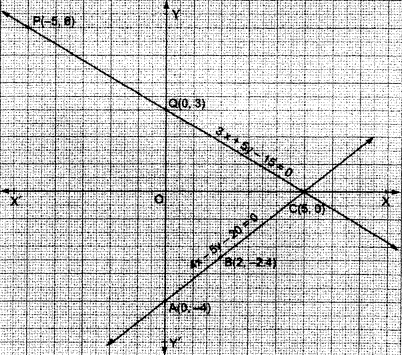
Thus, the line PQC is the graph of 3x + 5y -15 = 0.
The two graph lines intersect at the point C(5,0).
{tex}\therefore{/tex} x = 5, y = 0 is the solution of the given system of equations.
Clearly, the given equations are represented by the graph lines ABC and PQC respectively.
The vertices of {tex}\triangle{/tex}AQC formed by these lines and the y-axis are A(0, -4), Q(0,3) and C(5,0).
Posted by Siddharth Kumar Singh 6 years, 7 months ago
- 1 answers
Sia ? 6 years, 7 months ago
| less than 10 | 0 | 0-10 | 0 | 0 |
| less than 30 | 10 | 10-30 | 10 | 10 |
| less than 50 | 25 | 30-50 | 15 | 25 |
| less than 70 | 43 | 50-70 | 18 | 43(F) |
| less than 90 | 65 | 70-90 | 22(f) | 65 |
| less than 110 | 87 | 90-110 | 22 | 87 |
| less than 130 | 96 | 110-130 | 9 | 96 |
| less than 150 | 100 | 130-150 | 4 | 100 |
| N=100 |
We have
N=100
{tex}\therefore \quad \frac { N } { 2 } = \frac { 100 } { 2 } = 50{/tex}
The cumulative frequency just greater than {tex}\frac { N } { 2 }{/tex} is 65 then median class is 70 - 90 such that
l = 70, f = 22, F = 43, h = 90 - 70 =20
{tex}\therefore \quad \text { Median } = l + \frac { \frac { N } { 2 } - F } { f } \times h{/tex}
{tex}= 70 + \frac { 50 - 43 } { 22 } \times 20{/tex}
{tex}= 70 + \frac { 7 \times 20 } { 22 }{/tex}
=70 + 6.36
=76.36
Posted by Mala Rani 6 years, 7 months ago
- 1 answers

myCBSEguide
Trusted by 1 Crore+ Students

Test Generator
Create papers online. It's FREE.

CUET Mock Tests
75,000+ questions to practice only on myCBSEguide app
