
Ask questions which are clear, concise and easy to understand.
Ask QuestionPosted by Ramita Jha 6 years, 7 months ago
- 1 answers
Posted by Ansh Wadhwa 6 years, 7 months ago
- 1 answers
Manish Pandhyar 6 years, 7 months ago
Posted by Ashish Singh 6 years, 7 months ago
- 1 answers
Sia ? 6 years, 7 months ago
The given quadratic polynomial is 2x2 + 5x + k.
If {tex}\alpha, \beta{/tex} are zeroes of quadratic polynomial
{tex}\alpha + \beta= \frac { - b } { a } = \frac { - 5 } { 2 } {/tex}
{tex} \alpha \beta= \frac { c } { a } = \frac { k } { 2 }{/tex}
Putting these values in {tex}( \alpha + \beta ) ^ { 2 } - \alpha \beta{/tex} = 24,
we get {tex}\left( \frac { - 5 } { 2 } \right) ^ { 2 } - \frac { k } { 2 } = 24 {/tex}
{tex}\Rightarrow \frac { 25 } { 4 } - \frac { k } { 2 } = 24{/tex}
{tex}\Rightarrow\frac { - k } { 2 } = 24 - \frac { 25 } { 4 }{/tex}
{tex}\Rightarrow \frac { - k } { 2 } = \frac { 96 - 25 } { 4 }{/tex}
{tex}\Rightarrow k = \frac { - 71 } { 4 } \times 2 = \frac { - 71 } { 2 }{/tex}
Posted by Abhi Khatri 6 years, 7 months ago
- 1 answers
Sia ? 6 years, 7 months ago
On applying division lemma to 867 and 255
We get
867=255×3+102
255=102×2+51
102=51×2+0
Hence HCF(867,255)=51
Posted by Apurva Gholve 6 years, 7 months ago
- 2 answers
Posted by Piyush Bhatia 6 years, 7 months ago
- 1 answers
Pranav Ramesh 6 years, 7 months ago
Posted by Bhavana Reddy 6 years, 7 months ago
- 1 answers
Sia ? 6 years, 7 months ago
{tex}2x + 3y - 4 = 0{/tex}
{tex}a_1= 2, b_1= 3, c_1 = 4{/tex}
{tex}(k + 2)x + 6y-(3k + 2)= 0{/tex}
{tex}a _ { 2 } = k + 2 , b _ { 2 } = 6 , c _ { 2 } = - ( 3 k + 2 ){/tex}
{tex}\frac { a _ { 1 } } { a _ { 2 } } = \frac { b _ { 1 } } { b _ { 2 } } = \frac { c _ { 1 } } { c _ { 2 } }{/tex}
or, {tex}\frac { 2 } { k + 2 } = \frac { 3 } { 6 } = \frac { 4 } {- 3 k - 2 }{/tex}
Or, {tex}\frac { 2 } { k + 2 } = \frac { 3 } { 6 } {/tex}
or, {tex}3(k + 2) = 2 \times 6{/tex}
{tex}3k + 6 = 12{/tex}
{tex}3k = 12 - 6{/tex}
or, {tex}6 = 3k{/tex}
Hence,{tex} k = 2{/tex}
Posted by Sandeep Sharma 6 years, 7 months ago
- 1 answers
????? ? 6 years, 7 months ago
Posted by Anmol Kumar Jha 6 years, 7 months ago
- 1 answers
????? ? 6 years, 7 months ago
Posted by Raj Sekhar Paul 6 years, 7 months ago
- 2 answers
Khushi Agrawal 6 years, 7 months ago
Posted by Dhairya Baranwal 6 years, 7 months ago
- 1 answers
Posted by Sparsh Aggarwal 6 years, 7 months ago
- 0 answers
Posted by Sandeep Singh 6 years, 7 months ago
- 0 answers
Posted by Piyush Saroj 6 years, 7 months ago
- 3 answers
Posted by Suyash Kumar 6 years, 7 months ago
- 1 answers
Posted by Shrabana Santra 6 years, 7 months ago
- 1 answers
Sia ? 6 years, 7 months ago
L.H.S
= (1 + cotA + tanA) (sinA - cosA)
= sinA - cosA + cotA sinA - cotA cosA + sinA tanA - tanA cosA
{tex}= \sin A - \cos A + \frac{{\cos A}}{{\sin A}} \times \sin A - \cot A\cos A + \sin A\;\tan A - \frac{{\sin A}}{{\cos A}} \times \cos A{/tex}
= sinA - cosA + cosA - cotA cosA + sinA tanA - sinA
= sinA tanA - cotA cosA........(1)
Now taking ;
{tex}\quad \frac{{\sec A}}{{\cos e{c^2}A}} - \frac{{\cos ecA}}{{{{\sec }^2}A}}{/tex}
{tex} = \frac{{\frac{1}{{\cos A}}}}{{\frac{1}{{{{\sin }^2}A}}}} - \frac{{\frac{1}{{\sin A}}}}{{\frac{1}{{{{\cos }^2}A}}}}{/tex}
{tex} = \frac{{{{\sin }^2}A}}{{\cos A}} - \frac{{{{\cos }^2}A}}{{\sin A}}{/tex}
{tex} = \sin A \times \frac{{\sin A}}{{\cos A}} - \cos A \times \frac{{\cos A}}{{\sin A}}{/tex}
{tex} = \sin A \times \tan A - \cos A \times \cot A{/tex}.......(2)
From (1) & (2),
(1 + cotA + tanA) (sinA - cosA) = {tex}\frac { \sec A } { cosec ^ { 2 } A } - \frac { cosec A } { \sec ^ { 2 } A }{/tex} = sinA.tanA - cosA.cotA
Hence, Proved.
Posted by Ayushi Tiwari 6 years, 7 months ago
- 1 answers
Sia ? 6 years, 7 months ago
{tex}2x + 3y = 7{/tex}
{tex}(k - 1) x + (k + 2)y = 3k{/tex}
These are of the form
{tex}a_1x + b_1y + c_1 = 0 ,\ a_2x + b_2y + c_2 = 0{/tex}
where,
{tex}a_1= 2 ,\ b_1= 3,\ c_1 = -7,{/tex}
{tex}a_2=k - 1 \ ,b_2= k + 2 ,\ c_2 = -3k {/tex} for infinitely many solutions, we must have
{tex}\frac { a _ { 1 } } { a _ { 2 } } = \frac { b _ { 1 } } { b _ { 2 } } = \frac { c _ { 1 } } { c _ { 2 } }{/tex}
This hold only when
{tex}\frac { 2 } { k - 1 } = \frac { 3 } { k + 2 } = \frac { - 7 } { - 3 k }{/tex}
{tex}\frac { 2 } { k - 1 } = \frac { 3 } { k + 2 } = \frac { 7 } { 3 k }{/tex}
Now the following cases arises:
Case I:
{tex}\frac { 2 } { k - 1 } = \frac { 3 } { k + 2 }{/tex}
{tex}\Rightarrow{/tex}2(k + 2) = 3(k -1)
{tex}\Rightarrow{/tex}2k + 4= 3k - 3
{tex}\Rightarrow{/tex} k = 7
Case II:
{tex}\frac { 3 } { k + 2 } = \frac { 7 } { 3 k }{/tex}
{tex}\Rightarrow{/tex}7(k + 2) = 9k
{tex}\Rightarrow{/tex}7k + 14= 9k
{tex}\Rightarrow{/tex} k = 7
Case III:
{tex}\frac { 2 } { k - 1 } = \frac { 7 } { 3 k }{/tex}
{tex}\Rightarrow{/tex} 7k - 7 = 6k
{tex}\Rightarrow{/tex} k = 7
For k = 7, there are infinitely many solutions of the given system of equations.
Posted by Tanuj Kumar 6 years, 7 months ago
- 1 answers
Posted by Yash Bastawale,? 6 years, 7 months ago
- 9 answers
Yash Bastawale,? 6 years, 7 months ago
Yash Bastawale,? 6 years, 7 months ago
Kishu ? 6 years, 7 months ago
Posted by Bijendra Kisku 6 years, 7 months ago
- 0 answers
Posted by Shreya Chand 6 years, 7 months ago
- 1 answers
Sia ? 6 years, 7 months ago
Let α=4 - {tex}\sqrt 5{/tex}
and β = 4 + {tex}\sqrt 5{/tex}
Sum of zeroes,
α+β = 4 - {tex}\sqrt 5{/tex} + 4 + {tex}\sqrt 5{/tex} = 8
αβ = (4 - {tex}\sqrt 5{/tex})(4 + {tex}\sqrt 5{/tex}) = 16 - 5 = 11
Quadratic polynomial
p(x) = x2 - (α+β)x +αβ
= x2 - 8x + 11
Posted by Pratibha Rajpurohit 6 years, 7 months ago
- 1 answers
Gaurav Seth 6 years, 7 months ago
SIMILAR QUESTION: If d is the hcf of 45 and 27,find x and y satisfying d= 27x+45y
The numbers are :-
45 and 27
Lets find their HCF
BY Euclid's division Lemma :-
a = bq + r
45 = 27 x 1 + 18
27 = 18 x 1 + 9
18 = 9 x 2 + 0
HCF = d = 9
Given:-
d = 27x+45y
9 = 27x + 45y
9 = 27 - 18 x 1
18 = 45 - 27 x 1
Therefore ,
9 = 27 - [ 45 x 27 x 1 ] x 1
= 27 x 2 - 45
9 = 27 x 2 + 45 x [ -1 ]
x = 2
y = -1
Posted by Aayushi Jain Jain 6 years, 7 months ago
- 1 answers
Posted by Sahil Meena 6 years, 7 months ago
- 1 answers
Gaurav Seth 6 years, 7 months ago
PQR is a triangle right angled at P and M is a point on QR such that PM  QR. Show that PM2 = QM x MR.
Ans. Given: PQR is a triangle right angles at P and PM QR
QR
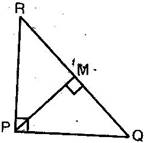
To Prove: PM2 = QM.MR
Proof: Since PMQR

 QMP
QMP PMR
PMR


Posted by Afshan Khan 6 years, 7 months ago
- 2 answers
Ashwini Ghorpade 6 years, 7 months ago
Krrish Garg 6 years, 7 months ago
Posted by Pooja Elligari 6 years, 7 months ago
- 1 answers
Posted by Thapki❤️ Thapki❤️ 6 years, 7 months ago
- 5 answers
Palak Bansal 6 years, 7 months ago
Palak Bansal 6 years, 7 months ago
Ravenclaw_? Raunak_ 6 years, 7 months ago
Thapki❤️ Thapki❤️ 6 years, 7 months ago
Posted by Abhishek Kumar 6 years, 7 months ago
- 4 answers

myCBSEguide
Trusted by 1 Crore+ Students

Test Generator
Create papers online. It's FREE.

CUET Mock Tests
75,000+ questions to practice only on myCBSEguide app

Harsh Arora 6 years, 7 months ago
2Thank You