
Ask questions which are clear, concise and easy to understand.
Ask QuestionPosted by Ishtiyaq Ahmad 6 years, 7 months ago
- 3 answers
Posted by Priya Priya 6 years, 7 months ago
- 1 answers
Ram Kushwah 6 years, 7 months ago
x-2y=6
Multiplying by 3 we get
3x-6y-18=0-------------(1)
3x-6y+0=0----------(2)
From (1) we get
3/3=-6/-6{tex}\neq{/tex}18/0
hence equation (1) and (20 have no solution
Posted by Khushi Purohit 6 years, 7 months ago
- 0 answers
Posted by Harsh Khandelwal 6 years, 7 months ago
- 1 answers
Sia ? 6 years, 7 months ago
Get identities in the notes : <a href="https://mycbseguide.com/cbse-revision-notes.html">https://mycbseguide.com/cbse-revision-notes.html</a>
Posted by Iqra H 6 years, 7 months ago
- 1 answers
Posted by Mereena Michael 6 years, 7 months ago
- 2 answers
Yogita Ingle 6 years, 7 months ago
According to Euclid’s Division Lemma if we have two positive integers a and b, then there exist unique integers q and r which satisfies the condition a = bq + r where 0 ≤ r ≤ b.
Sonam Singh 6 years, 7 months ago
Posted by Shweta Raghu 6 years, 7 months ago
- 1 answers
Sia ? 6 years, 7 months ago
Given: In figure, {tex}\triangle {/tex} POS {tex} \sim {/tex} {tex}\triangle {/tex}ROQ
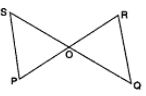
To prove: PS {tex}\parallel{/tex}QR
Proof: {tex}\triangle {/tex} POS {tex} \sim {/tex} {tex}\triangle {/tex}ROQ ........[Given]
{tex}\therefore {/tex} {tex}\angle{/tex} PSO = {tex}\angle{/tex} RQO .........[ {tex}\because {/tex} corresponding angle of two similar triangles are equal]
But these form a pair of alternate angles
{tex}\therefore {/tex} PS {tex}\parallel{/tex}QR
Posted by Pratik Samantaray 6 years, 7 months ago
- 1 answers
Sia ? 6 years, 7 months ago
Let n be any positive integer. Applying Euclids division lemma with divisor = 5, we get
{tex}\style{font-family:Arial}{\begin{array}{l}n=5q+1,5q+2,5q+3\;and\;5q+4\;\\\end{array}}{/tex}
Now (5q)2 = 25q2 = 5m, where m = 5q2, which is an integer;
{tex}\style{font-family:Arial}{\begin{array}{l}(5q\;+\;1)^{\;2}\;=\;25q^2\;+\;10q\;+\;1\;=\;5(5q^2\;+\;2q)\;+\;1\;=\;5m\;+\;1\\where\;m\;=\;5q^2\;+\;2q,\;which\;is\;an\;integer;\\\;(5q\;+\;2)^2\;=\;25q^2\;+\;20q\;+\;4\;=\;5(5q^2\;+\;4q)\;+\;4\;=\;5m\;+\;4,\\\;where\;m\;=\;5q^2\;+\;4q,\;which\;is\;an\;integer;\\\;(5q\;+\;3)^{\;2}\;=\;25q^2\;+\;30q\;+\;9\;=\;5(5q^2\;+\;6q+\;1)\;+\;4\;=\;5m\;+\;4,\\\;where\;m\;=\;5q^2\;+\;6q\;+\;1,\;which\;is\;an\;integer;\\\;(5q\;+\;4)^2\;=\;25q^2\;+\;40q\;+\;16\;=\;5(5q^2\;+\;8q\;+\;3)\;+\;1\;=\;5m\;+\;1,\;\\where\;m\;=\;5q^2\;+\;8q\;+\;3,\;which\;is\;an\;integer\\\end{array}}{/tex}
Thus, the square of any positive integer is of the form 5m, 5m + 1 or 5m + 4 for some integer m.
It follows that the square of any positive integer cannot be of the form 5m + 2 or 5m + 3 for some integer m.
Posted by Sarfaraz Khan 6 years, 7 months ago
- 1 answers
Yogita Ingle 6 years, 7 months ago
2x2 + x - 528= 0
2x2 + 33x - 32x - 528 = 0
x(2x + 33)- 16(2x+33)= 0
(x - 16)(2x + 33)
Zeros are x = 16 and x= -33/2
Posted by Kumar Gaurav 6 years, 7 months ago
- 0 answers
Posted by Shravan Kumar 6 years, 7 months ago
- 2 answers
Sia ? 6 years, 7 months ago
Given equations are
{tex}\frac{x}{4}{/tex} + {tex}\frac{2y}{3} = 7{/tex}...............(i)
and {tex}\frac{x}{6}{/tex} + {tex}\frac{3y}{5} = 11{/tex} .................(ii)
From equation (i), we get
{tex}\frac{x}{4}{/tex} + {tex}\frac{2y}{3} = 7{/tex}
{tex}\Rightarrow{/tex} {tex}\frac{x}{4}{/tex} = 7 - {tex}\frac{2y}{3}{/tex}
{tex}\Rightarrow{/tex} {tex} x = 4(7 -\frac{2y}{3}){/tex}
{tex}\Rightarrow{/tex} x = 28 - {tex}\frac{8y}{3}{/tex}.................(iii)
substituting x = 28 - {tex}\frac{8y}{3}{/tex} in equation (ii), we get
{tex}\frac { 28 - \frac { 8 y } { 3 } } { 6 } + \frac { 3 y } { 5 } = 11{/tex}
{tex}\Rightarrow{/tex} {tex}\frac { 84 - 8 y } { 18 } + \frac { 3 y } { 5 } = 11{/tex}
{tex}\Rightarrow{/tex} {tex}\frac{420 - 40y + 54y}{18 \times 5}{/tex} = 11
{tex}\Rightarrow{/tex} 420 + 14y = 990
{tex}\Rightarrow{/tex} 14y = 570
{tex}\Rightarrow{/tex} y = {tex}\frac{570}{14}{/tex} = {tex}\frac{285}{7}{/tex}
When y = {tex}\frac{285}{7}{/tex}, equation (iii) becomes
{tex}x = 28 - \frac { 8 \times \frac { 285 } { 7 } } { 3 }{/tex}
{tex}\Rightarrow{/tex} {tex} x = 28 -\frac{8 \times 285}{21}{/tex}
{tex}\Rightarrow{/tex} {tex}x = \frac{588 - 2280}{21}{/tex} = {tex}\frac{-1692}{21}{/tex}
{tex}\Rightarrow{/tex} -{tex}x =\frac{564}{7}{/tex}
{tex}\therefore{/tex} x = -{tex}\frac{564}{7}{/tex}, y = {tex}\frac{285}{7}{/tex} is the solution of given system of equations.
Posted by Aditya Jha 6 years, 7 months ago
- 1 answers
Sia ? 6 years, 7 months ago
The rational number for which the long division terminates after a finite number of steps is known as terminating decimal. Examples: The rational number for which the long division does not terminate after any number of steps is known as non-terminating decimal.
Posted by Sakshi Singh 6 years, 7 months ago
- 1 answers
Sia ? 6 years, 7 months ago
We will prove this result by contradiction method.
Let assume that {tex}( 2 + \sqrt { 3 } ){/tex} be rational.
Then 2 and {tex}\sqrt { 3 }{/tex} are rational.
{tex}\Rightarrow 2 + \sqrt { 3 } - 2{/tex} is rational ..... ({tex}\because{/tex} difference of two rational numbers is rational)
{tex}\Rightarrow \sqrt { 3 }{/tex} is rational
This contradicts the fact that {tex}\sqrt { 3 }{/tex} is irrational.
The Contradiction arises because we assume that {tex}( 2 + \sqrt { 3 } ){/tex} is rational.
Hence, {tex}2 + \sqrt { 3 }{/tex} is not a rational but an irrational number.
Posted by Poorvi Singh 6 years, 7 months ago
- 1 answers
Posted by Ankit Raj 6 years, 7 months ago
- 3 answers
Sangam Rajput 6 years, 7 months ago
Sangam Rajput 6 years, 7 months ago
Posted by Animesh Kumar 6 years, 7 months ago
- 1 answers
Sia ? 6 years, 7 months ago
Let {tex}\alpha,\mathrm\beta\;\mathrm{and}\;\mathrm\gamma{/tex} be the zeroes of the given polynomial.
Then, we have {tex}\alpha{/tex} = 2, {tex}\beta{/tex} = 1 and {tex}\gamma{/tex} = 1
Hence
{tex}\alpha + \beta + \gamma{/tex} = 2 + 1 + 1 = 4 ...............(1)
{tex}\alpha \beta + \beta \gamma + \gamma \alpha{/tex} = 2(1) + 1(1) + 1(2) = 2 + 1 + 2 = 5 ................(2)
{tex}\alpha \beta \gamma{/tex} = 2(1)(1) = 2 .............(3)
Now, a cubic polynomial whose zeros are {tex}\alpha , \beta{/tex} and {tex}\mathrm\gamma{/tex} is equal to
p(x) = x3 - {tex}( \alpha + \beta + \gamma ) x ^ { 2 } + ( \alpha \beta + \beta y + \gamma \alpha ) x - \alpha \beta \gamma{/tex}
On substituting values from (1),(2) and (3) we get
{tex}\mathrm p(\mathrm x)=\mathrm x^3-(4)\mathrm x^2+(5)\mathrm x-(2){/tex}
= x3 - 4x2 + 5x - 2
Posted by Danish Raza 6 years, 7 months ago
- 3 answers
Posted by Jyothi [email protected] 6 years, 7 months ago
- 0 answers
Posted by Mahesh Kumar Mahobia 6 years, 7 months ago
- 1 answers
Posted by Richa Singh 6 years, 7 months ago
- 1 answers
Sia ? 6 years, 7 months ago
According to Euclid’s Division Lemma if we have two positive integers a and b, then there exists unique integers q and r which satisfies the condition a = bq + r where 0 ≤ r ≤ b.
The basis of Euclidean division algorithm is Euclid’s division lemma. To calculate the Highest Common Factor (HCF) of two positive integers a and b we use Euclid’s division algorithm. HCF is the largest number which exactly divides two or more positive integers. By exactly we mean that on dividing both the integers a and b the remainder is zero.
Posted by Aastha... Richhariya... 6 years, 7 months ago
- 1 answers
Yogita Ingle 6 years, 7 months ago
Let us assume that √3 is a rational number
That is, we can find integers a and b (≠ 0) such that √3 = (a/b)
Suppose a and b have a common factor other than 1, then we can divide by the common factor, and assume that a and b are coprime.
√3b = a
⇒ 3b2=a2 (Squaring on both sides) → (1)
Therefore, a2 is divisible by 3
Hence a is also divisible by 3.
So, we can write a = 3c for some integer c.
Equation (1) becomes,
3b2 =(3c)2
⇒ 3b2 = 9c2
∴ b2 = 3c2
This means that b2 is divisible by 3, and so b is also divisible by 3.
Therefore, a and b have at least 3 as a common factor.
But this contradicts the fact that a and b are coprime.
This contradiction has arisen because of our incorrect assumption that √3 is rational.
So, we conclude that √3 is irrational.
Posted by Ankit Mishra 6 years, 7 months ago
- 1 answers
Yogita Ingle 6 years, 7 months ago
let √5 be rational
then it must in the form of p/q [q is not equal to 0][p and q are co-prime]
√5=p/q
=> √5 × q = p
squaring on both sides
=> 5×q×q = p×p ----- 1
p×p is divisible by 5
p is divisible by 5
p = 5c [c is a positive integer] [squaring on both sides ]
p×p = 25c×c --------- 2
sub p×p in 1
5×q×q = 25×c×c
q×q = 5×c×c
=> q is divisible by 5
thus q and p have a common factor 5
there is a contradiction
as our assumtion p &q are co prime but it has a common factor
so √5 is an irrational
Posted by Nikhil Dagar 6 years, 7 months ago
- 1 answers
Posted by Gangster Bp Singh 6 years, 7 months ago
- 1 answers
Posted by Dilip Kumar Raut 6 years, 6 months ago
- 1 answers
Sia ? 6 years, 6 months ago
LHS= {tex}\sin \left( 50 ^ { \circ } + \theta \right) - \cos \left( 40 ^ { \circ } - \theta \right) + \tan 1 ^ { \circ } \tan 10 ^ { \circ } \tan 20 ^ { \circ } \tan 70 ^ { \circ }{/tex}{tex}\tan 80 ^ { \circ } \tan 89 ^ { \circ }{/tex}
{tex}= \sin \left[ 90 ^ { \circ } - \left( 40 ^ { \circ } - \theta \right) ] - \cos \left( 40 ^ { \circ } - \theta \right) + \tan 1 ^ { \circ } \tan 10 ^ { \circ } \tan 20 ^ { \circ }\right. \tan \left( 90 ^ { \circ } - 20 ^ { \circ } \right) \tan \left( 90 ^ { \circ } - 10 ^ { \circ } \right) \tan \left( 90 ^ { \circ } - 1 ^ { \circ } \right){/tex}
{tex}= \cos \left( 40 ^ { \circ } - \theta \right) - \cos \left( 40 ^ { \circ } - \theta \right) + \tan 1 ^ { \circ } \tan 10 ^ { \circ }\tan 20 ^ { \circ } \cot 20 ^ { \circ } \cot 10 ^ { \circ } \cot 1 ^ { \circ }{/tex}
{tex}= 0 + 1\\ = 1\\= RHS{/tex}
Posted by Mr Nobody 6 years, 7 months ago
- 0 answers
Posted by Varun Gupta 6 years, 6 months ago
- 1 answers
Sia ? 6 years, 6 months ago
We have to prove that :-
{tex} \Rightarrow {\sec ^6}\theta = {\tan ^6}\theta +3{\tan ^2}\theta {\sec ^2}\theta + 1{/tex}
{tex} \Rightarrow {\sec ^6}\theta - {\tan ^6}\theta = 3{\tan ^2}\theta {\sec ^2}\theta + 1{/tex}
Now, LHS
{tex} = {\sec ^6}\theta - {\tan ^6}\theta {/tex}
{tex} = {\left( {{{\sec }^2}\theta } \right)^3} - {({\tan ^2}\theta )^3}{/tex}
{tex}= \left( {{{\sec }^2}\theta - {{\tan }^2}\theta } \right)\left[ {{{({{\sec }^2}\theta )}^2} + {{\sec }^2}\theta {{\tan }^2}\theta + {{({{\tan }^2}\theta )}^2}} \right]{/tex}{Since, a3 - b3 = (a - b )(a2 - ab + b2 )}
{tex} = 1\left[ {{{\sec }^4}\theta + {{\sec }^2}\theta {{\tan }^2}\theta + {{\tan }^4}\theta } \right]{/tex} {tex}\left[ {\because {{\sec }^2}\theta - {{\tan }^2}\theta = 1} \right]{/tex}
{tex} = {\sec ^4}\theta + {\tan ^4}\theta + {\sec ^2}\theta {\tan ^2}\theta {/tex}
{tex} = {({\sec ^2}\theta )^2} + {({\tan ^2}\theta )^2} + {\sec ^2}\theta {\tan ^2}\theta {/tex}
Adding and subtracting {tex}2{\sec ^2}\theta {\tan ^2}\theta {/tex}
{tex} = {({\sec ^2}\theta )^2} + {({\tan ^2}\theta )^2} - 2{\sec ^2}\theta {\tan ^2}\theta + 2{\sec ^2}\theta {\tan^2}\theta+ {\sec ^2}\theta {\tan ^2}\theta {/tex}
{tex} = {({\sec ^2}\theta - {\tan ^2}\theta )^2} + 3{\sec ^2}\theta {\tan ^2}\theta {/tex} {tex}\left[ {\because {{(a - b)}^2} = {a^2} + {b^2} - 2ab} \right]{/tex}
{tex} = 1 + 3{\sec ^2}\theta {\tan ^2}\theta {/tex} {tex}\left[ {\because {{\sec }^2}\theta - {{\tan }^2}\theta = 1} \right]{/tex}
= RHS
Hence proved
Posted by Tejesh Saini 6 years, 7 months ago
- 3 answers
Harsimran Singh ( Tata Timepass Company)?? 6 years, 7 months ago
Sia ? 6 years, 7 months ago

myCBSEguide
Trusted by 1 Crore+ Students

Test Generator
Create papers online. It's FREE.

CUET Mock Tests
75,000+ questions to practice only on myCBSEguide app

????? ?? 6 years, 7 months ago
1Thank You