
Ask questions which are clear, concise and easy to understand.
Ask QuestionPosted by Sonam Singh 6 years, 7 months ago
- 3 answers
Posted by Lakshmi Kanwar 6 years, 7 months ago
- 1 answers
Rishi Bansal 6 years, 7 months ago
Posted by Karan Sharma 6 years, 7 months ago
- 1 answers
Sia ? 6 years, 7 months ago
Given
{tex}9 x ^ { 2 } - 9 ( a + b ) x + 2 a ^ { 2 } + 5 a b + 2 b ^ { 2 } = 0{/tex}
Now, {tex}2 a ^ { 2 } + 5 a b + 2 b ^ { 2 } = 2 a ^ { 2 } + 4 a b + a b + 2 b ^ { 2 }{/tex}
{tex}= 2 a [ a + 2 b ] + b [ a + 2 b ]{/tex}
= (a + 2b) (2a + b)
Hence the given equation becomes,
{tex}9 x ^ { 2 } - 9 ( a + b ) x + ( a + 2 b ) ( 2 a + b ) = 0{/tex}
or, {tex}9 x ^ { 2 } - 3 [ 3 a + 3 b ] x + ( a + 2 b ) ( 2 a + b ) = 0{/tex}
{tex}9x^2-3(a+2b)x-3(2a+b)x+(a+2b)(2a+b)=0{/tex}
{tex}3x[3x-(a+2b)]-(2a+b)[3x-(a+2b)]=0{/tex}
or, {tex}[ 3 x - ( a + 2 b ) ] [ 3 x - ( 2 a + b ) ] = 0{/tex}
{tex}\Rightarrow\ either\ 3x=a+2b\ or\ 3x=2a+b{/tex}
{tex}\Rightarrow\ either\ x=\frac{a+2b}{3}\ or\ x=\frac{2a+b}{3}{/tex}
Hence, the roots = {tex}\frac { a + 2 b } { 3 } , \frac { 2 a + b } { 3 }{/tex}
Posted by Ritesh Mishra 6 years, 7 months ago
- 1 answers
Posted by Piyush Rohira 6 years, 7 months ago
- 2 answers
Tejaswini Mohapatra 6 years, 7 months ago
Yogita Ingle 6 years, 7 months ago
P(x) = x² - 2x - 8
= x2 - 4x + 2x - 8
= x(x - 4) + 2 ( x - 4)
= (x - 4) ( x + 2)
Posted by Shrishailpatil Malipatil 6 years, 7 months ago
- 1 answers
Sia ? 6 years, 7 months ago
x - y = 8.................(1)
3 x - 3 y = 16.............(2)
Here, {tex}a _ { 1 } = 1 , b _ { 1 } = - 1 , c _ { 1 } = - 8{/tex}
{tex}a _ { 2 } = 3 , b _ { 2 } = - 3 , c _ { 2 } = - 16{/tex}
We see that {tex}\frac { a _ { 1 } } { a _ { 2 } } = \frac { b _ { 1 } } { b _ { 2 } } \neq \frac { c _ { 1 } } { c _ { 2 } }{/tex}
Hence, the lines represented by the equations(1) and (2) are parallel.
Therefore, equations (1) and ( 2 ) have no solution, i.e., the given pair of linear equation is inconsistent.
Posted by Srilatha Chaparapu 6 years, 7 months ago
- 1 answers
Sia ? 6 years, 7 months ago
The circumference of a circle is found with the formula
C= π*d = 2*π*r
Thus pi equals a circle's circumference divided by its diameter.
Posted by Akshat Rai 6 years, 7 months ago
- 4 answers
Yogita Ingle 6 years, 7 months ago
Let α,β are the roots of the quadratic polynomial f(x) = x2+px+45 then
α + β = -p ---------(1) and αβ = 45
Given (α - β)2 = 144
∴ (α + β)2 – 4αβ = 144
⇒ (– p)2 – 4 × 45 = 144 [Using (1)]
⇒ p2 – 180 = 144
⇒ p2 = 144 + 180 = 324
⇒ p = ± 18
Thus, the value of p is ± 18.
Posted by Swati Lagna Satapathy 6 years, 7 months ago
- 1 answers
Sia ? 6 years, 7 months ago
According to question given equation is
{tex}2x - 3y = 6{/tex}
{tex}\Rightarrow{/tex} {tex}-3y = 6 - 2x{/tex}
{tex}\Rightarrow{/tex} {tex}3y = 2x - 6{/tex}
{tex}\Rightarrow{/tex} y = {tex}\frac{2x - 6}{3}{/tex}
The solution table of the equation {tex}2x - 3y = 6{/tex} is
| 0 | 3 | -3 |
| -2 | 0 | -4 |
x - 6 = 0
{tex}\Rightarrow{/tex} x = 6
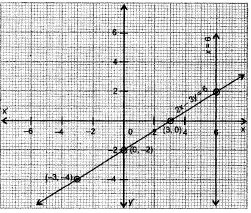
Plotting the points on graph, we get
the unique solution is x = 6, y = 2.
Posted by Nitte Prashanthi 6 years, 7 months ago
- 2 answers
Yogita Ingle 6 years, 7 months ago
In geometry, parallel lines can be defined as two lines in the same plane that are at equal distance from each other and never meet.
????? ?? 6 years, 7 months ago
Posted by Vanshika Dugar 6 years, 7 months ago
- 0 answers
Posted by Tiyas Dutta 6 years, 7 months ago
- 3 answers
Diksha Chawla 6 years, 7 months ago
Posted by Santosh Agrawal 6 years, 7 months ago
- 7 answers
Posted by Aditya Soni 6 years, 7 months ago
- 1 answers
Sukhpreet Siddhu 6 years, 7 months ago
Posted by Sujal Rajput 6 years, 7 months ago
- 3 answers
Honey ??? 6 years, 7 months ago
Posted by Sujal Rajput 6 years, 7 months ago
- 2 answers
Posted by Imran Ahmed 6 years, 7 months ago
- 1 answers
Posted by Divya Gupta 6 years, 7 months ago
- 0 answers
Posted by Vikas Sharma 6 years, 7 months ago
- 0 answers
Posted by Amratansh Kashyap 6 years, 7 months ago
- 1 answers
Sia ? 6 years, 7 months ago
The below equation is solved by cross multiplication method:
Given 5x + 4y - 4 = 0 .........(i)
x - 12y - 20 = 0 ........(ii)
Here, a1 = 5, b1= 4, c1= -4
a2= 1, b2 = - 12, c2 = - 40
By cross-multiplication method,
{tex}\frac { x } { b _ { 2 } c _ { 1 } - b _ { 1 } c _ { 2 } } = \frac { y } { c _ { 1 } a _ { 2 } - c _ { 2 } a _ { 1 } } = \frac { 1 } { a _ { 1 } b _ { 2 } - a _ { 2 } b _ { 1 } }{/tex}
{tex}\frac { x } { - 80 - 48 } = \frac { y } { - 4 + 100 } = \frac { 1 } { - 60 - 4 }{/tex}
{tex}\frac { x } { - 128 } = \frac { y } { 96 } = \frac { 1 } { 64 }{/tex}
{tex}\frac { x } { - 128 } = \frac { 1 } { - 64 } \text { and } \frac { y } { 96 } = \frac { 1 } { - 64 }{/tex}
Hence, {tex}x = 2 \text { and } y = \frac { - 3 } { 2 }{/tex}
Posted by ????? ?? 6 years, 7 months ago
- 5 answers
Posted by Rishu .. 6 years, 7 months ago
- 1 answers
Posted by Abhiram Patra 6 years, 7 months ago
- 2 answers
Srilatha Chaparapu 6 years, 7 months ago
Yogita Ingle 6 years, 7 months ago
135 and 225
Since 225 > 135, we apply the division lemma to 225 and 135 to obtain
225 = 135 × 1 + 90
Since remainder 90 ≠ 0, we apply the division lemma to 135 and 90 to obtain
135 = 90 × 1 + 45
We consider the new divisor 90 and new remainder 45, and apply the division lemma to obtain
90 = 2 × 45 + 0
Since the remainder is zero, the process stops.
Since the divisor at this stage is 45,
Therefore, the HCF of 135 and 225 is 45.
Posted by Anilkumar Anilkumar 6 years, 7 months ago
- 2 answers
Sia ? 6 years, 7 months ago
{tex}\sqrt 3{/tex} sin x = cos x
sin x / cos x = 1 / {tex}\sqrt 3{/tex}
tan x = 1/{tex}\sqrt 3{/tex}
tan 30 = 1 /{tex}\sqrt 3{/tex}
Hence x = 30
Posted by Sumit Kumar 6 years, 7 months ago
- 1 answers
Posted by Arjun Tyagi 6 years, 7 months ago
- 1 answers
Posted by Hemant Kumar 6 years, 7 months ago
- 2 answers

myCBSEguide
Trusted by 1 Crore+ Students

Test Generator
Create papers online. It's FREE.

CUET Mock Tests
75,000+ questions to practice only on myCBSEguide app

Sonam Singh 6 years, 7 months ago
0Thank You