
Ask questions which are clear, concise and easy to understand.
Ask QuestionPosted by Ashish Kumar 6 years, 7 months ago
- 1 answers
Sia ? 6 years, 7 months ago
Let we have ,
{tex}x= 0.1 \overline { 2 }{/tex}, then
{tex}x{/tex} = 0.12222....
{tex}\implies{/tex}10x = 1.2222.... ...(i)
{tex}\implies{/tex}100x= 12.2222... ...(ii)
Subtracting (i) from (ii), we get
{tex}\implies{/tex}100x-10x=11
{tex}\implies90 x = 11 \quad \therefore x = \frac { 11 } { 90 }{/tex}
Thus the value of x ={tex}0.1\overline {2}{/tex} is equal to {tex}\frac {11}{90}{/tex}
Posted by J. Indrani Ranjan Tamuli 6 years, 7 months ago
- 2 answers
Sia ? 6 years, 7 months ago
Geometry is the branch of mathematics concerned with the properties and relations of points, lines, surfaces, solids, and higher dimensional analogues.
Posted by Ranjan Jha 6 years, 7 months ago
- 2 answers
Ranjan Jha 6 years, 7 months ago
Posted by Sahil Tiwari 6 years, 7 months ago
- 1 answers
Posted by Anand Abhilash 6 years, 7 months ago
- 5 answers
Yogita Ingle 6 years, 7 months ago
x2 - x - 6 = 0
x2 - 3x + 2x - 6 = 0
x(x - 3) + 2 (x - 3) = 0
(x - 3) (x + 2) = 0
Posted by Gopinath Messi 6 years, 7 months ago
- 1 answers
Sia ? 6 years, 7 months ago
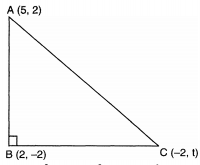
we are given that A (5, 2), B (2, - 2) and C (-2, t) are the vertices of a right-angled triangle with {tex}\angle B{/tex} = 90°.
AB2 = ( 2 - 5)2 + ( - 2 - 2)2 =9 + 16 = 25
BC2 = (- 2 - 2)2 + (t + 2)2 = 16 + (t + 2)2
AC2 = (5 + 2)2 + (2 - t)2 = 49 + (2 - t)2
Since {tex}\triangle{/tex}ABC is a right angled triangle
{tex}\therefore{/tex} AC2 = AB2 + BC2
or, 49 + (2 - t)2 = 25 + 16 + (t + 2)2
or, 49 + 4 - 4t + t2 = 41 + t2 + 4t + 4
or, 53 - 4t = 45 + 4t
or, 8t = 8
{tex}\therefore{/tex} t =1
Posted by Gopinath Messi 6 years, 4 months ago
- 1 answers
Sia ? 6 years, 4 months ago
A(0, 2) is equidistant from B(3, p) and C(p, 5). Therefore,
AB = AC
AB2 = AC2
(3 - 0)2 + (p - 2)2 = (p - 0)2 + (5 - 2)2
32 + p2 + 4 - 4p = p2 + 9
9 + 4 - 4p = 9
4 - 4p = 0
4 = 4p
p = 1
AB = {tex}\sqrt{(3-0)^2+(p-2)^2}=\sqrt{9+(1-2)^2}{/tex}{tex}=\sqrt{10}{/tex}
Posted by Mayank Yadav 6 years, 7 months ago
- 1 answers
Mayank Yadav 6 years, 7 months ago
Posted by Gopinath Messi 6 years, 7 months ago
- 1 answers
Sia ? 6 years, 7 months ago
|PQ| = |PR
{tex}\begin{aligned} \sqrt { [ x - ( a + b ) ] ^ { 2 } + [ y - ( b - a ) ] ^ { 2 } } = \sqrt { [ x - ( a - b ) ] ^ { 2 } + [ y - ( b + a ) ] ^ { 2 } } \end{aligned}{/tex}
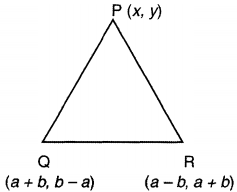
Squaring, we get
[x - (a + b)]2 + [y - (b - a)]2 = [x - (a - b)]2 + [y - (a + b)]2
or, [x - (a + b)]2 - [x - a + b]2 = (y - a - b)2 - (y - b + a)2
or, (x - a - b + x - a + b) ( x - a - b - x + a - b)
= (y - a - b + y - b + a)(y - a - b - y + b - a)
or, (2x - 2a) (- 2b) = (2y - 2b) (- 2a)
or, (x - a)b = (y - b)a
or, bx = ay.
Hence Proved.
Posted by Nandini Sharma❤️ 6 years, 7 months ago
- 1 answers
Sia ? 6 years, 7 months ago
Given polynomial is p(x) = 2x4 - 3x3 - 5x2 + 9x - 3
{tex}\sqrt { 3 } {/tex} and {tex}- \sqrt { 3 }{/tex} are the zeros of polynomial.
(x - {tex}\sqrt{3}{/tex})(x + {tex}\sqrt{3}{/tex}) = x2 - 3 will divide the given polynomial completely
Dividing 2x4 - 3x3 - 5x2 + 9x - 3 by x2 - 3, we get
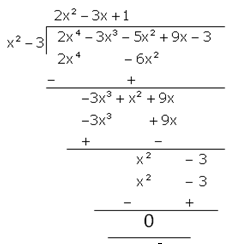
{tex}\therefore{/tex} Quotient q(x) = 2x2 - 3x + 1
= 2x2 - 2x - x + 1
= 2x(x - 1) - 1(x - 1)
q(x) = (x - 1) (2x - 1)
Other zeros of given polynomial are given by
q(x) = 0
{tex}\Rightarrow{/tex} (x - 1) (2x - 1) = 0
{tex}\Rightarrow{/tex} x - 1= 0 or 2x - 1 = 0
{tex}\Rightarrow{/tex} x = 1 or 2x = -1
{tex}\Rightarrow{/tex} x = 1 or x = {tex}\frac{1}{2}{/tex}
{tex}\therefore{/tex} x = 1, {tex}\frac{1}{2}{/tex}
Hence, zeros of given polynomial are {tex}\sqrt { 3 } , - \sqrt { 3 }{/tex}, 1 , {tex}\frac{1}{2}{/tex}.
Posted by Mohit Rajput 5 years, 9 months ago
- 1 answers
Posted by Manish Patel 6 years, 7 months ago
- 2 answers
Karan Kathuria 6 years, 7 months ago
Posted by Tushar Yadav 6 years, 6 months ago
- 1 answers
Sia ? 6 years, 6 months ago
Since the point (3, a) lies on the line 2x - 3y = 5, we have
2 {tex}\times{/tex} 3 - 3 {tex}\times{/tex} a = 5
{tex}\Rightarrow{/tex} 6 - 3a = 5
{tex}\Rightarrow{/tex} 3a = 1
{tex}\Rightarrow{/tex} {tex}a = \frac { 1 } { 3 }{/tex}
Posted by Annie Singh 6 years, 7 months ago
- 0 answers
Posted by Roshan Kumar 6 years, 4 months ago
- 1 answers
Sia ? 6 years, 4 months ago
The given equations are:
{tex}\frac{x}{a}{/tex} + {tex}\frac{y}{b}{/tex} {tex}=(a+b){/tex} {tex}\Rightarrow{/tex}{tex}bx + ay = ab(a + b){/tex}
{tex}\Rightarrow{/tex}{tex}bx + ay - ab(a + b) = 0{/tex} ....(i)
and {tex}\frac { x } { a ^ { 2 } } + \frac { y } { b ^ { 2 } } = 2{/tex} {tex}\Rightarrow{/tex} {tex}b^2x + a^2y = 2a^2b^2{/tex}
{tex}\Rightarrow{/tex}{tex} b^2x + a^2y -2a^2b^2 = 0{/tex}....(ii)
From eq. (i) and (ii), we get

{tex}\Rightarrow{/tex} {tex}\frac { x } { - 2 a ^ { 3 } b ^ { 2 } + a ^ { 3 } b ( a + b ) }{/tex} = {tex}\frac { - y } { - 2 a ^ { 2 } b ^ { 3 } + a b ^ { 3 } ( a + b ) }{/tex} = {tex}\frac { 1 } { a ^ { 2 } b - a b ^ { 2 } }{/tex}
{tex}\Rightarrow{/tex}{tex}\frac { x } { - a ^ { 3 } b ( 2 b - a - b ) }{/tex} = {tex}\frac { - y } { - a b ^ { 3 } ( 2 a - a - b ) }{/tex} = {tex}\frac { 1 } { a b ( a - b ) }{/tex}
{tex}\Rightarrow{/tex}{tex}\frac { x } { - a ^ { 3 } b ( b - a ) }{/tex} = {tex}\frac { y } { a b ^ { 3 } ( a - b ) }{/tex} = {tex}\frac { 1 } { a b ( a - b ) }{/tex}
{tex}\Rightarrow{/tex} {tex}x = \frac { a ^ { 3 } b ( a - b ) } { a b ( a - b ) }{/tex} = a2; {tex}y = \frac { a b ^ { 3 } ( a - b ) } { a b ( a - b ) } = b ^ { 2 }{/tex}
The solution is {tex}x = a^2, y = b^2{/tex} .
Posted by Lakshmi Kanwar 6 years, 7 months ago
- 3 answers
Chhaya Malhotra 6 years, 7 months ago
Posted by Ayush Prasad 6 years, 7 months ago
- 0 answers
Posted by Saurav Kaushik 6 years, 6 months ago
- 1 answers
Sia ? 6 years, 6 months ago
Let us assume that {tex}2\sqrt 3 - 1{/tex} is a rational. number
Then, there exist positive co-primes a and b such that
{tex}2\sqrt 3 - 1 = \frac{a}{b}{/tex}
{tex}2\sqrt 3 = \frac{a}{b} + 1{/tex}
{tex}\begin{array}{l}2\sqrt3=\frac{\mathrm a+\mathrm b}{\mathrm b}\\\end{array}{/tex}
{tex}\sqrt 3 = \frac{{a + b}}{{2b}}{/tex}
Here {tex}\begin{array}{l}\frac{\mathrm a+\mathrm b}{\mathrm b}\\\end{array}{/tex} is a rational number ,so {tex}\sqrt3{/tex} is a rational number
This contradicts the fact that {tex}\sqrt 3{/tex} is an irrational number
Hence {tex}2\sqrt 3 - 1{/tex} is irrational
Posted by Nandeshwar Kumar 6 years, 7 months ago
- 0 answers
Posted by Nandeshwar Kumar 6 years, 7 months ago
- 0 answers
Posted by Sanket Arjun 6 years, 7 months ago
- 0 answers
Posted by Himanshi Saini 6 years, 7 months ago
- 1 answers
Sia ? 6 years, 7 months ago
Given that {tex}\triangle{/tex}ABC ~ {tex}\triangle{/tex}DEF
We know that when two triangles are similar, then the ratios of the lengths of their corresponding sides are equal.
{tex}\Rightarrow \frac { A B } { D E } = \frac { B C } { E F }{/tex}
{tex}\Rightarrow \frac { 1 } { 2 } = \frac { 3 } { E F }{/tex}
{tex}\Rightarrow{/tex} EF = {tex}\frac 32{/tex} cm
Posted by Jay Patel 6 years, 7 months ago
- 1 answers
Sia ? 6 years, 7 months ago
According to the question,
diameter of cylindrical portion = 105 m
Therefore, radius of cylindrical portion= 52.5 m and
height of cylindrical portion (h) = 4 m
{tex}{/tex}Now, Curved Surface area of cylindrical portion = 2{tex}\pi r h{/tex}
{tex}= 2 \times \frac { 22 } { 7 } \times 52.5 \times 4{/tex}
{tex}= \frac { 9240 } { 7 }{/tex}
= 1320 m2
Given slant height of conical portion (l) = 40 m and
Radius of conical portion = Radius of cylindrical portion = 52.5 m
{tex}\Rightarrow{/tex} Curved Surface area of conical portion = {tex}\pi r l{/tex}
{tex}= \frac { 22 } { 7 } \times 52.5 \times 40{/tex}
{tex}= \frac { 46200 } { 7 }{/tex}
= 6600 m2
Therefore, Total surface area = Curved Surface area of cylindrical portion + Curved Surface area of conical portion
= 1320 + 6600
= 7920 m2
Posted by Aryaveer Shandilya 6 years, 7 months ago
- 0 answers
Posted by Arun Kashyap 6 years, 7 months ago
- 4 answers
Cyberavi . 6 years, 7 months ago

myCBSEguide
Trusted by 1 Crore+ Students

Test Generator
Create papers online. It's FREE.

CUET Mock Tests
75,000+ questions to practice only on myCBSEguide app

Sia ? 6 years, 6 months ago
Sp = Sq
{tex} \Rightarrow \frac{p}{2}\left[ {2a + (p - 1)d} \right] = \frac{q}{2}\left[ {2a + (q - 1)d} \right]{/tex}
{tex} \Rightarrow p\left[ {2a + pd - d} \right] = q\left[ {2a + qd - d} \right]{/tex}
{tex} \Rightarrow {/tex} 2ap + p2d - pd = 2aq + q2d - qd
{tex} \Rightarrow {/tex} 2a (p - q) + (p2 - q2)d - (p - q)d = 0
{tex} \Rightarrow {/tex} 2a (p - q) + (p + q) (p - q)d - (p - q)d = 0
{tex} \Rightarrow {/tex} (p - q) [2a + (p + q - 1)d] = 0
{tex} \Rightarrow {/tex} Sp+q = 0
0Thank You