
Ask questions which are clear, concise and easy to understand.
Ask QuestionPosted by Vishal Sharma 6 years, 7 months ago
- 2 answers
Posted by Miss Gaur 6 years, 7 months ago
- 1 answers
Nayanika Mallick 6 years, 7 months ago
Posted by Jyoti Singh 6 years, 7 months ago
- 1 answers
Sia ? 6 years, 7 months ago
On a graph paper, draw a horizontal line XOX' and a vertical line YOY' as the x-axis and they-axis respectively.
{tex}3x + y - 11 = 0{/tex} {tex}\Rightarrow{/tex}{tex}y = (11 -3x){/tex}. ...(i)
Putting {tex}x = 2{/tex} in (i), we get {tex}y = 5{/tex}.
Putting {tex}x = 3{/tex} in (i), we get {tex}y = 2{/tex}.
Putting {tex}x = 5{/tex} in (i), we get {tex}y = -4{/tex}.
| x | 2 | 3 | 5 |
| y | 5 | 2 | -4 |
On the graph paper, plot the points {tex}A (2, 5), B(3, 2)\ and\ C(5, -4).{/tex}
Join AB and BC to get the graph line ABC.
Thus, the line ABC is the graph of the equation {tex}3x + y - 11 = 0{/tex}.
{tex}x - y - 1 = 0{/tex} {tex}\Rightarrow{/tex}{tex}y = (x - 1){/tex} . ...(ii)
Putting {tex}x = -3{/tex} in (ii), we get {tex}y = -4{/tex}.
Putting {tex}x = 0{/tex} in (ii), we get {tex}y = -1{/tex}.
Putting {tex}x = 3{/tex} in (ii), we get {tex}y = 2{/tex}.
| x | -3 | 0 | 3 |
| y | -4 | -1 | 2 |
On the same graph paper as above, plot the points {tex}P(-3, -4)\ and\ Q(0, -1){/tex}. The third point {tex}B(3,2){/tex} is already plotted.
Join PQ and QB to get the graph line PQB.
Thus, line PQB is the graph of the equation {tex}x - y - 1 = 0{/tex}.
The two graph lines intersect at the point {tex}B(3,2){/tex}. {tex}x = 3, y = 2{/tex} is the solution of the given system of equations.
The region bounded by these lines and the y-axis has been shaded.
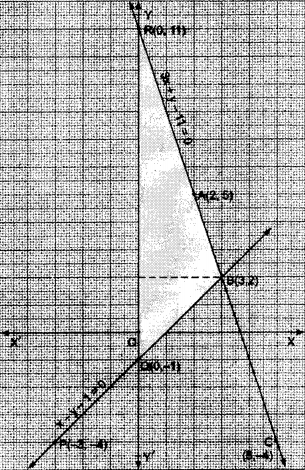
On extending the graph lines on both sides, we find that these graph lines intersect the y-axis at the points Q(0, -1) and R(0,11).
Posted by Jyoti Singh 6 years, 7 months ago
- 1 answers
Sia ? 6 years, 7 months ago
Given system of equations are:
{tex}2x + y = 6{/tex} ...(i)
{tex}2x - y + 2 = 0{/tex} ...(ii)
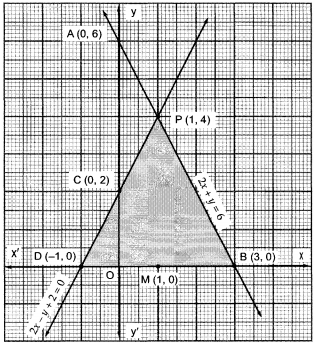
Graph of the equation {tex}2x + y = 6:{/tex}
We have,
{tex}2x + y = 6{/tex} {tex} \Rightarrow {/tex} {tex}y = 6 - 2x{/tex}
When x = 0, we have y = 6 - 2(0) = 6
When x =3, we have y = 6 - 2(3) = 6 - 6 = 0
Thus, we have the following table giving two points on the line represented by the equation {tex}2x + y = 6{/tex}
| x | 0 | 3 |
| y | 6 | 0 |
Graph of the equation {tex}2x - y + 2 = 0{/tex}:
We have,
{tex}2 x - y + 2 = 0 {/tex}{tex} \Rightarrow {/tex} y = 2x + 2
When x = 0, we have y = 2(0) + 2 = 2
When x = -1, we have y = 2(-1) + 2 = 2 - 2 = 0
Thus, we have the following table giving two points on the line representing the given equation
| x | 0 | -1 |
| y | 2 | 0 |
Thus, x = 1, y = 4 is the solution of the given system of equations. Draw PM perpendicular from P on x-axis
Clearly, we have
PM = y-coordinate of point P(1, 4)
{tex} \Rightarrow{/tex} PM=4
and, DB = 4
{tex} \therefore{/tex} Area of the shaded region =Area of {tex} \triangle{/tex}PBD
{tex}\Rightarrow{/tex} Area of the shaded region {tex}= \frac { 1 } { 2 } ( \text { Base } \times \text { Height } ){/tex}
{tex}\Rightarrow{/tex} Area of the shaded region {tex}= \frac { 1 } { 2 } ( D B \times P M ){/tex}
{tex}\Rightarrow{/tex} Area of the shaded region {tex}= \left( \frac { 1 } { 2 } \times 4 \times 4 \right) \text { sq. units } = 8 s q. units.{/tex}
Posted by Aaditya Kumar 6 years, 7 months ago
- 0 answers
Posted by Devu Pandey Ji 6 years, 7 months ago
- 1 answers
Sia ? 6 years, 7 months ago
Given:
f(x) = (2x4 – 9x3 + 5x2 + 3x – 1)
Zeroes = (2 + √3) and (2 – √3)
Given the zeroes, we can write the factors = (x – 2 + √3) and (x – 2 – √3)
{Since, If x = a is zero of a polynomial f(x), we can say that x - a is a factor of f(x)}
Multiplying these two factors, we can get another factor which is:
((x – 2) + √3)((x – 2) – √3) = (x – 2)2 – (√3)2
⇒x2 + 4 – 4x – 3 = x2 – 4x + 1
So, dividing f(x) with (x2 – 4x + 1)
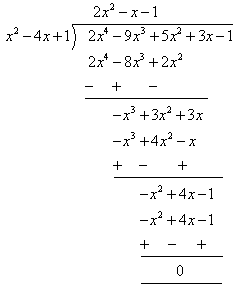
f(x) = (x2 – 4x + 1) (2x2 – x – 1)
Solving (2x2 – x – 1), we get the two remaining roots as
{tex}x = {-b \pm \sqrt{b^2-4ac} \over 2a}{/tex}
where f(x) = ax2 + bx + c = 0(using Quadratic Formula)
{tex}\mathrm{x}=\frac{-(-1) \pm \sqrt{(-1)^{2}-4(2)(-1)}}{2(2)}{/tex}
{tex}\mathrm{x}=\frac{-1 \pm 3}{4}{/tex}
{tex}\Rightarrow \mathrm{x}=1,-\frac{1}{2}{/tex}
Zeros of the polynomial = {tex}1,-\frac{1}{2}, 2+\sqrt{3}, 2-\sqrt{3}{/tex}
Posted by Binod Prasad 6 years, 7 months ago
- 1 answers
Ram Kushwah 6 years, 7 months ago
Two digit number divisible by 3 are
12,15.......................99
This is an Ap and a=12,d=3 ,l=99,n=?
l=a+(n-)d
99=12+(n-1)*3
(n-1)*3=99-12=87
n-1=87/3=29
n=30
Total no are+30
Posted by Md Abrarul Haque 6 years, 7 months ago
- 1 answers
Ram Kushwah 6 years, 7 months ago
Let numerator=x then den=x+18
as per given
{tex}\begin{array}{l}\frac{\displaystyle x+1}{x+18+1}=\frac{\displaystyle x+8}{x+18+15\;\;}\\\frac{\displaystyle x+1}{x+19}=\frac{\displaystyle x+8}{x+33}\\(x+1))(x+33)=(x+8)(x+19)\\x^2+34x+33=x^2+27x+152\end{array}{/tex}
{tex}\begin{array}{l}7x=152-33\\7x=119\\x=17\end{array}{/tex}
Numerator=-17
and denominator=-17+18=35
Number=-17/35
Posted by Sri Poorani Poorani 6 years, 7 months ago
- 1 answers
Harshita Suri 6 years, 7 months ago
Posted by Lalgarh Jattan 6 years, 7 months ago
- 1 answers
Posted by Kritika Khanagwal 6 years, 7 months ago
- 1 answers
Posted by Sidhant Baral 6 years, 7 months ago
- 1 answers
Sia ? 6 years, 7 months ago
It is given that AD = 1 cm,
BD = 2 cm and {tex}D E \| B C{/tex}
In {tex}\triangle{/tex}ADE and {tex}\triangle {/tex}ABC
{tex}\angle A D E = \angle A B C{/tex} (Corresponding angles)
{tex}\angle A = \angle A{/tex} [Common]
Therefore, by A.A. similar condition
{tex}\triangle \mathrm { ADE } \sim \triangle \mathrm { ABC }{/tex}
Ratio of areas of similar triangles is equal to the square of the ratio of the corresponding sides.
{tex}\therefore \quad \frac { \operatorname { ar } ( \triangle \mathrm { ABC } ) } { \operatorname { ar } ( \triangle \mathrm { ADE } ) } = \frac { \mathrm { AB } ^ { 2 } } { \mathrm { AD } ^ { 2 } }{/tex}
{tex}\Rightarrow \quad \frac { \operatorname { ar } ( \triangle A B C ) } { \operatorname { ar } ( \triangle A D E ) } = \left( \frac { 3 } { 1 } \right) ^ { 2 }{/tex}
{tex}\Rightarrow \quad \frac { \operatorname { arc } \triangle A B C ) } { \operatorname { ar } ( \triangle A D E ) }{/tex}
{tex}= \frac { 9 } { 1 }{/tex}
Posted by Vaishali ..... 6 years, 7 months ago
- 2 answers
Posted by Priyamvada Singh 6 years, 7 months ago
- 1 answers
Posted by Yashbant Barik 6 years, 7 months ago
- 2 answers
Posted by Yashbant Barik 6 years, 7 months ago
- 1 answers
Posted by Diwanshi Arora 6 years, 7 months ago
- 1 answers
Sia ? 6 years, 7 months ago
Given : In {tex}\triangle A B C{/tex}, DE || BC and intersects AB in D and AC in E.
Prove that : {tex}\frac{AD}{DB} = \frac{AE}{EC}{/tex}

Construction: Join BC, CD and draw EF {tex}\perp{/tex} BA and DG {tex}\perp{/tex} CA.
Now from the given figure we have,
EF {tex}\perp{/tex} BA (Construction)
EF is the height of ∆ADE and ∆DBE (Definition of perpendicular)
Area({tex}\triangle{/tex}ADE) ={tex}\frac{AD.EF}{2}{/tex} .....(1)
Area({tex}\triangle{/tex}DBE) = {tex}\frac{DB.EF}{2}{/tex} ....(2)
Divide the two equations we have
{tex}\frac{Area \triangle ADE}{Area \triangle DBE} = \frac{AD}{DB}{/tex} .....(3)
{tex}\frac{Area \triangle ADE}{Area \triangle DEC} = \frac{AE}{EC}{/tex} .....(4)
Therefore, {tex}\triangle \mathrm{DBE} \sim \triangle \mathrm{DEC}{/tex} (Both the ∆s are on the same base and between the same || lines).....(5)
Area({tex}\triangle{/tex}DBE) = Area({tex}\triangle{/tex}DEC) (If the two triangles are similar their areas are equal)
{tex}\frac{AD}{DB} = \frac{AE}{EC}{/tex} [from equation 3,4 and 5]
Hence proved.
Posted by Rahul Gupta 6 years, 7 months ago
- 1 answers
Sia ? 6 years, 7 months ago
{tex}k x + y = k ^ { 2 } \text { and } x + k y = 1{/tex}
{tex}a_1 = k , b_1 = 1, c_1= k^2{/tex}
and {tex}a_2 = 1, b_2 = k , c_2 = 1{/tex}
{tex}\frac { a _ { 1 } } { a _ { 2 } } = \frac { k } { 1 } , \frac { b _ { 1 } } { b _ { 2 } } = \frac { 1 } { k } , \frac { c _ { 1 } } { c _ { 2 } } = \frac { k ^ { 2 } } { 1 }{/tex}
For infinitely many solution
{tex}\frac { a _ { 1 } } { a _ { 2 } } = \frac { b _ { 1 } } { b _ { 2 } } = \frac { c _ { 1 } } { c _ { 2 } }{/tex}
{tex}\frac { k } { 1 } = \frac { 1 } { k } = \frac { k ^ { 2 } } { 1 } {/tex}
{tex}\frac { k } { 1 } = \frac { 1 } { k }{/tex}
{tex} k ^ { 2 } = 1{/tex}
{tex}k = \pm 1{/tex}
Posted by Akhil Dhiman 6 years, 7 months ago
- 1 answers
Posted by Santhosh Shivan 6 years, 7 months ago
- 1 answers
Sia ? 6 years, 7 months ago
Let another number = x
HCF (45, x) = 9
LCM (45, x) = 360
HCF {tex}\times{/tex} LCM = 45 {tex}\times{/tex} x
{tex}9 \times 360 = 45 \times x{/tex}
x = {tex}\frac { 9 \times 360 } { 45 }{/tex}= 72
Posted by Yash Sharma 6 years, 7 months ago
- 1 answers
Posted by Himank Sharma 6 years, 7 months ago
- 0 answers
Posted by Hardev Singh Sandhu 6 years, 7 months ago
- 1 answers
Rajan Kumar Pasi 6 years, 7 months ago
For this, you need to understand the repetition or cyclicity of unit digits coming in the powers of number 8
Powers of 8 = 8, 64, 512, 4096, 32768, 262144, 2097152, 16777216 and so on...
Unit digits of powers of 8 = 8, 4, 2, 6, 8, 4, 2, 6, ..........
So the repetition cycle is = {tex}\large8\to4\to2\to6{/tex}
So the cyclicity quantity is 4.
So,{tex}for \space38^{20}\\ We \space have\space to\space do =\frac{20}4 ,where \space remainder=0\\The \space cyclicity\space unit\space digit\space number\space for\space this\space is\space 6.{/tex}
Posted by Poonam Jhajriya 6 years, 7 months ago
- 2 answers
Kishu ? 6 years, 7 months ago
Posted by Sandeep Agrawal 6 years, 7 months ago
- 0 answers
Posted by Diksha Bajaj 6 years, 7 months ago
- 1 answers
Sia ? 6 years, 7 months ago
Let the two zeroes of the polynomials are α and β
where, {tex}\alpha = \frac {{ -b + \sqrt {b^2 - 4ac}}}{2a}{/tex} and {tex}\beta = \frac {{ -b - \sqrt {b^2 - 4ac}}}{2a}{/tex}
Now, {tex}\alpha + \beta {/tex}
{tex} = \frac{{ - b + \sqrt {{b^2} - 4ac} }}{{2a}}+ \left( {\frac{{ - b - \sqrt {{b^2} - 4ac} }}{{2a}}} \right){/tex}
{tex}= \frac{{ - b + \sqrt {{b^2} - 4ac} - b + \sqrt {{b^2} - 4ac} }}{{2a}}{/tex}
{tex}= \frac{{-2b }}{{2a}} = \frac{-b}{a}{/tex}
Posted by Nayanika Mallick 6 years, 7 months ago
- 3 answers
Aryan Gupta 6 years, 7 months ago
Vishal Singh 6 years, 7 months ago
Shashwat Shukla 6 years, 7 months ago
Posted by Anup Jha 6 years, 7 months ago
- 6 answers
Lakshmi Kanwar 6 years, 7 months ago
Yogita Ingle 6 years, 7 months ago
Smallest prime number = 2
Smallest composite number = 4
Factors of 2 are 1 and 2
Factors of 4 are 1, 2 and 4
Highest common factor (HCF) = 2

myCBSEguide
Trusted by 1 Crore+ Students

Test Generator
Create papers online. It's FREE.

CUET Mock Tests
75,000+ questions to practice only on myCBSEguide app

Sia ? 6 years, 7 months ago
We have,
{tex} \tan \theta + \frac { 1 } { \tan \theta } = 2{/tex}
Squaring both sides, we get
{tex}\Rightarrow \left( \tan \theta + \frac { 1 } { \tan \theta } \right) ^ { 2 } = 2 ^ { 2 }{/tex}
{tex}\Rightarrow\quad\tan^2\theta+\frac1{\tan^2\theta}+2\times\tan\theta\times\frac1{\tan\theta}=4{/tex}
{tex}\Rightarrow \quad \tan ^ { 2 } \theta + \frac { 1 } { \tan ^ { 2 } \theta } + 2 = 4{/tex}
{tex}\Rightarrow \quad \tan ^ { 2 } \theta + \frac { 1 } { \tan ^ { 2 } \theta } = 2{/tex}
Alternate method, We have
{tex}\tan \theta + \frac { 1 } { \tan \theta } = 2{/tex}
{tex}\Rightarrow \quad \tan ^ { 2 } \theta + 1 = 2 \tan \theta{/tex}
{tex}\Rightarrow \quad \tan ^ { 2 } \theta - 2 \tan \theta + 1 = 0{/tex}
{tex}\Rightarrow \quad ( \tan \theta - 1 ) ^ { 2 } = 0{/tex}
{tex}\Rightarrow \quad \tan \theta = 1{/tex}
{tex}\therefore \quad \tan ^ { 2 } \theta + \frac { 1 } { \tan ^ { 2 } \theta } = 1 + 1 = 2{/tex}
1Thank You