
Ask questions which are clear, concise and easy to understand.
Ask QuestionPosted by Ashish Kalia 6 years, 7 months ago
- 2 answers
Posted by Satender Pal 6 years, 7 months ago
- 1 answers
Sia ? 6 years, 7 months ago
{tex}x^2 + 6x - 16 = 0{/tex}
{tex}\Rightarrow{/tex} {tex}x^2 + 6x = 16{/tex}
{tex}\Rightarrow{/tex} {tex}x^2 + 6x + 9 = 16 + 9{/tex} [Adding on both sides square of coefficient of x, i.e. ({tex}\frac{6}{2}{/tex})2]
{tex}\Rightarrow{/tex} {tex}(x + 3)^2 = 25{/tex}
{tex}\Rightarrow{/tex} x + 3 = {tex}\pm{/tex}{tex}\sqrt{25}{/tex}
{tex}\Rightarrow{/tex} x + 3 =5 or x + 3 = -5
{tex}\Rightarrow{/tex} x = 2 or x = -8
Posted by Sajan Mandal 6 years, 7 months ago
- 2 answers
Posted by Chetan Upadhya Chetan 6 years, 7 months ago
- 1 answers
Posted by Sachin Sharma 6 years, 7 months ago
- 1 answers
Sia ? 6 years, 7 months ago
Get NCERT solutions here : <a href="https://mycbseguide.com/ncert-solutions.html">https://mycbseguide.com/ncert-solutions.html</a>

Posted by Chinki Mehlawat 6 years, 7 months ago
- 1 answers
Sia ? 6 years, 7 months ago
Given : cos{tex}\theta{/tex} + sin{tex}\theta{/tex}= p ....(i)
sec{tex}\theta{/tex} + cosec{tex}\theta{/tex} = q....(ii)
L.H.S = q(p2- 1)
= (sec{tex}\theta{/tex} + cosec{tex}\theta{/tex}) [(cos{tex}\theta{/tex} + sin{tex}\theta{/tex})2 - 1]
= (sec{tex}\theta{/tex} + cosec{tex}\theta{/tex}) (cos2{tex}\theta{/tex} + sin2{tex}\theta{/tex} + 2 sin{tex}\theta{/tex} cos{tex}\theta{/tex} - 1) {tex}[\because (a+b)^2=a^2+b^2+2ab]{/tex}
{tex}= \left( \frac { 1 } { \cos \theta } + \frac { 1 } { \sin \theta } \right) ( 2 \sin \theta \cos \theta ){/tex} {tex}[\because sin^2\theta+cos^2\theta=1]{/tex}
{tex}= 2sin\theta cos\theta. \frac{1}{cos\theta}+2sin\theta cos\theta.\frac{1}{sin\theta}{/tex}
= {tex}2sin\theta+2cos\theta{/tex}
= {tex}2(sin\theta+cos\theta){/tex}
= {tex}2p{/tex} ......( using eq.i )
= R.H.S.
Hence Proved.
Posted by Vandana Wadhwa 6 years, 7 months ago
- 1 answers
Suhani Rathore 6 years, 7 months ago
Posted by Abhishek Shukla 6 years, 7 months ago
- 1 answers
Sia ? 6 years, 7 months ago

Let O be the common centre of the two circles
and AB be the chord of the larger circle which touches the smaller circle at C.
Join OA and OC.
Then, OA = a and OC = b.
Now, {tex} \mathrm { OC } \perp A B{/tex} and OC bisects AB [{tex}\because{/tex} the chord of the larger circle touching the smaller circle, is bisected at the point of contact].
In right {tex}\triangle A C O{/tex}, we have
OA2 = OC2+AC2 [by Pythagoras' theorem]
{tex}\Rightarrow{/tex}AC = {tex}\sqrt { O A ^ { 2 } - O C ^ { 2 } } = \sqrt { a ^ { 2 } - b ^ { 2 } }{/tex}.
{tex}\therefore{/tex} AB = 2AC = {tex}2 \sqrt { a ^ { 2 } - b ^ { 2 } }{/tex} {tex}[ \because \text { C is the midpoint of } A B ]{/tex}
i.e, required length of the chord AB = {tex}2 \sqrt { a ^ { 2 } - b ^ { 2 } }{/tex}
Posted by Rekha Garg 6 years, 7 months ago
- 3 answers
Yogita Ingle 6 years, 7 months ago
Zero of the polynomial is -4
p(x) =x² - x - (2k + 2)
p(x) = x²-x-2k-2
p(-4)=0
0=-4²-(-4)-2k-2
0=16+4-2k-2
0=18-2k
2k=18
k=18/2=9
Posted by Sagar Verma 6 years, 7 months ago
- 1 answers
Ayush Yadav 6 years, 7 months ago
Posted by Sandeep Hello 6 years, 7 months ago
- 2 answers
Sia ? 6 years, 7 months ago
Let A(-2, 0) and B(6, 0) be the given points.
Let P(x, 0) be the point on x -axis such that PA = PB
PA = PB
PA2 = PB2
(x + 2)2 + (0 - 0)2 = (x - 6)2 + (0 - 0)2
{tex}\Rightarrow{/tex} x2 + 4 + 4x = x2 + 36 - 12x
{tex}\Rightarrow{/tex} 16x = 32
{tex}\Rightarrow{/tex} x = 2
{tex}\therefore{/tex} The point on x-axis is (2, 0).
Posted by Jashan Preet Singh 6 years, 7 months ago
- 2 answers
Diya ..... 6 years, 7 months ago
Sia ? 6 years, 7 months ago
An expression of more than two algebraic terms, especially the sum of several terms that contain different powers of the same variable(s).
Posted by Rimzim Mhaske 6 years, 7 months ago
- 2 answers
Sia ? 6 years, 7 months ago
The given pair of linear equations is
x + 3y - 5 = 0
3x + ky - 15 = 0
{tex}\Rightarrow{/tex} x + 2y - 5= 0
Here, a1 = 1, b1 = 3, c1 = -5
a2 = 3, b2 = k, c2 = -15
For having a unique solution, we must have
{tex}\frac { a _ { 1 } } { a _ { 2 } } \neq \frac { b _ { 1 } } { b _ { 2 } }{/tex}
{tex}\Rightarrow \quad \frac { 1 } { 3 } \neq \frac { 3 } { k } \Rightarrow k \neq 9{/tex}
Posted by Thilakeswari Manickam 6 years, 7 months ago
- 1 answers
Sia ? 6 years, 7 months ago
{tex}\frac{1}{2a + b + 2x}{/tex} = {tex}\frac{1}{2a}{/tex} + {tex}\frac{1}{b}{/tex} + {tex}\frac{1}{2x}{/tex}
{tex}\Rightarrow{/tex} {tex}\frac{1}{2a + b + 2x}{/tex} - {tex}\frac{1}{2x}{/tex} = {tex}\frac{1}{2a}{/tex} + {tex}\frac{1}{b}{/tex}
{tex}\Rightarrow{/tex}{tex}\frac { 2 x - 2 a - b - 2 x } { ( 2 a + b + 2 x ) ( 2 x ) }{/tex} = {tex}\frac{b + 2a}{2a \times b}{/tex}
{tex}\Rightarrow{/tex} {tex}\frac { - ( 2 a + b ) } { ( 2 a + b + 2 x ) 2 x }{/tex} = {tex}\frac{b + 2a}{2ab}{/tex}
{tex}\Rightarrow{/tex}{tex}\frac { - 1 } { 4 a x + 2 b x + 4 x ^ { 2 } }{/tex} = {tex}\frac{1}{2ab}{/tex}
{tex}\Rightarrow{/tex} {tex}4x^2 + 2bx + 4ax = -2ab{/tex}
{tex}\Rightarrow{/tex} {tex}4x^2 + 2bx + 4ax + 2ab = 0{/tex}
{tex}\Rightarrow{/tex} {tex}2x(2x + b) + 2a(2x + b) = 0{/tex}
{tex}\Rightarrow{/tex} (2x + b)(2x + 2a) = 0
{tex}\Rightarrow{/tex} x = -{tex}\frac{b}{2}{/tex} or x = -a
Posted by Nikhil More 6 years, 7 months ago
- 2 answers
Yogita Ingle 6 years, 7 months ago
Given points are (1,7),(4,2),(-1,-1),(-4,4)
Let the points are A,B,C,D.
Distance formula = √(x₂-x₁)²+(y₂-y₁)²
AB = √(4-1)²+(2-7)²
= √9+25
= √34
BC = √(-1-4)²+(-1-2)²
= √25+9
= √34
CD = √(-4-(-1))²+(4-(-1))²
= √9+25
= √34
DA = √(1-(-4))²+(7-4)²
= √25+9
= √34
We know that the all sides of the square are equal.
Here by the distance formula, we got the for sides equal .
So,from this we can say that these points are the vertices of a square.
Posted by Bivash Rajhans 6 years, 7 months ago
- 2 answers
Yogita Ingle 6 years, 7 months ago
3x + 9y = 11xy …………(ii)
For equation (i), we have: 6x+3y/ xy = 7
 </div>
Sia ? 6 years, 7 months ago
On dividing each of the given equations by xy, we get
{tex}\frac { 6 } { y } + \frac { 3 } { x } = 7{/tex}.......(i)
{tex}\frac { 3 } { y } + \frac { 9 } { x } = 11{/tex}.....(ii)
Putting {tex}\frac 1x{/tex} = u and {tex}\frac 1y{/tex} = v in (i) and (ii), we get
{tex}6v + 3u = 7{/tex}..... (iii)
{tex}3v + 9u = 11{/tex}.. ..(iv)
Multiplying (iii) by 3 and subtracting (iv) from the result, we get
{tex}18v - 3v = 21 - 11{/tex}
{tex}\Rightarrow{/tex} {tex}15v = 10{/tex}
{tex}\Rightarrow \quad v = \frac { 10 } { 15 } = \frac { 2 } { 3 }{/tex}
Putting v = {tex}\frac 23{/tex} in (iii), we get
{tex}\left( 6 \times \frac { 2 } { 3 } \right) + 3 u = 7{/tex}{tex}\Rightarrow 4 + 3 u = 7 \Rightarrow 3 u = 3 \Rightarrow u = 1{/tex}
{tex}u = 1{/tex} {tex}\Rightarrow \frac { 1 } { x } = 1 \Rightarrow x = 1{/tex}
{tex}v = \frac { 2 } { 3 } \Rightarrow \frac { 1 } { y } = \frac { 2 } { 3 }{/tex}{tex}\Rightarrow 2 y = 3 \Rightarrow y = \frac { 3 } { 2 }{/tex}
{tex}\therefore{/tex} {tex}x = 1\ and\ y = {/tex}{tex}\frac 32{/tex}
Posted by Rupesh Sahoo 6 years, 7 months ago
- 1 answers
Sia ? 6 years, 7 months ago
Given,
am+1 = 2an+1
{tex}\Rightarrow{/tex} a + (m + 1 - 1)d = 2[a + (n + 1 - 1)d]
{tex}\Rightarrow{/tex} a + md = 2[a + nd]
{tex}\Rightarrow{/tex} a + md = 2a + 2nd
{tex}\Rightarrow{/tex} md - 2nd = 2a - a
{tex}\Rightarrow{/tex} md - 2nd = a ..........(i)
To prove:
a3m+1 = 2am+n+1
Proof:
LHS
= a3m+1
= a + (3m + 1 - 1)d
= a + 3md
= md - 2nd + 3md [From (i)]
= 4md - 2nd
RHS
= 2am+n+1
= 2[a + (m + n + 1 -1)d]
= 2[a + md - nd]
= 2[md - 2nd + md + nd] [From (i)]
= 2[2md - nd]
= 4md - 2nd
Hence, LHS = RHS
Posted by Rafsan Halai 6 years, 7 months ago
- 1 answers
Posted by Dikson K Jesty 6 years, 7 months ago
- 7 answers
Posted by Raghav Tiwari Raghav Tiwari 6 years, 7 months ago
- 1 answers
Sia ? 6 years, 7 months ago
The frustum of a pyramid or truncated pyramid is the result of cutting a pyramid by a plane parallel to the base and separating the part containing the apex. The height of the pyramidal frustum is the perpendicular distance between the bases. The apothem is the height of any of its sides.
Posted by Armaan Garnayak 6 years, 7 months ago
- 1 answers
Sia ? 6 years, 7 months ago
Let height of each candle = {tex}x\ unit.{/tex}
First candle burns off in 6 hours.
Second candle burns off in 8 hours.
Height of 1st candle after burning for 1 hr = {tex}\frac{x}{6}{/tex}{tex}unit{/tex}
and height of 2nd candle after burning for 1 hr = {tex}\frac{x}{8}{/tex}{tex}unit{/tex}
Let the required time {tex}= y\ hrs{/tex}.
Length of 1st candle burnt after y hrs = {tex}\frac{y \times x}{6}{/tex}{tex}unit{/tex}
Height of 1st candle left = {tex}\left(x-\frac{x y}{6}\right){/tex}
Length of 2nd candle burnt after y hrs = {tex}\left(\frac{y \times x}{8}\right){/tex}{tex}unit{/tex}
Height of 2nd candle left = {tex}\left(x-\frac{x y}{8}\right){/tex}
According to the question,
Height of 1st candle = {tex}\frac{1}{2} \times{/tex}Height of 2nd candle
{tex}\Rightarrow \quad x-\frac{x y}{6}=\frac{1}{2}\left(x-\frac{x y}{8}\right){/tex}
{tex}\Rightarrow \quad x\left(1-\frac{y}{6}\right)=\frac{1}{2} x\left(1-\frac{y}{8}\right){/tex}
{tex}1-\frac{y}{6}=\frac{1}{2}\left(1-\frac{y}{8}\right){/tex}
{tex}\Rightarrow \quad 2-\frac{y}{3}=1-\frac{y}{8}{/tex}
{tex}2 -1 ={/tex} {tex}\frac{y}{3}-\frac{y}{8}{/tex}
1 = {tex}\frac{8 y-3 y}{24}{/tex}
{tex}\Rightarrow{/tex} {tex}24 = 5y{/tex}
{tex}\Rightarrow{/tex} {tex}y ={/tex} {tex}\frac{24}{5}{/tex}
{tex}y = 4.8 hours = 4\ hours\ 48\ minutes.{/tex}
Posted by Sharad Mishra 6 years, 7 months ago
- 3 answers
Posted by Basavaraj Tanagodi 6 years, 7 months ago
- 2 answers
Posted by Swayam Sharma 6 years, 7 months ago
- 6 answers
Posted by Shlok Pandey 6 years, 7 months ago
- 1 answers
Sia ? 6 years, 7 months ago
Let AC be the electric pole of height 4 m. Let B be a point 1.3 m below the top A of the pole AC.
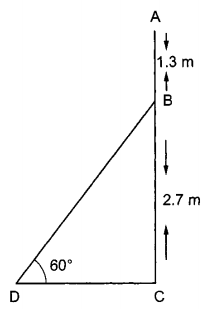
Then {tex}BC=AC-AB=4-1.7=2.3 m{/tex}
Here BD is the ladder and
{tex}\angle BDC{/tex} = 60o
In {tex}\triangle{/tex}BCD, we have
{tex}\frac{BD}{BC} =cosec60=\frac{2}{√3}{/tex}
BD = BC {tex}\times{/tex} {tex}2\over √3{/tex}
= 2.7 {tex}\times{/tex} {tex}\frac{2}{1.73} = 3.12 m{/tex}
Hence length of ladder = 3.12 meter
Posted by Tushar Lakhchaura 6 years, 7 months ago
- 6 answers
Tushar Lakhchaura 6 years, 6 months ago
Saurabh Chitte 6 years, 7 months ago
Posted by Het Patel 6 years, 7 months ago
- 1 answers

myCBSEguide
Trusted by 1 Crore+ Students

Test Generator
Create papers online. It's FREE.

CUET Mock Tests
75,000+ questions to practice only on myCBSEguide app

Yogita Ingle 6 years, 7 months ago
let 'x' be the number
Then,according to the question
x + x² = (63/4)
4x²+ 4x -63 = 0
Using splitting the middle term,
4x² + 18x - 14x -63 = 0
2x(2x-9) - 7(2x-9) = 0
(2x - 7)(2x - 9) = 0
⇒ x = (7/2) or (9/2)
x = (7/2) satisfy the condition given in the question
so, x =(7/2) is the number
0Thank You