
Ask questions which are clear, concise and easy to understand.
Ask QuestionPosted by Mahak Mittal 6 years, 7 months ago
- 1 answers
Posted by Rudraksh Buddhiwant 6 years, 7 months ago
- 1 answers
Sia ? 6 years, 7 months ago
F(x) = x3 + 4x2 - px + 8
as (x - 2) is a factor.
x - 2 = 0
{tex}\Rightarrow{/tex} x = 2
f(2) = 8 + 16 - 2p + 8 = 0
{tex}\Rightarrow{/tex} 32 = 2p
{tex}\Rightarrow{/tex} p = 16
Posted by Rakesh Kumar Parida 6 years, 7 months ago
- 1 answers
Gaurav Seth 6 years, 7 months ago
k = 8/3α
α = √15 / 4
Step-by-step explanation:
f(x) = kx³ - 8x² + 5
Roots are α - β , α & α +β
Sum of roots = - (-8)/k
Sum of roots = α - β + α + α +β = 3α
=> 3α = 8/k
=> k = 8/3α
or we can solve as below
f(x) = (x - (α - β)(x - α)(x - (α +β))
= (x - α)(x² - x(α+β + α - β) + (α² - β²))
= (x - α)(x² - 2xα + (α² - β²))
= x³ - 2x²α + x(α² - β²) - αx² +2α²x - α³ + αβ²
= x³ - 3αx² + x(3α² - β²) + αβ² - α³
= kx³ - 3αkx² + xk(3α² - β²) + k(αβ² - α³)
comparing with
kx³ - 8x² + 5
k(3α² - β²) = 0 => 3α² = β²
k(αβ² - α³) = 5
=>k(3α³ - α³) = 5
=> k2α³ = 5
3αk = 8 => k = 8/3α
(8/3α)2α³ = 5
=> α² = 15/16
=> α = √15 / 4
Posted by Sonam Singh 6 years, 7 months ago
- 0 answers
Posted by Rajnesh Mandhan 6 years, 7 months ago
- 1 answers
Sia ? 6 years, 7 months ago
The sample space of an experiment is the set of all possible outcomes of that experiment. The sample space of con experiment is: {head, tail}
Posted by Rudram Yaduvanshi 6 years, 7 months ago
- 1 answers
Posted by Pankaj Jain 6 years, 7 months ago
- 2 answers
Tushar Singh 6 years, 7 months ago
Posted by Tamanna Choudhary 6 years, 7 months ago
- 1 answers

Posted by Shreshtha Kushwaha 6 years, 7 months ago
- 1 answers
Tamanna Choudhary 6 years, 7 months ago
Posted by Tamanna Choudhary 6 years, 7 months ago
- 1 answers
Rajan Kumar Pasi 6 years, 7 months ago
This is simple, NCERT book has a question like this but for 2 or 3 things.
But the logic behind these kinds of question is LCM.
Solution: LCM(6,7,8,9,12) = 504 seconds.
Now, In 1 hr (= 3600 sec) no. of time they will hit together is
{tex}\large \frac{3600}{504} \space\space\space\implies \frac{50\times72}{7 \times72}\space\space\space\implies \frac{50}{7}\space\space\space\implies 7\frac{1}{7} \sim\boxed7{/tex}
Thus, the answer is: {tex}\large\boxed{7 \space times\space in\space an\space hour}{/tex}
Posted by Tamanna Choudhary 6 years, 6 months ago
- 1 answers
Sia ? 6 years, 6 months ago
{tex}{4^n} = {\left[ {{2^2}} \right]^n} = {2^{2n}}{/tex}
It does not contains '5'. So {tex}{4^n},n \in N{/tex} can never end with the digit 0
Posted by Tamanna Choudhary 6 years, 6 months ago
- 1 answers
Sia ? 6 years, 6 months ago
Let n = 4q + 1 (an odd integer)
{tex}\therefore \quad n ^ { 2 } - 1 = ( 4 q + 1 ) ^ { 2 } - 1{/tex}
{tex}= 16 q ^ { 2 } + 1 + 8 q - 1 \quad \text { Using Identity } ( a + b ) ^ { 2 } = a ^ { 2 } + 2 a b + b ^ { 2 }{/tex}
{tex}= 16{q^2} + 8q{/tex}
{tex}= 8 \left( 2 q ^ { 2 } + q \right){/tex}
= 8m, which is divisible by 8.
Posted by Tamanna Choudhary 6 years, 6 months ago
- 1 answers
Sia ? 6 years, 6 months ago
n3 - n = n (n2 - 1) = n (n - 1) (n + 1)
Whenever a number is divided by 3, the remainder obtained is either 0 or 1 or 2.
∴ n = 3p or 3p + 1 or 3p + 2, where p is some integer.
If n = 3p, then n is divisible by 3.
If n = 3p + 1, then n – 1 = 3p + 1 –1 = 3p is divisible by 3.
If n = 3p + 2, then n + 1 = 3p + 2 + 1 = 3p + 3 = 3(p + 1) is divisible by 3.
So, we can say that one of the numbers among n, n – 1 and n + 1 is always divisible by 3.
⇒ n (n – 1) (n + 1) is divisible by 3.
Similarly, whenever a number is divided by 2, the remainder obtained is 0 or 1.
∴ n = 2q or 2q + 1, where q is some integer.
If n = 2q, then n is divisible by 2.
If n = 2q + 1, then n – 1 = 2q + 1 – 1 = 2q is divisible by 2 and n + 1 = 2q + 1 + 1 = 2q + 2 = 2 (q + 1) is divisible by 2.
So, we can say that one of the numbers among n, n – 1 and n + 1 is always divisible by 2.
⇒ n (n – 1) (n + 1) is divisible by 2.
Since, n (n – 1) (n + 1) is divisible by 2 and 3.
∴ n (n-1) (n+1) = n3 - n is divisible by 6.( If a number is divisible by both 2 and 3 , then it is divisible by 6)
Posted by Tamanna Choudhary 6 years, 6 months ago
- 1 answers
Sia ? 6 years, 6 months ago
On dividing n by 3, let q be the quotient and r be the remainder.
Then, {tex}n = 3q + r{/tex}, where {tex}0 \leq r < 3{/tex}
{tex}\Rightarrow\;n = 3q + r{/tex} , where r = 0,1 or 2
{tex}\Rightarrow{/tex} {tex}n = 3q \;or \;n = (3q + 1) \;or\; n = (3q + 2){/tex}.
Case I If n = 3q then n is clearly divisible by 3.
Case II If {tex}\;n = (3q + 1)\; {/tex} then {tex} (n + 2)= (3q + 1 + 2) = (3q + 3) = 3(q + 1){/tex}, which is clearly divisible by 3.
In this case, {tex}(n + 2){/tex} is divisible by 3.
Case III If n = {tex}(3q + 2){/tex} then {tex}(n + 1) = (3q + 2 + 1) = (3q + 3) = 3(q + 1){/tex}, which is clearly divisible by 3.
In this case,{tex} (n + 1){/tex} is divisible by 3.
Hence, one and only one out of {tex}n, (n + 1){/tex} and {tex}(n + 2){/tex} is divisible by 3.
Posted by Rinki Pal 6 years, 7 months ago
- 0 answers
Posted by Sanjana . 6 years, 7 months ago
- 1 answers
Posted by Uday Verma 6 years, 7 months ago
- 1 answers
Sia ? 6 years, 7 months ago
Given,
{tex} \frac { x + 3 } { x - 2 } - \frac { 1 - x } { x } = \frac { 17 } { 4 }{/tex}
Taking LCM, we get
{tex} \Rightarrow \quad \frac { x ( x + 3 ) - ( 1 - x ) ( x - 2 ) } { x ( x - 2 ) } = \frac { 17 } { 4 }{/tex}
{tex} \Rightarrow \quad \frac { x ^ { 2 } + 3 x - \left( x - 2 - x ^ { 2 } + 2 x \right) } { x ^ { 2 } - 2 x } = \frac { 17 } { 4 }{/tex}
{tex} \Rightarrow \quad \frac { 2 x ^ { 2 } + 2 } { x ^ { 2 } - 2 x } = \frac { 17 } { 4 }{/tex}
After cross multiplication,we get
{tex} \Rightarrow{/tex} 8x2 + 8 = 17x2 - 34x
{tex}\Rightarrow{/tex} 9x2 - 34x - 8 = 0
{tex}\Rightarrow{/tex} 9x2 - 36x + 2x - 8 = 0
{tex}\Rightarrow{/tex} {tex}9 x ( x - 4 ) + 2 ( x - 4 ) = 0{/tex}
{tex} \Rightarrow{/tex} (x - 4)(9x + 2) = 0 {tex} \Rightarrow{/tex} x - 4 = 0 or, 9x + 2 = 0 {tex} \Rightarrow \quad x = 4 \text { or, } x = - \frac { 2 } { 9 }{/tex}
Posted by Adarsh Gupta 6 years, 7 months ago
- 1 answers
Yogita Ingle 6 years, 7 months ago
Let f(x) = x3 + 10x2 + ax + b
Since (x - 1) is a factor therefore
f(1) = 0
 1 + 10 + a + b = 0
a + b = -11 … (1)
Also, (x - 2) is a factor, therefore
f(2) = 0
(2)3 + 10( 2)2 + a(2) + b = 0
8 + 40+ 2a + b = 0
2a+ b = 48 … (2)
solve (i) and (2) to find final answer
Posted by Vikas Yadav 6 years, 7 months ago
- 1 answers
Sia ? 6 years, 7 months ago
Here we have to find out HCF of 576 and 121 by Using Euclid’s division Lemma, we get
576 = 121 {tex}\times {/tex}4 + 92
121 = 92 {tex}\times {/tex}1 + 29
92 = 29 {tex}\times {/tex} 3 + 5
29 = 5 {tex}\times {/tex} 5 + 4
5 = 4 {tex}\times {/tex}1 + 1
4 = 1{tex}\times {/tex}4 + 0
{tex}\therefore{/tex}HCF = 1.
Hence the numbers are co-prime.
Posted by Nand Kishore Upmanyu 6 years, 7 months ago
- 9 answers
Yogita Ingle 6 years, 7 months ago
The numbers are 0,1,2,… These numbers are called whole nos.
The number 0 is the first and the smallest whole nos.
Posted by Mamta Jha 6 years, 7 months ago
- 1 answers
Posted by Kratika Rimza 6 years, 7 months ago
- 1 answers
Posted by Jahnavi Jaanu 6 years, 7 months ago
- 1 answers
Gaurav Seth 6 years, 7 months ago
Let  be any positive integer
We know by Euclid's algorithm, if a and b are two positive integers, there exist unique integers q and r satisfying, where
where .
.
Take 

Since 0 ≤ <i style="box-sizing:inherit; outline:none; user-select:initial !important; line-height:inherit; max-width:100%; overflow:hidden">r </i>< 4, the possible remainders are 0, 1, 2 and 3.
That is,  <i style="box-sizing:inherit; outline:none; user-select:initial !important; line-height:inherit; max-width:100%; overflow:hidden"> </i>can be
  , where <i style="box-sizing:inherit; outline:none; user-select:initial !important; line-height:inherit; max-width:100%; overflow:hidden">q </i>is the quotient.
Since <i style="box-sizing:inherit; outline:none; user-select:initial !important; line-height:inherit; max-width:100%; overflow:hidden"> </i>is odd, <i style="box-sizing:inherit; outline:none; user-select:initial !important; line-height:inherit; max-width:100%; overflow:hidden"> </i>cannot be 4<i style="box-sizing:inherit; outline:none; user-select:initial !important; line-height:inherit; max-width:100%; overflow:hidden">q </i>or 4<i style="box-sizing:inherit; outline:none; user-select:initial !important; line-height:inherit; max-width:100%; overflow:hidden">q </i>+ 2 as they are both divisible by 2.
Therefore, any odd integer is of the form 4<i style="box-sizing:inherit; outline:none; user-select:initial !important; line-height:inherit; max-width:100%; overflow:hidden">q </i>+ 1 or 4<i style="box-sizing:inherit; outline:none; user-select:initial !important; line-height:inherit; max-width:100%; overflow:hidden">q </i>+ 3.
Posted by Kashyap Yadav 6 years, 7 months ago
- 1 answers
Posted by Tanuj Rathore 6 years, 7 months ago
- 2 answers
Kavya Dharshini 6 years, 7 months ago
Posted by Rekha Garg 6 years, 7 months ago
- 1 answers
Sia ? 6 years, 7 months ago
f(x) =4x2- 8kx + 8x - 9
= 4x2+ (8- 8k)x - 9
Let one zero = {tex}\alpha{/tex}
{tex}\therefore{/tex}other zero = -{tex}\alpha{/tex}[A.T.Q.]
Now Sum of zeroes ={tex}\frac { - b } { a }{/tex}
{tex}\Rightarrow \quad \alpha + ( - \alpha ) = \frac { - ( 8 - 8 k ) } { 4 }{/tex}{tex}\Rightarrow 0 = \frac { - 8 + 8 k } { 4 }{/tex}
{tex}\Rightarrow{/tex}-8 + 8k = 0 {tex}\Rightarrow{/tex}k = 1
Polynomial p(x) = kx2 + 3kx + 2
becomes p(x) ={tex}1 \times x ^ { 2 } + 3 \times x + 2{/tex} [Using k = 1]
= x2 + 3x + 2
For zeroes of p(x),x2 + 3x + 2 = 0
{tex}\Rightarrow{/tex} (x + 2)(x + 1) = 0
{tex}\Rightarrow{/tex} x = - 2,x = - 1
Posted by Yash Rajput 6 years, 7 months ago
- 2 answers
Satyaveer Singh 6 years, 7 months ago
Sana Khan 6 years, 7 months ago
Posted by Harsha Hr 6 years, 7 months ago
- 1 answers
Tanuj Rathore 6 years, 7 months ago
Posted by Satyaveer Singh 6 years, 7 months ago
- 1 answers
Sia ? 6 years, 7 months ago
Consider two right triangles XAY and WBZ such that tan A = tan B
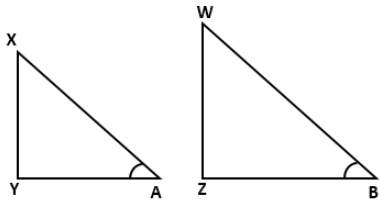
We have,
tan A = {tex}\frac { X Y } { A Y }{/tex} and tan B = {tex}\frac { WZ } { B Z }{/tex}
Since, tan A = tan B
{tex}\Rightarrow \frac { X Y } { A Y } = \frac { W Z } { B Z }{/tex}
{tex}\Rightarrow \frac { X Y } { W Z } = \frac { A Y } { B Z } = k{/tex}(say)......(i)
{tex}\Rightarrow X Y = k \times W Z \text { and } A Y = k \times B Z{/tex}.......(ii)
Using pythagoras theorem in triangles XAY and WBZ, we have
XA2 = XY2 + AY2 and WB2 = WZ2 + BZ2
{tex}\Rightarrow{/tex} XA2 = k2WZ2 + k2BZ2 and WB2 = WZ2 + BZ2
{tex}\Rightarrow{/tex} XA2 = k2(WZ2 + BZ2) and WB2 = WZ2 + BZ2
{tex}\Rightarrow\frac { X A ^ { 2 } } { W B ^ { 2 } } = \frac { k ^ { 2 } \left( W Z ^ { 2 } + B Z ^ { 2 } \right) } { \left( W Z ^ { 2 } + B Z ^ { 2 } \right) } = k ^ { 2 }{/tex}
{tex}\Rightarrow \frac { X A } { W B } = k{/tex}...........(iii)
From (i), (ii) and (iii), we get
{tex}\frac { X Y } { W Z } = \frac { A Y } { B Z } = \frac { X A } { W B }{/tex}
{tex}\Rightarrow \Delta A Y X \sim \Delta B Z W{/tex}
{tex}\Rightarrow \angle A = \angle B{/tex}
Posted by Nitte Prashanthi 6 years, 7 months ago
- 4 answers

myCBSEguide
Trusted by 1 Crore+ Students

Test Generator
Create papers online. It's FREE.

CUET Mock Tests
75,000+ questions to practice only on myCBSEguide app

Sia ? 6 years, 7 months ago
We have the following equation,
3x2 - 2kx + 27 = 0
a = 3, b = -2k and c = 27
{tex}\therefore{/tex} D = b2 - 4ac
= (-2k)2 - 4(3)(27)
= 4k2 - 324
Roots are real and equal if D = 0
{tex}\Rightarrow{/tex} 4k2 - 324 = 0
k2= {tex}\frac { 324 } { 4 }{/tex} = 81
{tex}\therefore k = \pm 9{/tex}
4Thank You