
Ask questions which are clear, concise and easy to understand.
Ask QuestionPosted by Siddhu Raj 6 years, 7 months ago
- 1 answers
Yogita Ingle 6 years, 7 months ago
Let the natural number be 'x'.
Therefore, according to the question.
x² - 84 = 3(x+8)
x² - 84 = 3x + 24
x² - 3x - 84 - 24 = 0
x² - 3x - 108 = 0
x² - 12x + 9x - 108 = 0
x(x - 12) + 9(x - 12) = 0
(x + 9) (x - 12)
⇒ x = -9 and x = 12
we have to take the positive value because natural numbers cannot be negative.
Therefore, the number is 12.
Posted by Sahil Kumar 6 years, 7 months ago
- 1 answers
Yogita Ingle 6 years, 7 months ago
Let positive integer a = 4m + r , By division algorithm we know here 0 ≤ r < 4 , So
When r = 0
a = 4m
Squaring both side , we get
a2 = ( 4m )2
a2 = 4 ( 4m2 )
a2 = 4 q , where q = 4m2
When r = 1
a = 4m + 1
squaring both side , we get
a2 = ( 4m + 1 )2
a2 = 16m2 + 1 + 8m
a2 = 4 ( 4m2 + 2m ) + 1
a2 = 4q + 1 , where q = 4m2 + 2m
When r = 2
a = 4m + 2
Squaring both hand side , we get
a2 = ( 4m + 2 )2
a2 = 16m2 + 4 + 16m
a2 = 4 ( 4m2 + 4m + 1 )
a2 = 4q , Where q = 4m2 + 4m + 1
When r = 3
a = 4m + 3
Squaring both hand side , we get
a2 = ( 4m + 3 )2
a2 = 16m2 + 9 + 24m
a2 = 16m2 + 24m + 8 + 1
a2 = 4 ( 4m2 + 6m + 2 ) + 1
a2 = 4q + 1 , where q = 4m2 + 6m + 2
Hence
Square of any positive integer is in form of 4q or 4q + 1 , where q is any integer . ( Hence proved )
Read more on Brainly.in - https://brainly.in/question/1143629#readmore
Posted by Harshita Panwar 6 years, 6 months ago
- 1 answers
Sia ? 6 years, 6 months ago
Let the speeds of walking of A and B be x km/hour and y km/hour respectively.
Time taken by a to walk a distance of 30 km {tex}{\text{ = }}\frac{{{\text{30}}}}{{\text{x}}}{\text{hours}}.....{\text{time = }}\frac{{{\text{distance}}}}{{{\text{speed}}}}{/tex}
Time taken by B to walk a distance of 30 km {tex}{\text{ = }}\frac{{{\text{30}}}}{{\text{y}}}{\text{hours}}.....{\text{time = }}\frac{{{\text{distance}}}}{{{\text{speed}}}}{/tex}
According to the question, {tex}\frac{{30}}{x} = \frac{{30}}{y} + 3 \Rightarrow \frac{{30}}{x} - \frac{{30}}{y} = 3{/tex}
{tex}\Rightarrow \frac{1}{x} - \frac{1}{y} = \frac{3}{{30}}{/tex} ....Dividing throughout by 30
{tex}\Rightarrow \frac{1}{x} - \frac{1}{y} = \frac{1}{{10}}{/tex} ....(1)
When A double his pace (speed), then speed of A = 2x km/hour.
Now,
Time taken by A to walk a distance of 30 km {tex} = \frac{{30}}{{2x}}.....time = \frac{{{\text{distance}}}}{{{\text{speed}}}}{/tex}
{tex}= \frac{{15}}{x}hours{/tex}
According to the question, {tex}\frac{{15}}{x} + 1\frac{1}{2} = \frac{{30}}{y}{/tex}
{tex}\Rightarrow \;\frac{{15}}{x} = \frac{{30}}{y} - \frac{3}{2} \Rightarrow \frac{{15}}{x} - \frac{{30}}{y} = - \frac{3}{2}{/tex}
{tex}\Rightarrow \frac{1}{x} - \frac{2}{y} = - \frac{1}{{10}}{/tex} ....(2) [Dividing throughout by 15]
Subtracting equation (2) from equation (1), we get {tex}\frac{1}{y} = \frac{1}{5} \Rightarrow{/tex} y = 5
Substituting y = 5 in equation (1), we get {tex}\frac{1}{x} - \frac{1}{5} = \frac{1}{{10}}{/tex}
{tex}\Rightarrow \;\frac{1}{x} = \frac{1}{5} + \frac{1}{{10}} \Rightarrow \frac{1}{x} = \frac{3}{{10}} \Rightarrow x = \frac{{10}}{3}{/tex}
So the solution of the equations (1) and (2) is {tex}x = \frac{{10}}{3}{/tex} and y = 5.
Hence, their speed of walking is {tex}\frac{{10}}{3}{/tex} km/hour and 5 km/hour respectively.
Verification. Substituting {tex}x = \frac{{10}}{3}{/tex} and y = 5,
We find that both the equations (1) and (2) are satisfied as shown below:
{tex}\frac{1}{x} - \frac{1}{y} = \frac{1}{{(10/3)}} - \frac{1}{5} = \frac{3}{{10}} - \frac{1}{5} = \frac{1}{{10}}{/tex}
{tex}\frac{1}{x} - \frac{2}{y} = \frac{1}{{10/3}} - \frac{2}{5} = \frac{3}{{10}} - \frac{2}{5} = - \frac{1}{{10}}{/tex}
This verifies the solution.
Posted by Chanchal Tanwer 6 years, 7 months ago
- 1 answers
Yogita Ingle 6 years, 7 months ago
P = 2n + 1 where n = 0, 1, 2, 3, 4, ...
=> p² = 4n² + 4n + 1
= 4(n² + n) + 1
= 4n(n+1) + 1
but n(n+1) is even because if n is odd, n+1 is even - otherwise n is even
therefore 4n(n+1) + 1 = 8m + 1 where m is an integer.
=> p² = 1
Posted by Rohan Singh 6 years, 7 months ago
- 1 answers
Ram Kushwah 6 years, 7 months ago
No , square of any positive integer of the form 3m + 1 is always in the form in the 3m + 1 ,
but it'snot in the form of - Either 3m or 3m + 2 because of the following solution :
⇒ a = bq + r
Let ''a'' be any positive integer and 'q be the quotient and let ''r'' be the remainder .
Therefore we get ,
a2 = ( 3 q + 1 )² { We square it , as according to the question }
a2 = 9 q² + 6 q² + 1² { (a + b )² = a² + b² + 2 a b }
a2 = 3 ( 3 q² + 2 q²) + 1
a2 = 3 q + 1 ( Where , q is 3 q + 1 )
So, we got that a2 is always in the form of 3 q + 1.
Posted by Swati Srivastava 6 years, 7 months ago
- 2 answers
Anbu Mani 5 years, 1 month ago
Ram Kushwah 6 years, 7 months ago
{tex}\begin{array}{l}\mathrm{let}\;\mathrm x=1.\overline{456}\\\mathrm{then}\;1000\mathrm x=1456.\overline{456}\\1000000=1456456.\overline{456}\\\mathrm{subtracting}\;\mathrm{we}\;\mathrm{get}\\999000\mathrm x=1455000\\\mathrm x=\frac{1455000}{999000}=\frac{1455}{999}=\frac{485}{333}\\\end{array}{/tex}
Hence the number is in p/q ,so it is a rational
Posted by Dipender Shekhawat 6 years, 7 months ago
- 1 answers
Ram Kushwah 6 years, 7 months ago
Let the coordinates of A(x1,y1),B(x2,y2),C(x3,y3)
Let the given points are at P(-1,2), Q(-6,5) and R(3,4)
So P is mid point of AB
so x1+x2/2=-1
x1+x2=-2----------------(1)
Similarly
x2+x3=-6*2=-12--------------(2)
and x3+x1=2*3=6-------------(3)
adding all three eqn we get
2*(x1+x2+x3)=-8
x1+x2+x3=-4
from (1)
x1+x2+x3-(x1+x2)=-4-(-2)=-2
x3=-2
From(2)
x1+x2+x3-(x2+x3)=-4-(-12)=8
x1=8
then x2=x1+x2+x3-(x1+x3)=-4-(8-2)=-4-6=-10
so x coordinates of A,B, C are 8,-10 and -2
similarly you can find y coordinates of A,B and C
Posted by Akash Dixit 6 years, 7 months ago
- 2 answers
Posted by Khushi Awatani 6 years, 7 months ago
- 0 answers
Posted by Tanya ?? Mishra 6 years, 7 months ago
- 1 answers
Ram Kushwah 6 years, 7 months ago
let the consecutive odd integers are x and x+2
then x2+(x+2)2=202
x2+x2+4x+4-202=0
2x2+4x-198=0
x2+2x-99=0
x2+11x-9x-99=0
x(x+11)-9(x+11)=0
(x+11)(x-9)=0
x=-11,9
So other no are -11+2 ad 9+2 or -9,11
So the numbers are
9,11 or -9,-11
Posted by Manish Sharma 6 years, 7 months ago
- 1 answers
Ajit Sharma 6 years, 7 months ago
The perimeter of the garden is=2 x ( 240 + 180) m
= 2 x 420 m=840 m
Therefore , To fence 1 round iron wire req= 840 m
To fence 3 round iron wire req= 3 x 840 m
=2520 m
Posted by Tamanna Choudhary 6 years, 7 months ago
- 1 answers
Ram Kushwah 6 years, 7 months ago
length=15 m 17 cm=1517 cm
breadth 9 m 2 cm=902 cm
Now 1517 =41*37
and 902=41*22
SO HCF(1517,902)=41
hence 41 can divide 1517 and 902 exactly
so Side of tile=41 cm
area=41*41=1681 cm2
So number of tiles
=1517*902/1681
=1368334/1681
=814 tiles
Posted by Priya Rani 6 years, 4 months ago
- 1 answers
Sia ? 6 years, 4 months ago
5 x - 4 y - 8 = 0
7 x + 6 y - 9 = 0
Here, a1= 5, b1 = -4, c1= 8
a2= 7, b2= 6, c2 = 9
We see that {tex}\frac { a _ { 1 } } { a _ { 2 } } \neq \frac { b _ { 1 } } { b _ { 2 } }{/tex}
Hence, the lines representing the given pair of linear equations intersect at the point and the equations are consistent having unique solution.
Posted by Pranav Mittal 6 years, 7 months ago
- 2 answers
Sia ? 6 years, 7 months ago
Then, it is implied that g(x) is a factor of the polynomial p(x).
Posted by Ms Future Doctor♥️♥️?? 6 years, 7 months ago
- 2 answers
Ms Future Doctor♥️♥️?? 6 years, 7 months ago
Posted by Gautam Chand 6 years, 7 months ago
- 2 answers
Sia ? 6 years, 7 months ago
{tex}2x + 3y = 6{/tex}
{tex}\Rightarrow y = \frac { 6 - 2 x } { 3 }{/tex}
| x | {tex}-3{/tex} | {tex}3{/tex} |
| y | {tex}4{/tex} | {tex}0{/tex} |
{tex}4x + 6y = 12{/tex}
{tex}\Rightarrow y = \frac { 12 - 4 x } { 6 }{/tex}
| x | -6 | 0 |
| y | 6 | 2 |
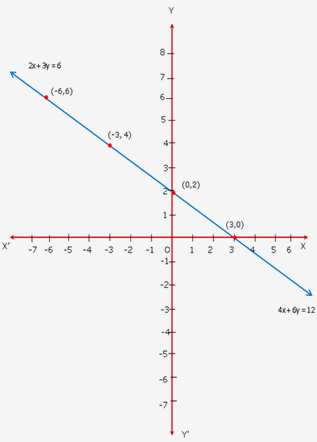
The graph of the system of equations are coincident lines.
{tex}\therefore{/tex} The system has infinitely many solutions.

Posted by Veena Patel 6 years, 7 months ago
- 1 answers
Sia ? 6 years, 7 months ago
Get RD Sharma Solutions of each chapter : <a href="https://mycbseguide.com/course/cbse-class-10-mathematics/1202/">https://mycbseguide.com/course/cbse-class-10-mathematics/1202/</a>
Posted by Vivek Sharma 6 years, 7 months ago
- 1 answers
Yogita Ingle 6 years, 7 months ago
324 = 252 x 1 + 72
252 = 72 x 3+ 36
72 = 36 x 2 + 0
HCF(324, 25) = 36
180 = 36 x 5 + 0
HCF (36, 180) = 36
:. HCF of 180, 252 and 324 is 36.
Posted by Shreya Ramteke 6 years, 7 months ago
- 2 answers
Tripti Rawat 6 years, 7 months ago
Given that, -4 is a zero of the polynomial f(x) = x2 - x - (2k + 2), so, we have
f(-4) = 0
{tex}\Rightarrow{/tex} (-4)2 - (-4) - 2k - 2 = 0
{tex}\Rightarrow{/tex} 16 + 4 - 2k - 2 = 0
{tex}\Rightarrow{/tex} 18 - 2k = 0
{tex}\Rightarrow{/tex} 2k = 18
{tex}\Rightarrow{/tex} k = 9.
Posted by Aaaaa Aaaaa 6 years, 7 months ago
- 1 answers
Sia ? 6 years, 7 months ago
Let the speed of the train be x km/hr and that of the car be y km/hr.
Case I Distance covered by train = 250 km.
Distance covered by car = (370 - 250) km = 120 km.
Time taken to cover 250 km by train = {tex}\frac { 250 } { x }{/tex} hours
Time taken to cover 120 km by car = {tex}\frac { 120 } { y }{/tex}hours
Total time taken =4 hours
{tex}\therefore \quad \frac { 250 } { x } + \frac { 120 } { y } = 4 \Rightarrow \frac { 125 } { x } + \frac { 60 } { y } = 2{/tex}.......(i)
Case II Distance covered by train = 130 km.
Distance covered by car = (370 -130) km = 240 km.
Time taken to cover 130 km by train = {tex}\frac { 130 } { x }{/tex} hours
Time taken to cover 240 km by car ={tex} \frac { 240 } { y }{/tex} hours
Total time taken = {tex}4 \frac { 18 } { 60 } \text { hours } = 4 \frac { 3 } { 10 } \text { hours } = \frac { 43 } { 10 }{/tex}hours
{tex}\therefore \quad \frac { 130 } { x } + \frac { 240 } { y } = \frac { 43 } { 10 } \Rightarrow \frac { 1300 } { x } + \frac { 2400 } { y } = 43{/tex}......(ii)
Putting {tex}\frac 1x{/tex}= u and {tex}\frac 1y{/tex}=v, equations (i) and (ii) become
{tex}125u + 60v = 2{/tex} ... (iii) and {tex}1300u + 2400v = 43{/tex}. ... (iv)
On multiplying (iii) by 40 and subtracting (iv) from the result, we get
5000u - 1300v = 80 - 43 {tex}\Rightarrow{/tex} 3700u = 37
{tex}\Rightarrow u = \frac { 37 } { 3700 } = \frac { 1 } { 100 } \Rightarrow \frac { 1 } { x } = \frac { 1 } { 100 } \Rightarrow x = 100{/tex}
Putting u = {tex}\frac{1}{100}{/tex} in (iv), we get
{tex}\left( 1300 \times \frac { 1 } { 100 } \right) + 2400 v = 43 \Rightarrow 2400 v = 43 - 13 = 30{/tex}
{tex}\Rightarrow v = \frac { 30 } { 2400 } = \frac { 1 } { 80 } \Rightarrow \frac { 1 } { y } = \frac { 1 } { 80 } \Rightarrow y = 80{/tex}
{tex}\therefore{/tex} x = 100 and y = 80.
Hence, the speed of the train is 100 km/hr and that of the car is 80 km/hr
Posted by Aaaaa Aaaaa 6 years, 7 months ago
- 1 answers
Sia ? 6 years, 7 months ago
It is given that angles of a cyclic quadrilateral ABCD are given by:
∠A = (4x + 20)°,
∠B = (3x - 5)°,
∠C = (4y)°
and ∠D = (7y + 5)°.
We know that the opposite angles of a cyclic quadrilateral are supplementary.
∠A + ∠C = 180°
4x + 20° + 4y = 180°
4x + 4y – 160° = 0 … (1)
And ∠B + ∠D = 180°
3x – 5 + 7y + 5 = 180°
3x + 7y - 180° = 0… (2)
By elimination method,
Step 1: Multiply equation (1) by 3 and equation (2) by 4 to make the coefficients of x equal.
Then, we get the equations as:
12x + 12y = 480 … (3)
12x + 16y = 540 … (4)
Step 2: Subtract equation (4) from equation (3),
(12x – 12x) + (16y - 12y) = 540 – 480
⇒ 4y = 60
y = 15
Step 3: Substitute value of y in (1),
4x + 4(15) – 160 = 0
⇒ x = 25
Hence, the angles of ABCD are
{tex}\angle{/tex}A = 120°, {tex}\angle{/tex}B = 70°,
{tex}\angle{/tex}C = 60° and {tex}\angle{/tex}D = 110°.
Posted by Shivang Pal 6 years, 7 months ago
- 1 answers
Sia ? 6 years, 7 months ago
Let p(x) = x3 + ax2 + bx + c
As -1 is one of the zeroes of p(x), p(-1) = 0
⇒ (-1)3 + a(-1)2 + b(-1) + c = 0
⇒ - 1 + a – b + c = 0
⇒ c = b –a + 1 …. (i)
Let {tex}\alpha{/tex}, β be two other zeroes of p(x),
then product of zeroes =-1× {tex}\alpha{/tex} × β ={tex}\;\;-\frac{\;\;Cons\tan t\;term\;}{coefficient\;of\;x^3}{/tex}
⇒ (-1) (α β) = {tex}\;\;-\frac{\;\;c}1{/tex}
⇒ - {tex}\alpha{/tex} β = - c
⇒ {tex}\alpha{/tex} β = c
⇒ {tex}\alpha{/tex} β = b –a + 1 [using (i)]
Hence, the product of other two zeroes of the given cubic polynomial is b – a + 1.
Posted by Aaaaa Aaaaa 6 years, 7 months ago
- 1 answers
Yogita Ingle 6 years, 7 months ago
Let the digits be x and y
Then the two-digit number is 10x + y
Given : y = 2x ----------1
Now 27 added to the no
10x + y + 27 = 10y + x
9y – 9x = 27
y – x = 3 -----------2
Substitute the value of y in eqn 2
2x – x = 3
x = 3
and y = 2 × 3 = 6
Therefore the no is 10x + y = 10 × 3 + 6 = 36
Answer : The two digit no is 36.

myCBSEguide
Trusted by 1 Crore+ Students

Test Generator
Create papers online. It's FREE.

CUET Mock Tests
75,000+ questions to practice only on myCBSEguide app

Jaivardhan Singh 6 years, 7 months ago
1Thank You