
Ask questions which are clear, concise and easy to understand.
Ask QuestionPosted by Rohan Raj Chaudhary 6 years, 7 months ago
- 1 answers
Rajan Kumar Pasi 6 years, 7 months ago
Here is the solutino of this question . I hope that you will understand this
<a href="https://www.teachoo.com/9007/2862/Question-30/category/CBSE-Class-10-Sample-Paper-for-2019-Boards/">https://www.teachoo.com/9007/2862/Question-30/category/CBSE-Class-10-Sample-Paper-for-2019-Boards/</a>
Posted by Sejal Kathait?????? 6 years, 7 months ago
- 6 answers
Yogita Ingle 6 years, 7 months ago
For a pair of given positive integers ‘a’ and ‘b’, there exist unique integers ‘q’ and ‘r’ such that
a=bq+r , where 0≤r<b
Explanaion: Thus, for any pair of two positive integers a and b; the relation
a=bq+r , where 0≤r<b
will be true where q is some integer.
Diya ? 6 years, 7 months ago
Posted by Reyan Bhuyan 6 years, 7 months ago
- 0 answers
Posted by Raunak ??? 6 years, 7 months ago
- 1 answers
Posted by Rishi Kumar 6 years, 7 months ago
- 0 answers
Posted by Dev Singh 6 years, 7 months ago
- 2 answers
Yogita Ingle 6 years, 7 months ago
420 = 272×1 + 148
272 = 148×1+124
148 = 124×1 + 24
124 = 24×5 + 4
24 = 4×6 + 0.
Therefore,4 is the HCF of 272 and 420.
Posted by Padarbibda Pradhan 6 years, 7 months ago
- 2 answers
Riya Rathore 6 years, 7 months ago
Natasha Sharma 6 years, 7 months ago
Posted by Ayushi Tiwari 6 years, 7 months ago
- 1 answers
Rajan Kumar Pasi 6 years, 7 months ago
{tex}\huge\implies \sqrt{\frac {49}{147}}\\ \huge\implies \sqrt\frac {7\times7}{21\times7}\\ \huge\implies \sqrt\frac {1}{3}\\\huge which\space is\space not\space a\space rational\space number. {/tex}
Posted by Janvi Bhatia 6 years, 7 months ago
- 1 answers
Sia ? 6 years, 7 months ago
We have,
{tex}\frac{{x + 1}}{{x - 1}} - \frac{{x - 1}}{{x + 1}} = \frac{5}{6}{/tex}
{tex}\Rightarrow{/tex} {tex}\frac{(x+1)^2-(x-1)^2}{(x-1)(x+1)}= \frac56{/tex}
{tex}\Rightarrow{/tex} (x2 + 1 + 2x) - (x2 + 1 - 2x) = {tex}\frac{5}{6}{/tex}(x2 - 12)
{tex}\Rightarrow{/tex} x2 + 1 + 2x - x2 - 1 + 2x = {tex}\frac{5}{6}{/tex}(x2 - 1)
{tex}\Rightarrow{/tex} 4x = {tex}\frac{5}{6}{/tex}(x2 - 1)
{tex}\Rightarrow{/tex} 24x = 5(x2 - 1)
{tex}\Rightarrow{/tex} 24x = 5x2 - 5
{tex}\Rightarrow{/tex} 5x2 - 24x - 5 = 0
{tex}\Rightarrow{/tex} 5x2 - 25x + 1x - 5 = 0
{tex}\Rightarrow{/tex} 5x(x - 5) + 1(x - 5) = 0
{tex}\Rightarrow{/tex} (x - 5)(5x + 1) = 0
{tex}\Rightarrow{/tex} x - 5 = 0 or 5x + 1 = 0
{tex}\Rightarrow{/tex} x = 5 or {tex}x = - \frac { 1 } { 5 }{/tex}
Posted by Het Patel 6 years, 7 months ago
- 1 answers
Rajan Kumar Pasi 6 years, 7 months ago
Very silly question.
Try to improve your imagination and thought process.
Solution: Let the cost of one pencil = Rs. {tex}\large x{/tex}
and Let the cost of one pen = Rs. {tex}\large y{/tex}
Now, the first sentence: The cost of pencil is half of the cost of pen {tex}\huge \implies x=\frac y2; \space \space \space\implies y=2x ; \space \space \space\implies 2x-y=0{/tex}
Now, the second sentence: If the cost of two pencils and one pen is Rs. 20 {tex}\huge \implies 2x+y=20{/tex}
Adding both the equations, we get: {tex}\huge \implies 4x=20 \space;\space\space \boxed {x=5} {/tex}
Putting the value of "x" in any of the two equation gives the value of "y", we get: {tex}\huge \implies y=2x \space;\space\space y=2\times5 \space;\space\space \boxed {y=10} {/tex}
Posted by Piyush Chaturvedi 6 years, 7 months ago
- 1 answers
Sia ? 6 years, 7 months ago
{tex}\alpha + \beta + \gamma + \delta = - \frac { b } { a }{/tex}
{tex}\alpha \beta + \alpha \gamma + \alpha \delta + \beta \gamma + \beta \delta + \gamma \delta = \frac { c } { a }{/tex}
{tex}\alpha \beta \gamma + \alpha \beta \delta + a \gamma \delta + \beta \gamma\delta = - \frac { d } { a }{/tex}
Posted by Debarshi Maity 6 years, 7 months ago
- 1 answers
Yogita Ingle 6 years, 7 months ago
If the number 4n, for any n, were to end with the digit zero, then it would be divisible by 5. That is, the prime factorisation of 4n would contain the prime 5. This is not possible because 4n = (2)2n; so the only prime in the factorisation of 4n is 2. So, the uniqueness of the Fundamental Theorem of Arithmetic guarantees that there are no other primes in the factorisation of 4n. So, there is no natural number n for which 4n ends with the digit zero.
You have already learnt how to find the HCF and LCM of two positive integers using the Fundamental Theorem of Arithmetic in earlier classes, without realising it! This method is also called the prime factorisation method. Let us recall this method through an example.
Posted by Himanshi Saini 6 years, 7 months ago
- 2 answers
Posted by Rajal Bhattad 6 years, 7 months ago
- 1 answers
Rajan Kumar Pasi 6 years, 7 months ago
Try to seek help from example 9 of chapter 2 page no.35
Posted by Himanshi Saini 6 years, 7 months ago
- 1 answers
Rajan Kumar Pasi 6 years, 7 months ago
Very poor you are, This question is same as of exercise 3.1
Posted by Ashish Sharma 6 years, 7 months ago
- 3 answers
Sia ? 6 years, 7 months ago
Polynomial is an expression of more than two algebraic terms, especially the sum of several terms that contain different powers of the same variable(s).
Ruplata Sahu 6 years, 7 months ago
Tanya ?? Mishra 6 years, 7 months ago
Posted by Nikhil Khilery 6 years, 7 months ago
- 2 answers
Sia ? 6 years, 7 months ago
Rational number between 0.25 and 0.32 is 0.28
Irrational number between 0.25 and 0.32 is 0.290290029000.........
Posted by Aastha Richhariya??.. 6 years, 7 months ago
- 8 answers
Raunak ??? 6 years, 7 months ago
Posted by Tejesh Saini 6 years, 7 months ago
- 1 answers
Posted by Sweety Verma 6 years, 7 months ago
- 1 answers
Diya ? 6 years, 7 months ago
Posted by Satyam Yadav 6 years, 7 months ago
- 2 answers
Gaurav Seth 6 years, 7 months ago
Let us assume that √3 is a rational number.
then, as we know a rational number should be in the form of p/q
where p and q are co- prime number.
So,
√3 = p/q { where p and q are co- prime}
√3q = p
Now, by squaring both the side
we get,
(√3q)² = p²
3q² = p² ........ ( i )
So,
if 3 is the factor of p²
then, 3 is also a factor of p ..... ( ii )
=> Let p = 3m { where m is any integer }
squaring both sides
p² = (3m)²
p² = 9m²
putting the value of p² in equation ( i )
3q² = p²
3q² = 9m²
q² = 3m²
So,
if 3 is factor of q²
then, 3 is also factor of q
Since
3 is factor of p & q both
So, our assumption that p & q are co- prime is wrong
Yogita Ingle 6 years, 7 months ago
Let us assume that √3 is a rational number
That is, we can find integers a and b (≠ 0) such that √3 = (a/b)
Suppose a and b have a common factor other than 1, then we can divide by the common factor, and assume that a and b are coprime.
√3b = a
⇒ 3b2=a2 (Squaring on both sides) → (1)
Therefore, a2 is divisible by 3
Hence a is also divisible by 3.
So, we can write a = 3c for some integer c.
Equation (1) becomes,
3b2 =(3c)2
⇒ 3b2 = 9c2
∴ b2 = 3c2
This means that b2 is divisible by 3, and so b is also divisible by 3.
Therefore, a and b have at least 3 as a common factor.
But this contradicts the fact that a and b are coprime.
This contradiction has arisen because of our incorrect assumption that √3 is rational.
So, we conclude that √3 is irrational.
Posted by Abhinav Anand 6 years, 7 months ago
- 1 answers
Posted by Rasmita Behera 6 years, 7 months ago
- 1 answers
Rajan Kumar Pasi 6 years, 7 months ago
Your visualization power is low.
In recasting process, the total volume of first solid shape is used to make another shape(s),
Thus, the volume of first solid = the volume of another solid(s).
Solution: For sphere: let the radius = r cm ; The volume = v cm3
For cone: let the radius = R cm ; The volume = V cm3
 |
The volume of the sphere (v)= {tex}\large\frac{4\pi r^3}{3}{/tex}{tex}\large\implies\frac{4\pi \times3^3}{3}{/tex}{tex}\large\implies{4\pi 3^2}{/tex}{tex}\large\implies{4\pi \times9}{/tex}{tex}\large\implies\boxed {36\pi}{/tex} |
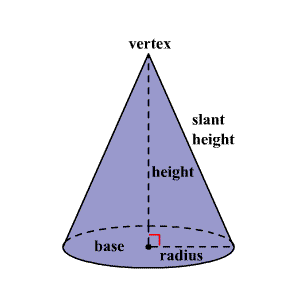 |
The volume of the cone (V)= {tex}\large\frac{\pi (R)^2h}{3}{/tex}{tex}\large\implies\frac{\pi \times R^2\times3}{3}{/tex}{tex}\large\implies\boxed{\pi\times R^2}{/tex} |
| Therefore, | {tex}\large\implies V=v\\ \large\implies {\pi\times R^2} = 36\pi\\(\pi \space of \space both \space sides\space are\space cancelled\space or \space divided)\\ \large\implies { R^2} = 36\space\space\space;\large\implies R=\sqrt{36}\\\large\implies R=6\space cm. {/tex} |
Posted by Jaimina Gharia 6 years, 7 months ago
- 0 answers
Posted by Anmol Randhawa 6 years, 7 months ago
- 1 answers
Purva Dhammi 6 years, 7 months ago
Distance formula= √ (x2 - x1)2 + ( y2 - y1)2
Distance = 10 units
√ (13-3)2 + (m-1)2 = 10
√ (10)2 + m2 + (1)2 - 2(m)(1) = 10
Squaring both sides
(10)2 + m2 + (1)2 - 2(m)(1) = (10)2
100 + m2 + 1 - 2m = 100
m2 -2m + 1 = 100 - 100
m2 -2m+1 = 0
m2 - 1m - 1m +1 =0
m (m -1) -1( m-1) =0
( m-1) (m-1) =0
m-1=0
Therefore, m= 1
Posted by Preeti Nigam 6 years, 7 months ago
- 0 answers
Posted by Dharmendar Yadav 6 years, 6 months ago
- 1 answers
Sia ? 6 years, 6 months ago
{tex}\sqrt { 180 } = \sqrt { 2 ^ { 2 } \times 3 ^ { 2 } \times 5 } = 6 \sqrt { 5 }{/tex}
On multiplying with {tex}\sqrt { 5 }{/tex} and 1, we get
{tex}6 \sqrt { 5 } \times \sqrt { 5 } \times 1 = 30{/tex}
{tex}\therefore{/tex} {tex}\sqrt 5{/tex} and 1 are two numbers which on multiplication with {tex}\sqrt{180} {/tex} gives a rational number.
One is irrational and other is rational.
Posted by Narj Go Eet Singh 6 years, 7 months ago
- 1 answers
Sia ? 6 years, 7 months ago
Let f(x)=3x2 + 4x +2k
If -2 is zero of f(x) then f(-2)=0 then f(-2)=0
{tex}\Rightarrow{/tex} 3 × (-2)² + 4 × -2 + 2k = 0
{tex}\Rightarrow{/tex} 12 - 8 + 2k = 0
{tex}\Rightarrow{/tex} 4 + 2k = 0
{tex}\Rightarrow{/tex} 2k = -4
{tex}\Rightarrow{/tex} k = {tex}\frac{{ - 4}}{2}{/tex}
{tex}\Rightarrow{/tex} k = -2

myCBSEguide
Trusted by 1 Crore+ Students

Test Generator
Create papers online. It's FREE.

CUET Mock Tests
75,000+ questions to practice only on myCBSEguide app

Sia ? 6 years, 7 months ago
p(x) = 3x2 + x - 2 = 0
= 3x2 + 3x - 2x - 2 = 0
= 3x(x + 1) - 2(x + 1) = 0
= (3x - 2)(x + 1) = 0
Hence, zeroes are -1 and {tex}\frac 23{/tex}
Verification:
Sum of zeroes = {tex}- 1 + \frac { 2 } { 3 } = \frac { - 1 } { 3 }{/tex}
Product of zeroes = {tex}( - 1 ) \times \left( \frac { 2 } { 3 } \right) = \frac { -2 } { 3 }{/tex}
Again sum of zeroes = {tex}- \frac { \text { Coeff. of } x } { \text { Coeff. of } x ^ { 2 } } = \frac { - 1 } { 3 }{/tex}
Product of zeroes = {tex}\frac { \text { Constant term } } { \text { Coeff. of } x ^ { 2 } }{/tex} = {tex}\frac{-2}{3}{/tex}
Verified.
0Thank You