
Ask questions which are clear, concise and easy to understand.
Ask QuestionPosted by Pranshu Sharma 6 years, 7 months ago
- 1 answers
Posted by Saurabh Sinha 6 years, 7 months ago
- 1 answers
Yogita Ingle 6 years, 7 months ago
Basic Proportionality Theorem was first stated by Thales, a Greek mathematician. Hence it is also known as Thales Theorem.
Basic Proportionality Theorem (can be abbreviated as BPT) states that, if a line is parallel to a side of a triangle which intersects the other sides into two distinct points, then the line divides those sides in proportion.
Posted by Mayank Yadav 6 years, 7 months ago
- 1 answers
Rajan Kumar Pasi 6 years, 7 months ago
I think you didn't learn properly the rules Graphical representation. It is given on page number 46.
and this question is of Example no.16
Don't you think it is a thing of shame, this shows that you are not learning properly.
Open your book , go to example no. 13 of chapter 3 page no.61. It is solved already there
Posted by A For All Type 6 years, 7 months ago
- 0 answers
Posted by Astha Tirkey 6 years, 7 months ago
- 0 answers
Posted by Astha Tirkey 6 years, 7 months ago
- 1 answers
Posted by Devansh Negi 6 years, 7 months ago
- 0 answers
Posted by Tanya ?? Mishra 6 years, 7 months ago
- 1 answers
Deepak Singh 6 years, 7 months ago
Posted by Ravi Damodaran 6 years, 7 months ago
- 0 answers
Posted by Anurag Kumar 6 years, 7 months ago
- 1 answers
Anjali Atmaja 6 years, 7 months ago
Posted by Raj Rai 6 years, 7 months ago
- 1 answers
Rajan Kumar Pasi 6 years, 7 months ago
What the hell, you are unable to solve the NCERT book questions, It is Q.5 of Exercise-7.2
Learn the examples properly to get the idea.
 |
Posted by Aashish Yadav 6 years, 7 months ago
- 0 answers
Posted by Puja Singh 6 years, 7 months ago
- 0 answers
Posted by Puja Singh 6 years, 7 months ago
- 0 answers
Posted by Roshan Rana 6 years, 7 months ago
- 1 answers
Tripti Rawat 6 years, 7 months ago
Posted by Roshan Rana 6 years, 7 months ago
- 1 answers
Tripti Rawat 6 years, 7 months ago
Posted by Durgesh Durgesh 6 years, 7 months ago
- 2 answers
Posted by Aayushi Umariya 6 years, 4 months ago
- 1 answers
Sia ? 6 years, 4 months ago
We have,
{tex} x = 30 ^ { \circ }{/tex}
{tex} \Rightarrow 2 x = 60 ^ { \circ }{/tex}
{tex}L.H.S=\;\tan2x=\tan60^\circ=\sqrt3{/tex}
and, {tex}R.H.S=\frac{2\tan x}{1-\tan^2x}{/tex}
{tex} = \frac { 2 \tan 30 ^ { \circ } } { 1 - \tan ^ { 2 } 30 ^ { \circ } }{/tex}
{tex} = \frac { 2 \times \frac { 1 } { \sqrt { 3 } } } { 1 - \left( \frac { 1 } { \sqrt { 3 } } \right) ^ { 2 } }{/tex}
{tex} = \frac { 2 / \sqrt { 3 } } { 1 - \frac { 1 } { 3 } }{/tex}
{tex} = \frac { 2 / \sqrt { 3 } } { 2 / 3 }{/tex}
{tex} = \frac { 2 } { \sqrt { 3 } } \times \frac { 3 } { 2 } = \sqrt { 3 }{/tex}
therefore, L.H.S = R.H.S
Posted by Hema Singh 6 years, 7 months ago
- 1 answers
Yogita Ingle 6 years, 7 months ago
(a +b) (a -b ) = (a)2 - (b)2
(√5+√3) (√5-√3) = (√5)2 - (√3)2
= 5 - 3
= 2
Posted by Rohit Roy 6 years, 7 months ago
- 1 answers
Gaurav Seth 6 years, 7 months ago
X2+x-12 =0
x2+ 4x-3x-12=0
x(x+4)-3(x+4)=0
(x-3) (x+4) =0
so x= 3
or. x=-4
p(x)÷g(x)= q(x) + r
p(x)÷g(x)= q(x) +0
x3 + ax2 + bx -84 ÷ x2+x-12
after dividing remainder will be ax2 - x2+bx+12x-84=0
let x=3
27a-9+3b+36-84=0
9a + 3b= 57
3(3a+b)=57
3a+b=19________eq 1
now let x= -4
ax2-x2+bx+12x-84=0
16a-16-4b-48-84=0
16a-4b=148
4(4a-b)=148
4a-b=37_________eq 2
add equation 1 and equation 2
so ,
3a + b +4a -b = 19+37
7a = 56
a= 8
put a=8 in equation 1
3a+b = 19
24 +b=19
or b=-5
Posted by Aju Meena 6 years, 7 months ago
- 0 answers
Posted by ?Miss. Cornetto.? 6 years, 7 months ago
- 2 answers
Posted by Prem Raj 6 years, 7 months ago
- 1 answers
Sia ? 6 years, 7 months ago
On a graph paper, draw a horizontal line XOX' and a vertical line YOY' as the x-axis and they-axis respectively.
{tex}3x + y - 11 = 0{/tex} {tex}\Rightarrow{/tex}{tex}y = (11 -3x){/tex}. ...(i)
Putting {tex}x = 2{/tex} in (i), we get {tex}y = 5{/tex}.
Putting {tex}x = 3{/tex} in (i), we get {tex}y = 2{/tex}.
Putting {tex}x = 5{/tex} in (i), we get {tex}y = -4{/tex}.
| x | 2 | 3 | 5 |
| y | 5 | 2 | -4 |
On the graph paper, plot the points {tex}A (2, 5), B(3, 2)\ and\ C(5, -4).{/tex}
Join AB and BC to get the graph line ABC.
Thus, the line ABC is the graph of the equation {tex}3x + y - 11 = 0{/tex}.
{tex}x - y - 1 = 0{/tex} {tex}\Rightarrow{/tex}{tex}y = (x - 1){/tex} . ...(ii)
Putting {tex}x = -3{/tex} in (ii), we get {tex}y = -4{/tex}.
Putting {tex}x = 0{/tex} in (ii), we get {tex}y = -1{/tex}.
Putting {tex}x = 3{/tex} in (ii), we get {tex}y = 2{/tex}.
| x | -3 | 0 | 3 |
| y | -4 | -1 | 2 |
On the same graph paper as above, plot the points {tex}P(-3, -4)\ and\ Q(0, -1){/tex}. The third point {tex}B(3,2){/tex} is already plotted.
Join PQ and QB to get the graph line PQB.
Thus, line PQB is the graph of the equation {tex}x - y - 1 = 0{/tex}.
The two graph lines intersect at the point {tex}B(3,2){/tex}. {tex}x = 3, y = 2{/tex} is the solution of the given system of equations.
The region bounded by these lines and the y-axis has been shaded.
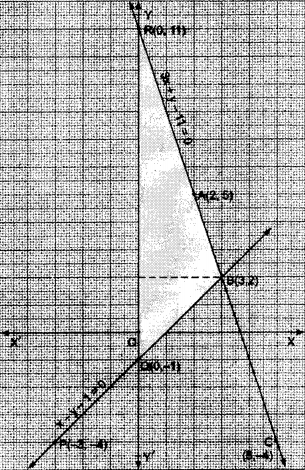
On extending the graph lines on both sides, we find that these graph lines intersect the y-axis at the points Q(0, -1) and R(0,11).
Area of triangle = {tex}\frac 12 \times 12 \times 3 = 18{/tex} sq units.
Posted by Akshat Chandak 6 years, 7 months ago
- 3 answers
Sourav Mahapatra 6 years, 7 months ago
Posted by Krishna Gupta 6 years, 7 months ago
- 1 answers
Sia ? 6 years, 7 months ago
p(x) = (k-1)x2 + kx + 1
Since, -3 is a zero of the polynomial.
p(-3) = (k - 1)(-3)2 + k(-3) + 1 = 0
9(k - 1) - 3k + 1 = 0
9k - 9 - 3k + 1 = 0
6k - 8 = 0
6k = 8
k = 8/6
k = 4/3
Posted by Ashlesha Shukla 6 years, 7 months ago
- 1 answers
Posted by Maya Dubey 6 years, 7 months ago
- 1 answers
Sia ? 6 years, 7 months ago
We know that HCF of two numbers is a divisor of their LCM. Here, 18 is not a divisor of 380.
But 380 = 18×21+2
Here 2 is remainder so 380 is not divisible by 18.
So, 18 and 380 cannot be respectively HCF and LCM of two numbers.
Posted by Satyam Yadav 6 years, 7 months ago
- 1 answers

myCBSEguide
Trusted by 1 Crore+ Students

Test Generator
Create papers online. It's FREE.

CUET Mock Tests
75,000+ questions to practice only on myCBSEguide app

Rajan Kumar Pasi 6 years, 7 months ago
Question is incomplete
0Thank You