
Ask questions which are clear, concise and easy to understand.
Ask QuestionPosted by Minu Haloi 6 years, 7 months ago
- 1 answers
Posted by Yash Gupta 6 years, 7 months ago
- 1 answers
Ram Kushwah 6 years, 7 months ago
{tex}\begin{array}{l}\sqrt2=2^{1/2}\\(\sqrt2)^2=(2^\frac12)^2\\=2^{\frac12\times2}\\=2^1\\=2\\Hence\;the\;root\;is\;removed\;\end{array}{/tex}
Posted by Devrajb Devrajb 6 years, 7 months ago
- 0 answers
Posted by Anjali Mahankal 6 years, 7 months ago
- 1 answers
Abcd Singh ?? 6 years, 7 months ago
Posted by Anil Kumar 6 years, 7 months ago
- 1 answers
Posted by Arjun Rathore 6 years, 7 months ago
- 2 answers
Ram Kushwah 6 years, 7 months ago
f(t)=t^2-4t+3
{tex}\begin{array}{l}\alpha+\beta=4,\alpha\beta=3\\\alpha^4\beta^3+\alpha^3\beta^4\\=\alpha^3\beta^3(\alpha+\beta)\\=(3)^3(4)\\=27\times4\\=108\\\end{array}{/tex}
Posted by Ullas .D.N 6 years, 7 months ago
- 1 answers
Rajan Kumar Pasi 6 years, 7 months ago
I think you didn't have a clear image of this question in your mind.
Lets see this,
| Year | Increment | Total |
| 1 | 0 | 5000 |
| 2 | 500 | 5500 |
| 3 | 0 | 5500 |
| 4 | 550 | 6050 |
| 5 | 0 | 6050 |
| 6 | 605 | 6655 |
| 7 | 0 | 6655 |
| 8 | 665.5 | 7320.5 |
| 9 | 0 | 7320.5 |
| 10 | 732.05 | 8052.55 |
We can see here that to be an AP the common difference "d" must be the same between each successive terms.
But here, 5500, 6050, 6655, 7320.5 are not making an AP which can be seen clearly.
Posted by Nikhil Gurjar 6 years, 7 months ago
- 0 answers
Posted by Nikhil Gurjar 6 years, 7 months ago
- 0 answers
Posted by Vaishnavi Taware 6 years, 7 months ago
- 0 answers
Posted by Abhishek Patel 6 years, 7 months ago
- 2 answers
Sia ? 6 years, 7 months ago
0.2 x + 0.3 y = 1.3 ; 0.4 x + 0.5 y = 2.3
The given system of linear equations is:
0.2 x + 0.3 y = 1.3..............(1)
0.4 x + 0.5 y = 2.3...................(2)
From equation (1),
0.3 y = 1.3 - 0.2 x
{tex}\Rightarrow \quad y = \frac { 1.3 - 0.2 x } { 0.3 }{/tex}.........................(3)
Substituting this value of y in equation(2), we get
{tex}0.4 x + 0.5 \left( \frac { 1.3 - 0.2 x } { 0.3 } \right) = 2.3{/tex}
{tex}\Rightarrow{/tex}0.12 x + 0.65 - 0.1 x = 0.69
{tex}\Rightarrow{/tex}0.12 x - 0.1 x = 0.69 - 0.65
{tex}\Rightarrow{/tex}0.02 x = 0.04
{tex}\Rightarrow{/tex}{tex}\mathrm { x } = \frac { 0.04 } { 0.02 } = 2{/tex}
Substituting this value of x in equation(3), we get
{tex}y = \frac { 1.3 - 0.2 ( 2 ) } { 0.3 } = \frac { 1.3 - 0.4 } { 0.3 } = \frac { 0.9 } { 0.3 } = 3{/tex}
Therefore, the solution is x = 2, y = 3, we find that both equation (1) and (2) are satisfied as shown below:
0.2 x + 0.3 y = ( 0.2 )( 2 )+( 0.3)( 3 ) = 0.4 + 0.9 = 1.3
0.4 x + 0.5 y= ( 0.4 )( 2 ) + ( 0.5 )( 3 ) } = 0.8 + 1.5 = 2.3
This verifies the solution.
Yogita Ingle 6 years, 7 months ago
0.2x+0.3y = 1.3 ....... (i)
eq (i) ×10
2x+3y=13
0.4x+0.5y=2.3 ...... (ii)
eq(ii) ×10
4x+5y=23
from eq (i)
x =13-3y/2
putting value of x in eq (ii)
4(13-3y/2)+5y=23
26-6y+5y=23
26-y=23
y= 3
putting value of y in eq (i)
2x+3(3)=13
2x=13-9
x=4/2
x=2
Posted by Dona Dona 6 years, 7 months ago
- 1 answers
Sia ? 6 years, 7 months ago
x2 - 6x + 12
Here, a = 1, b = -6 and c = 12
D = b2 - 4ac
D = (-6)2 - 4(1)(12)
D = 36 - 48
D = -12
Hence, D < 0
Therefore, there exists no real root of the equation.
Posted by Anuj Anuj Anuj Anuj 6 years, 7 months ago
- 1 answers
Posted by Vjlaxmi Saini 6 years, 7 months ago
- 4 answers
Posted by Satish Suryawanshi 6 years, 7 months ago
- 1 answers
????? ? 6 years, 7 months ago
Posted by Ritu Gitte 6 years, 7 months ago
- 1 answers
Ram Kushwah 6 years, 7 months ago
{tex}\begin{array}{l}\frac{7\sin\;\theta+\;5\cos\theta}{\;5\sin\theta\;+\;7\;\cos\;\theta}=\frac{7\sin\;\theta+7\sin\;\theta}{7\sin\;\theta+{\displaystyle\frac{\;7\times5}5}\cos\theta}\\=\frac{\displaystyle14\sin\;\theta}{7\sin\;\theta+{\displaystyle\frac75}\times7\sin\;\theta}=\frac{70\sin\;\theta}{7\sin\;\theta+49\sin\;\theta}\\=\frac{\displaystyle70\sin\;\theta}{\displaystyle56\sin\;\theta}=\frac{70}{56}=\frac54\end{array}{/tex}
Posted by Abhishek Gupta 6 years, 6 months ago
- 1 answers
Sia ? 6 years, 6 months ago
On a graph paper, draw a horizontal line XOX' and a vertical line YOY' as the x-axis and they-axis respectively.
{tex}3x + y - 11 = 0{/tex} {tex}\Rightarrow{/tex}{tex}y = (11 -3x){/tex}. ...(i)
Putting {tex}x = 2{/tex} in (i), we get {tex}y = 5{/tex}.
Putting {tex}x = 3{/tex} in (i), we get {tex}y = 2{/tex}.
Putting {tex}x = 5{/tex} in (i), we get {tex}y = -4{/tex}.
| x | 2 | 3 | 5 |
| y | 5 | 2 | -4 |
On the graph paper, plot the points {tex}A (2, 5), B(3, 2)\ and\ C(5, -4).{/tex}
Join AB and BC to get the graph line ABC.
Thus, the line ABC is the graph of the equation {tex}3x + y - 11 = 0{/tex}.
{tex}x - y - 1 = 0{/tex} {tex}\Rightarrow{/tex}{tex}y = (x - 1){/tex} . ...(ii)
Putting {tex}x = -3{/tex} in (ii), we get {tex}y = -4{/tex}.
Putting {tex}x = 0{/tex} in (ii), we get {tex}y = -1{/tex}.
Putting {tex}x = 3{/tex} in (ii), we get {tex}y = 2{/tex}.
| x | -3 | 0 | 3 |
| y | -4 | -1 | 2 |
On the same graph paper as above, plot the points {tex}P(-3, -4)\ and\ Q(0, -1){/tex}. The third point {tex}B(3,2){/tex} is already plotted.
Join PQ and QB to get the graph line PQB.
Thus, line PQB is the graph of the equation {tex}x - y - 1 = 0{/tex}.
The two graph lines intersect at the point {tex}B(3,2){/tex}. {tex}x = 3, y = 2{/tex} is the solution of the given system of equations.
The region bounded by these lines and the y-axis has been shaded.
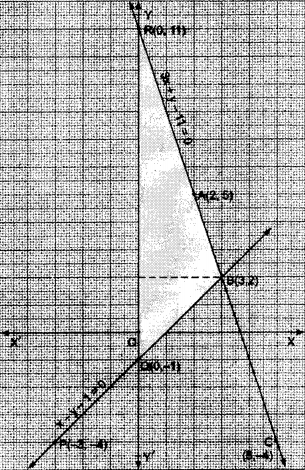
On extending the graph lines on both sides, we find that these graph lines intersect the y-axis at the points Q(0, -1) and R(0,11).
Posted by Ritika Pallai 6 years, 4 months ago
- 1 answers
Sia ? 6 years, 4 months ago
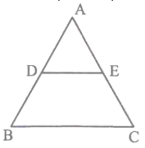
We know that, the ratio of the areas of two similar triangles is equal to the square of their corresponding sides.
Also,
{tex}\Delta ADE{/tex} {tex}\sim{/tex} {tex}\triangle{/tex}ABC [given]
Now AD = 1, DB = 2
{tex}\therefore{/tex} AB = AD + DB = 1 + 2 = 3
{tex}\therefore{/tex} {tex}\frac{\operatorname{ar}(\triangle A B C)}{\operatorname{ar}(\triangle A D E)}{/tex} = {tex}\frac{A B^{2}}{A D^{2}}{/tex} = {tex}\left(\frac{3}{1}\right)^{2}{/tex} = {tex}\frac{9}{1}{/tex}
Posted by Krrishiv Boopathi 6 years, 7 months ago
- 0 answers
Posted by Harshita Kanwar 6 years, 7 months ago
- 0 answers
Posted by Rahul Rahulkumarmahato 6 years, 7 months ago
- 2 answers
Sia ? 6 years, 7 months ago
Let the ten's and unit's digits of the required number be x and y respectively.
Then, the number = (10x + y).
The number obtained on reversing the digits = (10y + x).
As per given condition
The sum of a two-digit number and the number obtained by reversing the order of its digits is 99.
{tex}\therefore{/tex} (10y + x) + (10x + y) = 99
{tex}\Rightarrow{/tex} 11(x + y) = 99
{tex}\Rightarrow{/tex} x + y = 9.
The digits differ by 3
So, (x - y) = ±3.
Thus, we have
x + y = 9 ........ (i)
x - y = 3 .......... (ii)
or x + y = 9 ......... (iii)
x - y = -3 ............ (iv)
From (i) and (ii), we get x = 6, y = 3.
From (iii) and (iv), we get x = 3, y = 6.
Hence, the required number is 63 or 36.
Nitesh Kumar 6 years, 7 months ago
Posted by Harsh Jobanputra 6 years, 7 months ago
- 1 answers
Sia ? 6 years, 7 months ago
Get RD Sharma Solution here : <a href="https://mycbseguide.com/course/cbse-class-10-mathematics/1202/">https://mycbseguide.com/course/cbse-class-10-mathematics/1202/</a>
Posted by Mohit Malik Jaat 6 years, 7 months ago
- 1 answers
Mohit Malik Jaat 6 years, 7 months ago
Posted by Nikhel Dhiman 6 years, 7 months ago
- 1 answers
Sia ? 6 years, 7 months ago
Let the numerator and denominator of the fraction be x and y respectively.
Then,
Fraction= {tex} \frac { x } { y }{/tex}
It is given that
Denominator = 2 (Numerator) + 4
{tex}\Rightarrow{/tex} {tex}y = 2x + 4 {/tex}
{tex}\Rightarrow{/tex}{tex}2x - y + 4 =0{/tex}
According to the given condition, we have
{tex}y - 6 = 12(x - 6){/tex}
{tex}\Rightarrow{/tex} {tex}y - 6 =12x -72{/tex}
{tex}\Rightarrow{/tex} {tex}12x - y - 66 =0{/tex}
Thus, we have the following system of equations
2x - y + 4 =0 ............(i)
12x - y -66 =0 .............(ii)
Subtracting equation (i) from equation (ii), we get
10x - 70 =0 {tex}\Rightarrow{/tex} x = 7
Putting x = 7 in equation (i), we get
14 - y + 4 =0 {tex}\Rightarrow{/tex} y = 18
Hence, required fraction ={tex}\frac { 7 } { 18 }.{/tex}
Posted by Raghav Sharma 6 years, 7 months ago
- 0 answers
Posted by Aishwarya More 6 years, 7 months ago
- 2 answers
Nitesh Kumar 6 years, 7 months ago
Posted by Ayush Upadhyay 6 years, 7 months ago
- 1 answers
Sia ? 6 years, 7 months ago
Let the ten's and unit digit be y and x respectively.
So the number is 10y + x
The number when digits are reversed becomes 10x + y
So, 7(10x + y) = 4(10y + x)
or, 70x+ 7y= 40y + 4x
or, 70x - 4x = 40y - 7y
or 66x = 33y
{tex} \Rightarrow {/tex} 2x = y .....(i)
The difference of the digits is 3
y - x= 3
2x - x = 3
x = 3
x = 3 and y = 6
Hence the number is 63
Posted by Tamanna Choudhary 6 years, 7 months ago
- 1 answers
Sia ? 6 years, 7 months ago
We have equation
{tex}a + b p ^ { \frac { 1 } { 3 } } + c p ^ { \frac { 2 } { 3 } } = 0{/tex} ...(i)
Multiplying both sides by {tex}p ^ { \frac { 1 } { 3 } }{/tex}in eq(i), we get
{tex}a p ^ { \frac { 1 } { 3 } } + b p ^ { \frac { 2 } { 3 } } + c p = 0{/tex} ...(ii)
Multiplying (i) by b and (ii) by c, we get
{tex}ab+b^2p^\frac13+bcp^\frac23=0{/tex} .......(iii)
{tex}acp^\frac13+bcp^\frac23+c^2p=0{/tex} .......(iv).
subtracting equation (iv) from equation (iii) we get
{tex}ab+b^2p^\frac13+bcp^\frac23-acp^\frac13-bcp^\frac23-c^2p=0{/tex}
{tex}\Rightarrow\left(b^2p^\frac13-acp^\frac13\right)+\left(ab-c^2p\right)=0{/tex}
{tex}\Rightarrow \quad \left( b ^ { 2 } - a c \right) p ^ \frac{1}{3} + a b - c ^ { 2 } p = 0{/tex}
{tex}\Rightarrow \quad b ^ { 2 } - a c = 0 \text { and } a b - c ^ { 2 } p = 0 \quad \left[ \because p ^ { 1 / 3 } \text { is irrational } \right]{/tex}
{tex}\Rightarrow \quad b ^ { 2 } = a c \text { and } a b = c ^ { 2 } p{/tex}
{tex}\Rightarrow \quad b ^ { 2 } = a c \text { and } a ^ { 2 } b ^ { 2 } = c ^ { 4 } p ^ { 2 }{/tex}
{tex}\Rightarrow \quad a ^ { 2 } ( a c ) = c ^ { 4 } p ^ { 2 }{/tex} [Putting b2 = ac in a2b2 = c4p2]
{tex}\Rightarrow \quad a ^ { 3 } c - p ^ { 2 } c ^ { 4 } = 0{/tex}
{tex}\Rightarrow \quad \left( a ^ { 3 } - p ^ { 2 } c ^ { 3 } \right) c = 0{/tex}
{tex}\Rightarrow \quad a ^ { 3 } - p ^ { 2 } c ^ { 3 } = 0 , \text { or } c = 0{/tex}
Now, {tex}a ^ { 3 } - p ^ { 2 } c ^ { 3 } = 0{/tex}
{tex}\Rightarrow p^2=\left(\frac ab\right)^3{/tex}
cube root both side we get
{tex}\left(p^2\right)^\frac13=\frac{a}{b}{/tex}
{tex}\left(p^\frac13\right)^2=\frac{a}{b}{/tex}
this is not possible as {tex}p ^ { 1 / 3 }{/tex} is irrational and {tex}\frac { a } { b }{/tex} is rational.
{tex}\therefore \quad a ^ { 3 } - p ^ { 2 } c ^ { 3 } \neq 0{/tex}
Hence, c = 0
Putting c = 0 in b2 = ac = 0, we get b = 0
Putting b = 0 and c = 0 in equation (i) {tex}a + b p ^ { 1 / 3 } + c p ^ { 2 / 3 } = 0{/tex}
a + 0 +0 = 0, we get a = 0
Hence, a = b = c = 0.
Posted by Basantilata Mahanta 6 years, 7 months ago
- 1 answers
Sia ? 6 years, 7 months ago
By Euclid’s division lemma, we have
a = bq + r; 0 ≤ r < b
For a = n and b = 5, we have
n = 5q + r …(i)
Where q is an integer
and 0 ≤ r < 5, i.e. r = 0, 1, 2, 3, 4.
Putting r = 0 in (i), we get
n = 5q
⇒ n is divisible by 5.
n + 4 = 5q + 4
⇒ n + 4 is not divisible by 5.
n + 8 = 5q + 8
⇒ n + 8 is not divisible by 5.
n + 12 = 5q + 12
⇒ n + 12 is not divisible by 5.
n + 16 = 5q + 16
⇒ n + 16 is not divisible by 5.
Putting r = 1 in (i), we get
n = 5q + 1
⇒ n is not divisible by 5.
n + 4 = 5q + 5 = 5(q + 1)
⇒ n + 4 is divisible by 5.
n + 8 = 5q + 9
⇒ n + 8 is not divisible by 5.
n + 12 = 5q + 13
⇒ n + 12 is not divisible by 5.
n + 16 = 5q + 17
⇒ n + 16 is not divisible by 5.
Putting r = 2 in (i), we get
n = 5q + 2
⇒ n is not divisible by 5.
n + 4 = 5q + 9
⇒ n + 4 is not divisible by 5.
n + 8 = 5q + 10 = 5(q + 2)
⇒ n + 8 is divisible by 5.
n + 12 = 5q + 14
⇒ n + 12 is not divisible by 5.
n + 16 = 5q + 18
⇒ n + 16 is not divisible by 5.
Putting r = 3 in (i), we get
n = 5q + 3
⇒ n is not divisible by 5.
n + 4 = 5q + 7
⇒ n + 4 is not divisible by 5.
n + 8 = 5q + 11
⇒ n + 8 is not divisible by 5.
n + 12 = 5q + 15 = 5(q + 3)
⇒ n + 12 is divisible by 5.
n + 16 = 5q + 19
⇒ n + 16 is not divisible by 5.
Putting r = 4 in (i), we get
n = 5q + 4
⇒ n is not divisible by 5.
n + 4 = 5q + 8
⇒ n + 4 is not divisible by 5.
n + 8 = 5q + 12
⇒ n + 8 is not divisible by 5.
n + 12 = 5q + 16
⇒ n + 12 is not divisible by 5.
n + 16 = 5q + 20 = 5(q + 4)
⇒ n + 16 is divisible by 5.
Thus for each value of r such that 0 ≤ r < 5 only one out of n, n + 4, n + 8, n + 12 and n + 16 is divisible by 5.
Posted by Yash Pandit 6 years, 7 months ago
- 1 answers
Ram Kushwah 6 years, 7 months ago
{tex}\begin{array}{l}\alpha+\beta+\gamma=-\frac ba\\\alpha\beta\gamma=-\frac ca\\\alpha\beta+\beta\gamma+\gamma\alpha=\frac da\\\\\end{array}{/tex}

myCBSEguide
Trusted by 1 Crore+ Students

Test Generator
Create papers online. It's FREE.

CUET Mock Tests
75,000+ questions to practice only on myCBSEguide app

Aastha Aastha 6 years, 7 months ago
1Thank You