
Ask questions which are clear, concise and easy to understand.
Ask QuestionPosted by Trishala Gaikwad 6 years, 7 months ago
- 1 answers
Posted by Trishala Gaikwad 6 years, 7 months ago
- 1 answers
Ram Kushwah 6 years, 7 months ago
2x²-x-1=2x²-2x+x-1=2x(x-1)+(x-1)=(x-1)((2x+1)
and 4x²+8x+3.=4x²+6x+2x+3=2x(2x+3)+(2x+3)=(2x+3)(2x+1)
Here common factor=2x+1
hence HCF=2x+1
Posted by Trishala Gaikwad 6 years, 6 months ago
- 1 answers
Sia ? 6 years, 6 months ago
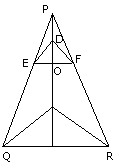
In {tex}\triangle {/tex}OQP,DE || OQ
{tex}\frac{{PE}}{{EQ}} = \frac{{PD}}{{DO}}{/tex} .....(i)
In {tex}\triangle {/tex}OPR,DF {tex} \bot {/tex} OR
{tex}\frac{{PD}}{{DO}} = \frac{{PF}}{{FR}}{/tex} .....(ii)
From (i) and (ii) , we get
{tex}\frac{{PE}}{{EQ}} = \frac{{PF}}{{FR}}{/tex}
{tex}\therefore {/tex} From {tex}\triangle {/tex}PQR
EF {tex} \bot {/tex} OR
Posted by Trishala Gaikwad 6 years, 7 months ago
- 1 answers
Ram Kushwah 6 years, 7 months ago
(2x-1) (x-3)=(x+5)
2x2-x-6x+3=x+5
2x2-8x-2=0
x2-4x-1=0
this is a quadratic equation
Posted by Trishala Gaikwad 6 years, 6 months ago
- 1 answers
Sia ? 6 years, 6 months ago
Given linear equation is
(3k + 1)x + 3 y - 2 = 0 .......... (i)
(k2 + 1)x + (k - 2)y - 5 = 0 ............ (ii)
Compare with a1x + b1y + c = 0 and a2x + b2y and c2 = 0
a1 = 3k + 1 , b1 = 3 , c1 = -2
and a2 = k2+ 1 , b2 = k - 2, c2 = -5
The given system of equations will have no solution, if
{tex} \frac { a_1 } { a_2 } = \frac { b_1 } { b_2} \neq \frac { c_1 } { c_2 }{/tex}
{tex} \frac { 3 k + 1 } { k ^ { 2 } + 1 } = \frac { 3 } { k - 2 } \neq \frac { - 2 } { - 5 }{/tex}
{tex}\Rightarrow \quad \frac { 3 k + 1 } { k ^ { 2 } + 1 } = \frac { 3 } { k - 2 } \text { and } \frac { 3 } { k - 2 } \neq \frac { 2 } { 5 }{/tex}
Now, {tex}\frac { 3 k + 1 } { k ^ { 2 } + 1 } = \frac { 3 } { k - 2 }{/tex}
{tex}\Rightarrow{/tex} (3k + 1)(k - 2)=3(k2 + 1)
{tex}\Rightarrow{/tex} 3k2 - 5k - 2 =3k2 + 3
{tex}\Rightarrow{/tex} -5k - 2 =3
{tex}\Rightarrow{/tex} -5k = 5
{tex}\Rightarrow{/tex} k = -1
Clearly, {tex}\frac { 3 } { k - 2 } \neq \frac { 2 } { 5 }{/tex} for k = -1.
Hence, the given system of equations will have no solution for k = -1.
Posted by Trishala Gaikwad 6 years, 6 months ago
- 1 answers
Sia ? 6 years, 6 months ago
Let the polynomial be ax2 + bx + c
and its zeroes be {tex}\alpha{/tex} and {tex}\beta{/tex}
Then, {tex}\alpha + \beta = \frac { 1 } { 4 } = - \frac { b } { a } \text { and } \alpha \beta = - 1 = \frac { c } { a }{/tex}
If a = 4, then b = -1 and c = -4
So, one quadratic polynomial which files
the given conditions is 4x2 - x - 4
Or
If {tex}\alpha{/tex} and {tex}\beta{/tex} zeroes of the polynomials then standard form quadratic polynomial is given by
{tex}x ^ { 2 } - ( \alpha + \beta ) x + \alpha \beta{/tex}
Let {tex}\alpha = \frac { 1 } { 4 } \text { and } \beta = - 1{/tex}
Now,
{tex}= x ^ { 2 } - ( \alpha + \beta ) x + \alpha \beta{/tex}
{tex}= x ^ { 2 } - \left( \frac { 1 } { 4 } \right) x + ( - 1 ){/tex}
{tex}= \frac { 1 } { 4 } \left( 4 x ^ { 2 } - x - 4 \right){/tex}
Required polynomial is 4x2 - x - 4
Posted by Trishala Gaikwad 6 years, 7 months ago
- 1 answers
Rajan Kumar Pasi 6 years, 7 months ago
Solution: Here is a sample diagram related to the given question.
Given : {tex}\huge \angle A=\angle Q \space ; \space \space \space \angle B=\angle R{/tex} Thus , {tex}\huge \angle C=\angle P {/tex}
Hence, {tex}\huge \triangle ABC\cong \triangle QRP {/tex}
Now, (i) is not possible and (ii), (iii), (iv) are possible conditions
Posted by Rohan Singh 6 years, 7 months ago
- 1 answers
Rajan Kumar Pasi 6 years, 7 months ago
Question: if {tex}\large \alpha \space and \space \beta{/tex} are the zeros of {tex}\large x^2 + 5 x + 5{/tex} then find the value of: (i) {tex}(\alpha -1)+(\beta -1){/tex},(ii) {tex}\large \frac {\alpha} {\beta} +\frac { \beta} { \alpha}{/tex}
Solution: Roots of the equation {tex}\huge x^2 + 5 x + 5 = {\frac {-5\pm \sqrt 5}{2}}{/tex}
Thus, {tex}\huge \alpha = {\frac {-5+ \sqrt 5}{2}} \space , \space \beta = {\frac {-5- \sqrt 5}{2}}{/tex}
Now, (i) {tex}\huge (\alpha -1)+(\beta -1) \space = \space (\alpha+\beta-2) \space = \space {\frac {-5+ \sqrt 5}{2}} + {\frac {-5- \sqrt 5}{2}} - 2{/tex}
{tex}\huge \implies {\frac {-5+ \sqrt 5 -5-\sqrt 5}{2}} - 2{/tex} {tex}\huge \implies {\frac {-10}{2}} - 2{/tex}
{tex}\huge \implies {\frac {-10-4}{2}} {/tex} {tex}\huge \implies {\frac {-14}{2}} {/tex} {tex}\huge \implies\boxed{ -7}{/tex}
Now, (i) {tex}\huge {\frac {\alpha}{\beta}}+{\frac {\beta} {\alpha}} \space = \frac{\alpha ^2 + \beta ^2}{\alpha \beta} {/tex}
{tex}\large \implies Since, (i)\space The \space sum \space of \space zeroes, \space \alpha+\beta=5 ,(-b/a)\space \space \space ;\space \space \space (ii)\space The \space product \space of \space zeroes, \space \alpha\beta = 5, \space \space (c/a){/tex}
| {tex}\large \implies (i) \space\alpha+\beta=5\\ (squaring\space both\space sides\space of\space the\space equation)\\ \implies \alpha^2+2\alpha\beta+\beta^2=25\\ \implies \alpha^2+\beta^2=25-2\alpha\beta\\ (But\space (ii)\space \alpha\beta=5)\\ \therefore\space \alpha^2+\beta^2=25-2\times 5\\ \implies \alpha^2+\beta^2=25-10 \\ \implies \boxed{\alpha^2+\beta^2= 15}{/tex} | {tex}\huge \implies\therefore \frac{\alpha^2+\beta^2}{\alpha\beta} \\ \huge \implies \frac{15}{5} \\ \huge \implies \boxed3{/tex} |
Posted by Tanu Anand 6 years, 7 months ago
- 1 answers
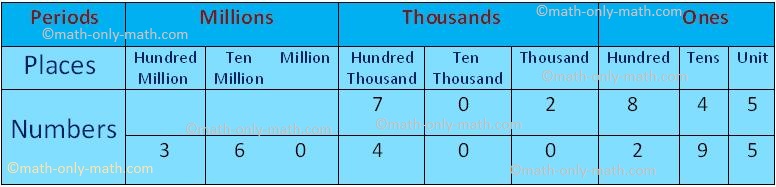
Posted by Vikassingh Sen 6 years, 7 months ago
- 0 answers
Posted by Sanjay Kushwaha 6 years, 7 months ago
- 1 answers
Ram Kushwah 6 years, 7 months ago
Let the first terms are a and b
then their difference 100th terms=
=(a+99d)-(b+99d)=100
a-b=100
now difference 1000th terms
=a+999d-(b+999d)
=a-b=100
Posted by Nishant Sehrawat 6 years, 7 months ago
- 1 answers
Posted by Trisha Jii 6 years, 7 months ago
- 1 answers
Yogita Ingle 6 years, 7 months ago
Given √2 is irrational number.
Let √2 = a / b wher a,b are integers b ≠ 0
we also suppose that a / b is written in the simplest form
Now √2 = a / b ⇒ 2 = a2 / b2 ⇒ 2b2 = a2
∴ 2b2 is divisible by 2
⇒ a2 is divisible by 2
⇒ a is divisible by 2
∴ let a = 2c
a2 = 4c2 ⇒ 2b2 = 4c2 ⇒ b2 = 2c2
∴ 2c2 is divisible by 2
∴ b2 is divisible by 2
∴ b is divisible by 2
∴a are b are divisible by 2 .
this contradicts our supposition that a/b is written in the simplest form
Hence our supposition is wrong
∴ √2 is irrational number.
Posted by Lalchand Bhati 6 years, 7 months ago
- 1 answers
Rajan Kumar Pasi 6 years, 7 months ago
This is Q.4 of Exercise 13.1, you have to understand the language of the question and solve it properly.
Its answer is 7cm for the greatest diameter and the Total Surface Area of the solid will be 332.5 cm2.
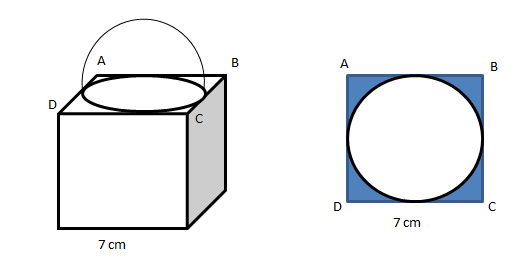
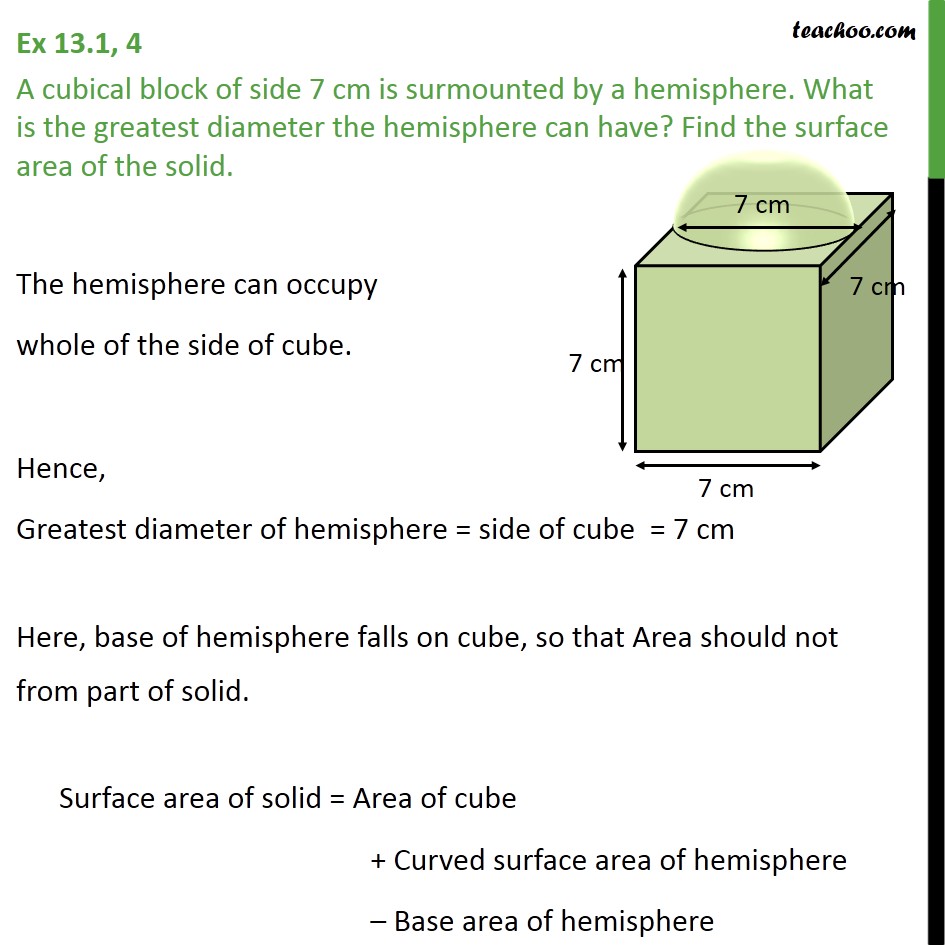
The base area of the hemisphere is subtracted because it is hidden and is not visible from outside so we cant cover it.
Posted by Abcd Singh ?? 6 years, 7 months ago
- 2 answers
Abcd Singh ?? 6 years, 7 months ago
Rajan Kumar Pasi 6 years, 7 months ago
Oh my god !! seems like you haven't practiced successive division. It is soo easy.
{tex}\huge 520 = 92\times5+50\\\space\space \huge
92= 50\times 1 + 42\\\space\space \huge
50=42\times1+8\\\space\space \huge
42=\space8\times5+2\\\space\space \space\space\huge
8= \space2\times4+0{/tex}
Here we ended up at 8, soo its divisor will be our HCF i.e. {tex}\large\boxed2{/tex}
Posted by Varsha Solanki 6 years, 7 months ago
- 1 answers
Posted by Prem Shah 6 years, 7 months ago
- 2 answers
Sia ? 6 years, 7 months ago
Prime factorization:
{tex}144 = 2 ^ { 4 } \times 3 ^ { 2 }{/tex}
{tex}198 = 2 \times 3 ^ { 2 } \times 11{/tex}
HCF = product of smallest power of each common prime factor in the numbers {tex}= 2 \times 3 ^ { 2 } = 18{/tex}
James Darwing 6 years, 7 months ago

Posted by Rakesh Kumar 6 years, 7 months ago
- 2 answers
Sia ? 6 years, 7 months ago
Suppose {tex}\sqrt [ 3 ] { 6 }{/tex} be rational number and {tex}\sqrt [ 3 ] { 6 } = \frac { a } { b }{/tex} where {tex}a\ and\ b{/tex} are co-prime and {tex}b\ne0{/tex}
{tex}\Rightarrow ( \sqrt [ 3 ] { 6 } ) ^ { 3 } = \frac { a ^ { 3 } } { b ^ { 3 } }{/tex}
{tex}\Rightarrow 6 = \frac { a ^ { 3 } } { b ^ { 3 } } {/tex}
{tex}\Rightarrow 6 . b ^ { 3 } = a ^ { 3 }{/tex}
{tex}\Rightarrow {/tex} {tex}a^3{/tex} is divisible by {tex}6{/tex} {tex}\Rightarrow{/tex} {tex}a{/tex} is divisible by {tex}6{/tex}.
Let {tex}a = 6c{/tex}
{tex}6b^3 = (6c)^3{/tex}
{tex}\Rightarrow \quad b ^ { 3 } = 36 c ^ { 3 }{/tex}
{tex}\Rightarrow {/tex} {tex}b^3{/tex} is divisible by {tex}6{/tex} {tex}\Rightarrow {/tex} {tex}b{/tex} is divisible by {tex}6{/tex}.
{tex}\Rightarrow {/tex} {tex}a\ and\ b{/tex} have a common factor i.e, {tex}6{/tex}
{tex}\Rightarrow {/tex} {tex}a\ and\ b{/tex} are not co-prime which is a contradiction
{tex}\therefore \sqrt [ 3 ] { 6 }{/tex} is an irratonal.
Posted by Asheesh Thakur 6 years, 7 months ago
- 3 answers
Posted by Sagar Jangra 6 years, 7 months ago
- 1 answers
Ram Kushwah 6 years, 7 months ago
f(x)=x2-3x-2
an b are zeros
so a+b=3,ab=-2
now if the zeros are 1/2a+b and 1/2b+a
{tex}\begin{array}{l}\frac1{2a+b}+\frac1{2b+a}=\frac{2a+b+2b+a}{(2a+b)(2b+a)}=\frac{3(a+b)}{(2a+b)(2b+a)}\\=\frac{3(3)}{4ab+ab+2a^2+2b^2}=\frac9{5\ast(-2)+2\lbrack\;(a+b)^2-2ab)}\\=\frac9{-10+2\ast(9-2(-2)\rbrack}=\frac9{-10+2\ast(9+4)}=\frac9{-10+26}=\frac9{16}\\\\\end{array}{/tex}
{tex}\begin{array}{l}Product\;of\;zeros=\frac1{2a+b}\times\frac1{2b+a}=\frac1{(2a+b)(2b+a)}=\frac1{(2a+b)(2b+a)}\\=\frac1{4ab+ab+2a^2+2b^2}=\frac1{5\ast(-2)+2\lbrack\;(a+b)^2-2ab)}\\=\frac1{-10+2\ast(9-2(-2)\rbrack}=\frac1{-10+2\ast(9+4)}=\frac1{-10+26}=\frac1{16}\\\\\end{array}{/tex}
hence the polynomial
=x2-(9/16)x+1/16
or 16x2-9x+1
Posted by Nagasaki Ali 6 years, 7 months ago
- 1 answers
Rajan Kumar Pasi 6 years, 7 months ago
Hahaha, oh my god!!!, don't you think this is too much, you are not studying properly
{tex}\large
p(x):x^3 -x^2+6x-5\\
putting, \space x=2\\
p(2):(2)^3-(2)^2+6\times2-5\\
p(2):8-4+12-5\\
p(2):\boxed {11}{/tex}
You just only have to replace '{tex}\large x
{/tex}' by the value given and perform the arithmetic operations.
Now, after seeing this, don't forget it.
And please write your qeustions properly while asking.
Posted by Vikas Paswan 6 years, 7 months ago
- 1 answers
Posted by Shreeji Tiwari 6 years, 7 months ago
- 1 answers
Sia ? 6 years, 7 months ago
Let {tex} \alpha{/tex} and {tex} \frac { 1 } { \alpha }{/tex} be the zeros of (a2 + 9)x2 + 13x + 6a.
Then, we have
{tex} \alpha \times \frac { 1 } { \alpha } = \frac { 6 a } { a ^ { 2 } + 9 }{/tex}
⇒ 1 = {tex} \frac { 6 a } { a ^ { 2 } + 9 }{/tex}
⇒ a2 + 9 = 6a
⇒ a2 - 6a + 9 = 0
⇒ a2 - 3a - 3a + 9 = 0
⇒ a(a - 3) - 3(a - 3) = 0
⇒ (a - 3) (a - 3) = 0
⇒ (a - 3)2 = 0
⇒ a - 3 = 0
⇒ a = 3
So, the value of a in given polynomial is 3.
Posted by Cbse Student 6 years, 7 months ago
- 0 answers
Posted by Minu Haloi 6 years, 7 months ago
- 1 answers

myCBSEguide
Trusted by 1 Crore+ Students

Test Generator
Create papers online. It's FREE.

CUET Mock Tests
75,000+ questions to practice only on myCBSEguide app

Tanya Shah 6 years, 7 months ago
1Thank You