
Ask questions which are clear, concise and easy to understand.
Ask QuestionPosted by Gargi Anmole 6 years, 5 months ago
- 0 answers
Posted by Neeti Gupta 6 years, 5 months ago
- 1 answers
Sia ? 6 years, 5 months ago
Since x + a is a factor of x2+ px + q
then (-a)2 - pa + q = 0
{tex}\Rightarrow{/tex}a2 = pa -q ..........(i)
also (x + a) is a factor of x2+ mx + n then we get
(-a )2 - am + n = 0
{tex}\Rightarrow{/tex} a2 - am + n= 0
{tex}\Rightarrow{/tex}a2 = am - n........(ii)
From eq(i) and (ii), we get
am - n = ap - q
{tex}\Rightarrow{/tex}am - ap = n - q
Hence, a = {tex}\left[ \frac { n - q } { m - p } \right]{/tex}
Posted by Ananya Mehta 6 years, 5 months ago
- 3 answers
Akanksha Kumari? 6 years, 5 months ago
Ayesha Jawed 6 years, 5 months ago
Posted by Davinder Kaur 6 years, 5 months ago
- 2 answers
Hari Haran 6 years, 5 months ago
Posted by Yashvardhan Dadhich 6 years, 5 months ago
- 0 answers
Posted by Shivangi Singh 6 years, 5 months ago
- 2 answers
Sana Kauser 6 years, 5 months ago
equation = ax² + bx + c = 0
It has equal roots .
So ,
D = 0
b² - 4ac = 0
b² = 4ac
=> 4 a c = b²
=> c = b² / 4a
So ,
the value of c = b² / 4a
Posted by Football _Champ07 6 years, 5 months ago
- 1 answers
Posted by Jasmeen Aulakh 6 years, 5 months ago
- 2 answers
Yashvardhan Dadhich 6 years, 5 months ago
Yashvardhan Dadhich 6 years, 5 months ago
Posted by Soni Singh 6 years, 5 months ago
- 1 answers
Posted by Harleen Kaur 6 years, 5 months ago
- 1 answers
Posted by Harsh Gandharav 6 years, 5 months ago
- 1 answers
Ram Kushwah 6 years, 5 months ago
17×5×11×3×2 + 2×11
=2×11 × ( 17×5×3 + 1)
=2×11 × ( 255+1)
=22 × 256
=22 ×16 ×16
The number is product of more than one number so the number is composite
Posted by Naman Pant 6 years, 5 months ago
- 0 answers
Posted by Noushiba Sidheeque 6 years, 5 months ago
- 0 answers
Posted by Akilesh Yogesh 6 years, 5 months ago
- 2 answers
Mehak Rani 6 years, 5 months ago
Tec Om 6 years, 5 months ago
Posted by Divakar Singh 6 years, 5 months ago
- 1 answers
Sia ? 6 years, 5 months ago
if -2 and -1 are zeros of f(x) = 2x4 + x3 - 14x2 - 19x - 6
x+2 and x+1 are factors of f(x)
So (x + 2)(x + 1) = x2 + x + 2x + 2 = x2 + 3x + 2 is a factor of f(x)
On long division of f(x) by x2 + 3x + 2 we get
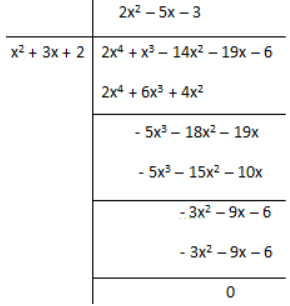
f(x) = 2x4 + x3 - 14x2 - 19x - 6 = (2x2 - 5x - 3)(x2 + 3x + 2)
= (2x + 1)(x - 3)(x + 2)(x + 1)
Therefore, zeroes of the polynomial = {tex}\frac{{ - 1}}{2}{/tex}, 3, -2, -1.
Posted by Apurba Gour 6 years, 5 months ago
- 2 answers
Ayesha Jawed 6 years, 5 months ago
Posted by Apurba Gour 6 years, 5 months ago
- 1 answers
Posted by Aadya Singh 6 years, 5 months ago
- 1 answers
Sia ? 6 years, 5 months ago
Suppose, speed of the train be x km/hr and the speed of taxi be y km/h.
time taken to cover 300 km by the train = {tex}\frac { 300 } { x }{/tex}hours
time taken to cover 200 km by the taxi = {tex}\frac { 200 } { y }{/tex} hours
Total time taken = {tex}5 \frac { 30 } { 60 } \text { hours } = 5 \frac { 1 } { 2 } \text { hours } = \frac { 11 } { 2 }{/tex} hours
{tex}\therefore \frac { 300 } { x } + \frac { 200 } { y } = \frac { 11 } { 2 }{/tex}
{tex}\Rightarrow \frac { 600 } { x } + \frac { 400 } { y } = 11{/tex}
Put {tex}\frac 1x{/tex} = u and {tex}\frac 1y{/tex} = v
{tex}\Rightarrow{/tex}{tex}600u + 400v = 11{/tex}..........(i)
time taken to cover {tex}260\ km{/tex} by the train = {tex}\frac { 260 } { x }{/tex}hours
time taken to cover {tex}240\ km{/tex} by the taxi = {tex}\frac { 240 } { y }{/tex} hours
Total time taken = {tex}5 \frac { 36 } { 60 } \text { hours } = 5 \frac { 1 } { 2 } \text { hours } = \frac { 11 } { 2 }{/tex}hours
{tex}\Rightarrow{/tex}{tex}1300u + 1200v = 28{/tex}..........(ii)
Multiplying (i) by 3 and subtracting (ii) from it,
{tex}\Rightarrow500 u = 5 \Rightarrow u = \frac { 5 } { 500 } \Rightarrow u = \frac { 1 } { 100 }{/tex}
Substituting u = {tex}\frac{1}{100}{/tex} in (i), {tex}\Rightarrow{/tex} v = {tex}\frac{1}{80}{/tex}
{tex}\therefore u = \frac { 1 } { 100 } \Rightarrow \frac { 1 } { x } = \frac { 1 } { 100 } \Rightarrow x = 100{/tex}
{tex}v = \frac { 1 } { 80 } \Rightarrow \frac { 1 } { y } = \frac { 1 } { 80 } \Rightarrow y = 80{/tex}
{tex}\therefore{/tex} the speed of the train = {tex}100\ km/hr{/tex}
the speed of the taxi = {tex}80\ km/hr{/tex}
Posted by Sharayu Pawale 6 years, 5 months ago
- 1 answers
Posted by Disha Jain 6 years, 5 months ago
- 2 answers
Akanksha Kumari? 6 years, 5 months ago
Posted by Afnan Afnu 6 years, 5 months ago
- 1 answers
Sia ? 6 years, 5 months ago
Let the present ages of Aftab and his daughter be x year and y year respectively. Then the algebraic representation is
Given by the following equations:
x - 7 = 7(y - 7)
{tex}\Rightarrow{/tex} x - 7y + 42 = 0 ...(1)
And x + 3 = 3(y + 3)
{tex}\Rightarrow{/tex} x - 3y - 6 = 0 ...(2)
To, represent this equation graphically, well find two solution for each equation, These solution are given below;
For Equation (1) x - 7y + 42 = 0
{tex}\Rightarrow{/tex} 7y = x + 42
{tex}\Rightarrow y = \frac{{x + 42}}{7}{/tex}
Table 1 of solutions
| x | 0 | 7 |
| y | 6 | 7 |
For Equation (2) x - 3y - 6 = 0
{tex}\Rightarrow{/tex} 3y = x - 6
{tex}\Rightarrow y = \frac{{x - 6}}{3}{/tex}
Table 2 of solutions
| x | 0 | 6 |
| y | -2 | 0 |
We plot the A(0, 6) and B(7, 7)
Corresponding to the solutions in table 1 on a graph paper to get the line AB representing the equation (1) and the points C(0, -2) and D(6, 0) corresponding to the solutions in table 2 on the same graph paper to get the line CD representing the equation (2), as shown in the figure

We observe in figure that the two lines representing the two equations are intersecting at the point P(42, 12).
Posted by Avani Jain 6 years, 5 months ago
- 2 answers
Posted by Sonu Thakur 6 years, 5 months ago
- 2 answers
Shivangi Singh 6 years, 5 months ago
Posted by Sonu Thakur 6 years, 5 months ago
- 0 answers
Posted by Aadya Singh 6 years, 5 months ago
- 1 answers
Gaurav Seth 6 years, 5 months ago
Question: Points A and B are 70 km apart on a highway , a car starts from point A and another car starts from point B simultaneously. If they travel in the same direction, they meet in 7 hrs, but if they travel towards each other, they meet in 1 hour.Find the speed of 2 cars ?
Solution;

Posted by Sonu Thakur 6 years, 5 months ago
- 3 answers
Sonu Thakur 6 years, 5 months ago
Sonu Thakur 6 years, 5 months ago
Gaurav Seth 6 years, 5 months ago
Question:
To draw the graph of a quadratic polynomial and observe
(i) the shape of the curve when the co-efficient of x square is positive and (ii) same when its negative
Solution:
1 ) Draw a quadratic equation when co-efficient of x2 is positive
Lets our quadratic equation is y = x2 ( Here co-efficient of x2 is +1 )
Step 1 - find several points for equation y = x2 As:
| x | y = x2 |
| -3 | 9 |
| -2 | 4 |
| -1 | 1 |
| 0 | 0 |
| 2 | 4 |
| 3 | 9 |
Step 2 - draw these points on graph and join them by smooth curving line As:

2 ) Draw a quadratic equation when co-efficient of x2 is negative.
Let our quardetic equation is As : y = -x2 ( Here co-efficient of x2 is -1 )
Step 1 - find several points for equation y = - x2 As:
| x | y = -x2 |
| -3 | - 9 |
| -2 | - 4 |
| - 1 | - 1 |
| 0 | 0 |
| 1 | 1 |
| 2 | 4 |
| 3 | 9 |
| 4 | 16 |
Step 2 - draw these points on graph and join them by smooth curving line As:
.jpg)
Posted by Vedant C Patel 6 years, 5 months ago
- 2 answers
Gaurav Seth 6 years, 5 months ago
Use the identity (a^3+b^3)= (a+b)(a^2+b^2-ab)
sin^3A + cos^3A÷(sinA +cos ). + sinA.cosA
(sinA+cosA)(sin^2+cos^2 -sinA.cosA)÷ (sinA + cosA)+ sinA.cosA
or( sinA^2+cosA^2 -sinA.cosA) +sinA.cosA
1-sinA.cosA+sinA.cosA
1
Posted by Navjot Kaur 6 years, 5 months ago
- 1 answers
Gaurav Seth 6 years, 5 months ago
We have given that
4th term of an A.P.= a4 = 0
∴ a + (4 – 1)d = 0
∴ a + 3d = 0
∴ a = –3d ….(1)
25th term of an A.P. = a25
= a + (25 – 1)d
= –3d + 24d ….[From the equation (1)]
= 21d
3 times 11th term of an A.P. = 3a11
= 3[a + (11 – 1)d]
= 3[a + 10d]
= 3[–3d + 10d]
= 3 × 7d
= 21d
∴ a25 = 3a11
i.e., the 25th term of the A.P. is three times its 11th term.
Posted by . . 6 years, 5 months ago
- 1 answers
Gaurav Seth 6 years, 5 months ago
(cos 0° + sin 45° + sin 30°)(sin 90° − cos 45° + cos 60°) …(i)
By trigonometric ratios we have
By substituting above values in (i), we get

myCBSEguide
Trusted by 1 Crore+ Students

Test Generator
Create papers online. It's FREE.

CUET Mock Tests
75,000+ questions to practice only on myCBSEguide app
