
Ask questions which are clear, concise and easy to understand.
Ask QuestionPosted by Wasim Khan 6 years, 5 months ago
- 1 answers
Posted by Sanjeet Kumar 6 years, 5 months ago
- 1 answers
Sia ? 6 years, 5 months ago
Check revision notes for the formulae : https://mycbseguide.com/cbse-revision-notes.html
Posted by Dikshita Shyam 6 years, 5 months ago
- 1 answers
Posted by Vanah Narula 6 years, 5 months ago
- 1 answers
Sia ? 6 years, 5 months ago
First find the HCF of 65 and 117 by Using Euclid's division algorithm,
117 = 65{tex}\times{/tex} 1 + 52
65 = 52{tex}\times{/tex} 1 + 13
52 = 13{tex}\times{/tex} 4 + 0
So, HCF of 117 and 65 = 13
HCF = {tex}65m + 117n{/tex}
For, {tex}m= 2{/tex} and {tex}n = -1{/tex},
HCF = 65{tex}\times{/tex} 2 + 117{tex}\times{/tex} (-1)
= 130 - 117
= 13
Hence, the integral values of m and n are 2 and -1 respectively and the HCF of 117 and 65 is 13.
Posted by Veer Jain 6 years, 5 months ago
- 1 answers
Sia ? 6 years, 5 months ago
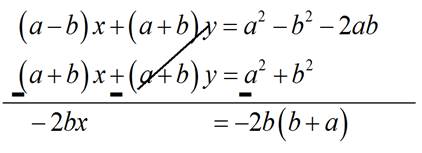
x = a + b
{tex}\therefore{/tex} (a - b)(a + b) + (a + b)y = a2 - b2 - 2ab
a2 - b2 + (a + b)y = a2 - b2 - 2ab
{tex}y = \frac{{ - 2ab}}{{a + b}}{/tex}
Posted by Karnal Meena 6 years, 5 months ago
- 1 answers
Posted by Apurba Gour 6 years, 5 months ago
- 1 answers
Akanksha Kumari? 6 years, 5 months ago
Posted by Yash Kumar 6 years, 5 months ago
- 0 answers
Posted by Dishal Patadiya 6 years, 5 months ago
- 1 answers
Akanksha Kumari? 6 years, 5 months ago
Posted by Ankul Maurya 6 years, 5 months ago
- 1 answers
Sia ? 6 years, 5 months ago
Posted by Shivangi Singh 6 years, 5 months ago
- 2 answers
Megha Singla 6 years, 5 months ago
Posted by Harsh Sedani 6 years, 5 months ago
- 1 answers
Akanksha Kumari? 6 years, 5 months ago
Posted by Nik Nikhil Thakur 6 years, 5 months ago
- 1 answers
Posted by Shaurya Suman 6 years, 5 months ago
- 2 answers
Posted by Aman Singh 6 years, 5 months ago
- 1 answers
Sia ? 6 years, 5 months ago
Here, a = 5
l = 45
S = 400
We know that
{tex}S = \frac{n}{2}(a + l){/tex}
{tex} \Rightarrow 400 = \frac{n}{2}(5 + 45){/tex}
{tex} \Rightarrow 400 = \frac{n}{2}(50){/tex}
{tex} \Rightarrow 400 - 25n{/tex}
{tex} \Rightarrow n = \frac{{400}}{{25}}{/tex}
{tex} \Rightarrow n = 16{/tex}
Hence, the number of terms is 16.
Again, we know that
l = a + (n - 1)d
{tex} \Rightarrow {/tex} 45 = 5 + (16 - 1)d
{tex} \Rightarrow {/tex} 45 = 5 + 15d
{tex} \Rightarrow {/tex} 40 = 15 d
{tex} \Rightarrow d = \frac{{40}}{{15}} = \frac{8}{3}{/tex}
Hence, the common difference is {tex}\frac{8}{3}{/tex}.
Posted by Ananya Agnihotri 6 years, 5 months ago
- 1 answers
Sia ? 6 years, 5 months ago
Let the two numbers are x and 8 - x.
According to question,
{tex}15\left( {\frac{1}{x} + \frac{1}{{8 - x}}} \right) = 8{/tex}
{tex} \Rightarrow 15\left( {\frac{{8 - x + x}}{{x(8 - x)}}} \right) = 8{/tex}
{tex} \Rightarrow {/tex} {tex}15 \times 8=8x(8-x){/tex}
{tex} \Rightarrow 15 = \frac{{8x}}{8}(8 - x){/tex}
{tex} \Rightarrow {/tex} 15 = x(8 - x)
{tex} \Rightarrow {/tex} 15 = 8x - x2
{tex} \Rightarrow {/tex} x2 - 8x + 15 = 0
Factorise the equation,
{tex} \Rightarrow {/tex} x2 - 5x - 3x + 15 = 0
{tex} \Rightarrow {/tex} x(x - 5) - 3(x - 5) = 0
{tex} \Rightarrow {/tex} (x - 5)(x - 3) = 0
{tex} \Rightarrow {/tex} x = 5 or x = 3
Hence, required numbers are 3 and 5.
Posted by Ayush Singh 6 years, 5 months ago
- 0 answers
Posted by Aman Kumar 6 years, 5 months ago
- 1 answers
Megha Singla 6 years, 5 months ago
Posted by Kush Rathee 6 years, 5 months ago
- 2 answers
Posted by Gurdyal Singh 6 years, 5 months ago
- 2 answers
Gaurav Seth 6 years, 5 months ago
Solution:
Plotting the above points and drawing lines joining them, we get the graphs of the equations x + 3y = 6 and 2x - 3y = 12
Rishu Kumar 6 years, 5 months ago
Posted by Ankit Kumar 6 years, 5 months ago
- 1 answers
Sia ? 6 years, 5 months ago
n3 - n = n (n2 - 1) = n (n - 1) (n + 1)
Whenever a number is divided by 3, the remainder obtained is either 0 or 1 or 2.
∴ n = 3p or 3p + 1 or 3p + 2, where p is some integer.
If n = 3p, then n is divisible by 3.
If n = 3p + 1, then n – 1 = 3p + 1 –1 = 3p is divisible by 3.
If n = 3p + 2, then n + 1 = 3p + 2 + 1 = 3p + 3 = 3(p + 1) is divisible by 3.
So, we can say that one of the numbers among n, n – 1 and n + 1 is always divisible by 3.
⇒ n (n – 1) (n + 1) is divisible by 3.
Similarly, whenever a number is divided by 2, the remainder obtained is 0 or 1.
∴ n = 2q or 2q + 1, where q is some integer.
If n = 2q, then n is divisible by 2.
If n = 2q + 1, then n – 1 = 2q + 1 – 1 = 2q is divisible by 2 and n + 1 = 2q + 1 + 1 = 2q + 2 = 2 (q + 1) is divisible by 2.
So, we can say that one of the numbers among n, n – 1 and n + 1 is always divisible by 2.
⇒ n (n – 1) (n + 1) is divisible by 2.
Since, n (n – 1) (n + 1) is divisible by 2 and 3.
∴ n (n-1) (n+1) = n3 - n is divisible by 6.( If a number is divisible by both 2 and 3 , then it is divisible by 6)
Posted by Ankit Kumar 6 years, 5 months ago
- 1 answers
Posted by Prashant Kalkhudiya 6 years, 5 months ago
- 1 answers
Sia ? 6 years, 5 months ago
Since {tex}\alpha , \beta{/tex} are the zeros of the polynomial f(x) = x2 - 5x + k.
Compare f(x) = x2 - 5x + k with ax2 + bx + c.
So, a = 1 , b = -5 and c = k
{tex}\alpha + \beta = - \frac { ( - 5 ) } { 1 }{/tex} = 5
{tex}\alpha \beta = \frac { k } { 1 } = k{/tex}
Given, {tex}\alpha - \beta{/tex} = 1
Now, {tex}( \alpha + \beta ) ^ { 2 } = ( \alpha - \beta ) ^ { 2 } + 4 \alpha \beta{/tex}
{tex}\Rightarrow{/tex} (5)2 = (1)2 + 4k
{tex}\Rightarrow{/tex} 25 = 1 + 4k
{tex}\Rightarrow{/tex} 4k = 24
{tex}\Rightarrow{/tex} k = 6
Hence the value of k is 6.
Posted by Naman Dhingra 6 years, 5 months ago
- 0 answers
Posted by Sujeet Kumar Sahani 6 years, 5 months ago
- 1 answers
Sia ? 6 years, 5 months ago
Let {tex}\sqrt 5{/tex} is a rational number.
{tex}\sqrt { 5 } = \frac { a } { b }{/tex}(a, b are co-primes and b{tex}\neq{/tex}0)
or, {tex}a = b \sqrt { 5 }{/tex}
On squaring both the sides, we get
a2=5b2 ---------------------------------(1)
Hence 5 is a factor of a2
so 5 is a factor of a
Let a = 5c, (c is some integer)
{tex}\therefore{/tex} a2 = 25c2
From equation(1) putting the value of a2
or, 5b2 = 25c2
or b2=5c2
so 5 is a factor of b2
or 5 is a factor of b
Hence 5 is a common factor of a and b
But this contradicts the fact that a and b are co-primes.
This is because we assumed that {tex}\sqrt 5{/tex} is rational
{tex}\therefore{/tex} {tex}\sqrt 5{/tex} is irrational.

myCBSEguide
Trusted by 1 Crore+ Students

Test Generator
Create papers online. It's FREE.

CUET Mock Tests
75,000+ questions to practice only on myCBSEguide app

Gaurav Seth 6 years, 5 months ago
Let the cost price of one chair be Rs. x and that of one table be Rs. y. Profit on chair = 25%.
∴ Selling price of one chair


Profit on a table = 10%
∴ Selling price of one table =
According to the given condition, we have
If profit on a chair is 10% and on a table is 25%, then total selling price is Rs. 1535.

Subtracting equation (ii) from equation (i), we get
3x - 3y = -300 ⇒ x - y = -100
Adding equation (ii) and (i), we get
47x + 47y = 61100 ⇒ x + y = 1300
Thus, we have following equations
x - y = -100 ...(iii)
x + y = 1300 ...(iv)
From (iii), we have
x - y = - i 00
⇒ x = y - 100 ...(v)
Substituting the value of x in (iv), we get
x + y = 1300
⇒ y - 100 + y - 1300
2y - 100 = 1300
⇒ 2y - 1400 ⇒ y = 700
Substituting the value of y in (v), we get
x = y - 100
⇒ x = 700 - 100 = 600
Hence, cost price of one chair = Rs. 600 and cost price of one table = Rs. 700
2Thank You