
Ask questions which are clear, concise and easy to understand.
Ask QuestionPosted by Shruti Khandelwal 6 years, 5 months ago
- 1 answers
Posted by Shivam Chhabra 6 years, 5 months ago
- 1 answers
Posted by Harsh Sooda 6 years, 5 months ago
- 1 answers
Sia ? 6 years, 5 months ago
Let the fraction be {tex}\frac{x}{y}{/tex}
According to the question, the fraction becomes {tex}\frac{1}{3}{/tex} when 2 is subtracted from the numerator.
{tex}\therefore{/tex} {tex}\frac{x-2}{y}{/tex} = {tex}\frac{1}{3}{/tex}
By cross multiplying, we get
{tex}\Rightarrow 3x -6 = y{/tex}...(i)
According to the question, the fraction becomes {tex}\frac{1}{2}{/tex} when 1 is subtracted from the denominator.
{tex}\therefore{/tex}{tex}\frac{x}{y-1}{/tex} = {tex}\frac{1}{2}{/tex}
By cross multiplying, we get
{tex}\Rightarrow 2x = y-1{/tex}....(ii)
Substituting (i) in (ii), we get
{tex} \Rightarrow 2x = 3x-6 -1 \\\Rightarrow x =7{/tex}
Substituting x in (i), we get
{tex}\Rightarrow 21-6 = y \\\Rightarrow y=15{/tex}
{tex}\therefore x = 7, y = 15{/tex}
{tex}\therefore{/tex} Required fraction if {tex}\frac{7}{15}.{/tex}
Posted by Ananya Agnihotri 6 years, 5 months ago
- 2 answers
Sia ? 6 years, 5 months ago
Let f(x)= x2 + 11x + k
If -3 is zero of f(x) then f(-3)=0
(-3)2 + 11{tex}\times{/tex}(-3) + k = 0
9 - 33 + k = 0
- 24 + k = 0
k = 24
Posted by Shivam Verma 6 years, 5 months ago
- 0 answers
Posted by Shivam Verma 6 years, 5 months ago
- 1 answers
Posted by Goswami Manavgiri 6 years, 5 months ago
- 10 answers
?? .. 6 years, 5 months ago
?? .. 6 years, 5 months ago
?? D ?? 6 years, 5 months ago
Posted by Priyanshu Chauhan 6 years, 5 months ago
- 1 answers
Sia ? 6 years, 5 months ago
Check last year papers here : https://mycbseguide.com/cbse-question-papers.html
Posted by Priyanshu Chauhan 6 years, 5 months ago
- 1 answers
Posted by Baby Sahoo 6 years, 5 months ago
- 2 answers
Sia ? 6 years, 5 months ago
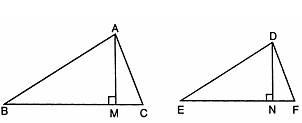
Given: {tex}\triangle {/tex} ABC {tex} \sim {/tex}{tex}\triangle {/tex}DEF
AM {tex} \bot {/tex} BC and DN {tex} \bot {/tex} EF
To prove:{tex}\frac{{area\vartriangle ABC}}{{area\vartriangle DEF}} = \frac{{A{M^2}}}{{D{N^2}}}{/tex}
proof::{tex}\frac{{area\vartriangle ABC}}{{area\vartriangle DEF}} = \frac{{A{B^2}}}{{D{E^2}}}{/tex}................[Area theorem]
In {tex}\triangle {/tex} ABM and DEN
{tex}\angle{/tex} ABM and {tex}\angle{/tex} DEN [ {tex}\triangle {/tex} ABC {tex} \sim {/tex} {tex}\triangle {/tex}DEF]
{tex}\angle{/tex}AMB = {tex}\angle{/tex}DNE [90o each]
{tex}\Rightarrow {/tex} {tex}\triangle {/tex}ABM {tex} \sim {/tex}{tex}\triangle {/tex}DEN [AA similarity]
{tex}\therefore {/tex} {tex}\frac{{AB}}{{DE}} = \frac{{AM}}{{DN}}{/tex}
{tex}\Rightarrow {/tex} {tex}\frac{{A{B^2}}}{{D{E^2}}} = \frac{{A{M^2}}}{{D{N^2}}}{/tex} .....(ii)
From (i) and (ii) we get
{tex}\frac{{area\vartriangle ABC}}{{area\vartriangle DEF}} = \frac{{A{M^2}}}{{D{N^2}}}{/tex}.
Posted by Deve Gowda T C 6 years, 5 months ago
- 2 answers
Sia ? 6 years, 5 months ago
Let the fraction be {tex}\frac{x}{y}{/tex}, Then, according to the question,
{tex}\frac{{x - 1}}{y} = \frac{1}{3}{/tex} ...(1)
{tex}\frac{x}{{y + 8}} = \frac{1}{4}{/tex} ...(2)
{tex}\Rightarrow{/tex} 3(x - 1) = y ...(3)
4x = y + 8 = ...(4)
{tex}\Rightarrow{/tex} 3x - y - 3 = 0 ...(5)
4x - y - 8 = 0 ...(6)
To solve the equation (5) and (6) by cross multiplication method
We draw the diagram below;
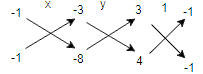
Then, {tex}\frac{x}{{( - 1)( - 8) - ( - 1)( - 3)}} = \frac{y}{{( - 3)(4) - ( - 8)(3)}}{/tex}{tex} = \frac{1}{{(3)( - 1) - (4)( - 1)}}{/tex}
{tex}\Rightarrow \frac{x}{{8 - 3}} = \frac{y}{{ - 12 + 24}} = \frac{1}{{ - 3 + 4}}{/tex}
{tex}\Rightarrow \frac{x}{5} = \frac{y}{{12}} = \frac{1}{1}{/tex}
{tex}\Rightarrow{/tex} x = 5 and y = 12
Hence, the required fraction is {tex}\frac{5}{{12}}{/tex}.
Verification :substituting x = 5, y = 12
We find that both the equations (1) and (2) are satisfied as shown below:
{tex}\frac{{x - 1}}{y} = \frac{{5 - 1}}{{12}} = \frac{4}{{12}} = \frac{1}{3}{/tex}
{tex}\frac{x}{{y + 8}} = \frac{5}{{12 + 8}} = \frac{5}{{20}} = \frac{1}{4}{/tex}
Hence, the solution we have got is correct.
Pavneet Kaur 6 years, 5 months ago
Posted by Kishan Prajapati 6 years, 5 months ago
- 3 answers
Posted by Yuvraj Mishra 6 years, 5 months ago
- 0 answers
Posted by Devna Baiju 6 years, 5 months ago
- 1 answers
Sia ? 6 years, 5 months ago
{tex}2x + 3y = 7{/tex}
{tex}(k - 1) x + (k + 2)y = 3k{/tex}
These are of the form
{tex}a_1x + b_1y + c_1 = 0 ,\ a_2x + b_2y + c_2 = 0{/tex}
where,
{tex}a_1= 2 ,\ b_1= 3,\ c_1 = -7,{/tex}
{tex}a_2=k - 1 \ ,b_2= k + 2 ,\ c_2 = -3k {/tex} for infinitely many solutions, we must have
{tex}\frac { a _ { 1 } } { a _ { 2 } } = \frac { b _ { 1 } } { b _ { 2 } } = \frac { c _ { 1 } } { c _ { 2 } }{/tex}
This hold only when
{tex}\frac { 2 } { k - 1 } = \frac { 3 } { k + 2 } = \frac { - 7 } { - 3 k }{/tex}
{tex}\frac { 2 } { k - 1 } = \frac { 3 } { k + 2 } = \frac { 7 } { 3 k }{/tex}
Now the following cases arises:
Case I:
{tex}\frac { 2 } { k - 1 } = \frac { 3 } { k + 2 }{/tex}
{tex}\Rightarrow{/tex}2(k + 2) = 3(k -1)
{tex}\Rightarrow{/tex}2k + 4= 3k - 3
{tex}\Rightarrow{/tex} k = 7
Case II:
{tex}\frac { 3 } { k + 2 } = \frac { 7 } { 3 k }{/tex}
{tex}\Rightarrow{/tex}7(k + 2) = 9k
{tex}\Rightarrow{/tex}7k + 14= 9k
{tex}\Rightarrow{/tex} k = 7
Case III:
{tex}\frac { 2 } { k - 1 } = \frac { 7 } { 3 k }{/tex}
{tex}\Rightarrow{/tex} 7k - 7 = 6k
{tex}\Rightarrow{/tex} k = 7
For k = 7, there are infinitely many solutions of the given system of equations.
Posted by Sarika Yadav 6 years, 5 months ago
- 3 answers
Posted by Avantika Yadav 6 years, 5 months ago
- 4 answers
Posted by Prakash Lohar 6 years, 5 months ago
- 8 answers
Rani Mishra ??? 6 years, 5 months ago
Posted by Manan Solanki 6 years, 5 months ago
- 0 answers
Posted by Pulluri Pranay 6 years, 5 months ago
- 3 answers
Posted by Maaira Khan 6 years, 5 months ago
- 2 answers
Posted by Harshitha G S 6 years, 5 months ago
- 0 answers
Posted by Kaif Aarzoo 6 years, 5 months ago
- 1 answers
Posted by Mohammed Daanish 6 years, 5 months ago
- 7 answers
Nikita Pokhariya 6 years, 5 months ago
Rani Jha 6 years, 5 months ago
Aryana Nayak 6 years, 5 months ago
Robbo Blb 6 years, 5 months ago
Posted by Md Abrarul Haque 6 years, 5 months ago
- 1 answers
Sia ? 6 years, 5 months ago
LHS = {tex}\frac{\tan A}{\sec A-1}+\frac{\tan A}{\sec A+1}{/tex}
{tex}=\frac{\tan A(\sec A+1)+\tan A(\sec A-1)}{(\sec A-1)(\sec A+1)}{/tex}
{tex}=\frac{\tan A \cdot \sec A+\tan A+\tan A \sec A-\tan A}{\sec ^{2} A-1}{/tex}
{tex}=\frac{2 \tan A \sec A}{\tan ^{2} A}{/tex} [{tex}\because{/tex} {tex}(sec^2\theta - 1) = tan^2\theta {/tex}]
{tex}=\frac{2 \sec A}{\tan A}{/tex}
{tex}=\frac{2 \frac{1}{\cos A}}{\frac{\sin A}{\cos A}}{/tex}
{tex}=2 \times \frac{1}{\cos A} \times \frac{\cos A}{\sin A}{/tex}
{tex}=\frac{2}{\sin \mathrm{A}}{/tex}
{tex}= 2 cosec\ A{/tex} = RHS
Posted by Kashish Varlani 6 years, 5 months ago
- 1 answers
Mugdha Kumari 6 years, 5 months ago
Posted by Shivani .... 6 years, 5 months ago
- 1 answers
Posted by Tashu Thapa 6 years, 5 months ago
- 1 answers
Posted by Nainu Choudhary 6 years, 5 months ago
- 1 answers

myCBSEguide
Trusted by 1 Crore+ Students

Test Generator
Create papers online. It's FREE.

CUET Mock Tests
75,000+ questions to practice only on myCBSEguide app

Mugdha Kumari 6 years, 5 months ago
0Thank You