
Ask questions which are clear, concise and easy to understand.
Ask QuestionPosted by Vijayraj Singh 6 years, 5 months ago
- 0 answers
Posted by Harpreet Singh 6 years, 5 months ago
- 0 answers
Posted by Arvind Goyal 6 years, 5 months ago
- 0 answers
Posted by Maya Verma 6 years, 5 months ago
- 1 answers
Posted by Risha Marwah 6 years, 5 months ago
- 1 answers
Posted by Akku Aashi 6 years, 5 months ago
- 2 answers
Sia ? 6 years, 5 months ago
Let {tex}\alpha,\mathrm\beta\;\mathrm{and}\;\mathrm\gamma{/tex} be the zeroes of the given polynomial.
Then, we have {tex}\alpha{/tex} = 3, {tex}\beta{/tex} = 5 and {tex}\gamma{/tex} = -2
Hence
{tex}\alpha + \beta + \gamma{/tex} = 3 + 5 - 2 = 6 ...............(1)
{tex}\alpha \beta + \beta \gamma + \gamma \alpha{/tex} = 3(5) + 5(-2) + (-2)3 = 15 - 10 - 6 = -1 ................(2)
{tex}\alpha \beta \gamma{/tex} = 3(5)(-2) = -30 .............(3)
Now, a cubic polynomial whose zeros are {tex}\alpha , \beta{/tex} and {tex}\mathrm\gamma{/tex} is equal to
p(x) = x3 - {tex}( \alpha + \beta + \gamma ) x ^ { 2 } + ( \alpha \beta + \beta y + \gamma \alpha ) x - \alpha \beta \gamma{/tex}
On substituting values from (1),(2) and (3) we get
{tex}\mathrm p(\mathrm x)=\mathrm x^3-(6)\mathrm x^2+(-1)\mathrm x-(-30){/tex}
= x3 - 6x2 - x + 30
Posted by Shivam Patidar 6 years, 5 months ago
- 1 answers
Mugdha Kumari 6 years, 5 months ago
Posted by Alfia Haidar 6 years, 5 months ago
- 0 answers
Posted by Shalaikanba Khomdram 6 years, 5 months ago
- 0 answers
Posted by Hemant Sabhani 6 years, 5 months ago
- 1 answers
Sia ? 6 years, 5 months ago
The given sequence is an A.P. in which first term a = 20 and common difference d = {tex}-\frac34{/tex}
Let the nth term of the given A.P. be negative then
Tn < 0
a+(n-1)d<0
20+(n-1)({tex}-\frac34{/tex})<0
On multiplication by 4 we get
80-3n+3<0
83-3n<0
83<3n
Or 3n>83
{tex}n > \frac{83}{3}{/tex}
n > 27.67
Hence 28th term will be first negative term
Posted by Abdul Samad 6 years, 5 months ago
- 1 answers
Sia ? 6 years, 5 months ago
Let A(1, 7), B(4, 2), C(-1, -1) and D(-4, 4) be the given points. One way of showing that ABCD is a square is to use the property that all its sides should be equal both its diagonals should also be equal. Now,
{tex}A B = \sqrt { ( 1 - 4 ) ^ { 2 } + ( 7 - 2 ) ^ { 2 } } = \sqrt { 9 + 25 } = \sqrt { 34 }{/tex}
{tex}B C = \sqrt { ( 4 + 1 ) ^ { 2 } + ( 2 + 1 ) ^ { 2 } } = \sqrt { 25 + 9 } = \sqrt { 34 }{/tex}
{tex}C D = \sqrt { ( - 1 + 4 ) ^ { 2 } + ( - 1 - 4 ) ^ { 2 } } = \sqrt { 9 + 25 } = \sqrt { 34 }{/tex}
{tex}D A = \sqrt { ( 1 + 4 ) ^ { 2 } + ( 7 - 4 ) ^ { 2 } } = \sqrt { 25 + 9 } = \sqrt { 34 }{/tex}
{tex}A C = \sqrt { ( 1 + 1 ) ^ { 2 } + ( 7 + 1 ) ^ { 2 } } = \sqrt { 4 + 64 } = \sqrt { 68 }{/tex}
{tex}B D = \sqrt { ( 4 + 4 ) ^ { 2 } + ( 2 - 4 ) ^ { 2 } } = \sqrt { 64 + 4 } = \sqrt { 68 }{/tex}
Since, AB = BC = CD = DA and AC = BD, all the four sides of the quadrilateral ABCD are equal and its diagonals AC and BD are also equal. Therefore, ABCD is a square.
Posted by Shivam Sharma 6 years, 5 months ago
- 1 answers
Sia ? 6 years, 5 months ago
We have,
sec 70° sin 20° + cos 20° cosec 70°
= sec (90° - 20°) sin 20° + cos 20° cosec (90° - 20°)
= cosec20° sin20° + cos20° sec20° [{tex}\because{/tex}Sec(90°-A)=CosecA & Cosec(90° - A) = SecA ]
{tex}= \frac { \sin 20 ^ { \circ } } { \sin 20 ^ { \circ } } + \frac { \cos 20 ^ { \circ } } { \cos 20 ^ { \circ } }{/tex}. [{tex}\because{/tex}Cosec A=(1/SinA) & SecA =(1/CosA) ]
= 1 + 1 = 2
Posted by Rohit Sharma 6 years, 5 months ago
- 6 answers
Posted by Pradeep Kumar Das 6 years, 5 months ago
- 0 answers
Posted by Neelam Gambhire 6 years, 5 months ago
- 0 answers
Posted by Abhishek Kumar Singh 6 years, 5 months ago
- 1 answers
Posted by A A 6 years, 5 months ago
- 1 answers
Sia ? 6 years, 5 months ago
Suppose, P and Q be the cars starting from A and B respectively and let their speeds be x km/hr and y km/hr respectively.
Case I:
When the cars P and Q move in the same direction.
Distance covered by the car P in 7 hours = 7x km
Distance covered by the car Q in 7 hours = 7y km
Let the cars meet at point M.

{tex}\therefore{/tex}{tex}AM = 7x\ km\ \ and\ \ BM = 7y\ km{/tex}
{tex}\therefore{/tex}{tex}AM - BM = AB{/tex}
{tex}\Rightarrow{/tex}{tex}7x - 7y = 70{/tex}
{tex}\Rightarrow{/tex}{tex}7(x - y) = 70{/tex}
{tex}\Rightarrow{/tex}{tex} x - y = 10{/tex}..........(i)
Case II:
When the cars P and Q move in the opposite directions.
Distance covered by the car P in 1 hour = x km
Distance covered by the car Q in 1 hour = y km
In this case, let the cars meet at the point N

{tex}\therefore{/tex} {tex}AN = x\ km\ \ and\ \ BN = y\ km{/tex}
{tex}\therefore{/tex} {tex}AN + BN = AB{/tex}
{tex}\Rightarrow{/tex}{tex}x + y = 70{/tex}........(ii)
Adding (i) and (ii), we get
{tex}2x = 80{/tex}
{tex}\Rightarrow{/tex}{tex}x = 40{/tex}
Putting {tex}x = 40{/tex} in (i), we get
{tex}40 - y = 10{/tex}
{tex}\Rightarrow{/tex} {tex}y =(40 - 10) = 30{/tex}
{tex}\therefore{/tex} {tex}x = 40, y = 30{/tex}
Speed of car starting from point A = {tex}40km/hr.{/tex}
Speed of car Starting from point B = {tex}30km/hr.{/tex}
Posted by Suchneet Kaur 6 years, 5 months ago
- 0 answers
Posted by Akhil Gujjar 6 years, 5 months ago
- 0 answers
Posted by Abhishek Rajput 6 years, 5 months ago
- 3 answers
Sia ? 6 years, 5 months ago
ax + by = a - b multiply by a
bx - ay = a + b multiply by b
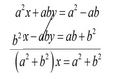
{tex}\Rightarrow{/tex} x = 1
{tex}\therefore{/tex} a + by = a - b
by = -b
y = -1
{tex}\therefore{/tex} x = 1
y = -1
Posted by No No 6 years, 5 months ago
- 0 answers
Posted by Ramveer Singh 6 years, 5 months ago
- 6 answers
Posted by Krishnveer Singh 6 years, 5 months ago
- 4 answers
Posted by Technical Raza 6 years, 5 months ago
- 0 answers
Posted by Deepak Mishra 6 years, 5 months ago
- 2 answers

myCBSEguide
Trusted by 1 Crore+ Students

Test Generator
Create papers online. It's FREE.

CUET Mock Tests
75,000+ questions to practice only on myCBSEguide app
