
Ask questions which are clear, concise and easy to understand.
Ask QuestionPosted by Anil Choudary 6 years, 5 months ago
- 1 answers
Posted by Sandeepa Yadav 6 years, 5 months ago
- 3 answers
Posted by Rajendra Rajendra P G 6 years, 5 months ago
- 2 answers
Sia ? 6 years, 5 months ago
x + y = 5 ...(1)
2x + 2y = 10 ...(2)
Here, a1 = 1, b1 = 1, c1 = -5
a2 = 2, b2 = 2, c2 = -10
We see that {tex}\frac{{{a_1}}}{{{a_2}}} = \frac{{{b_1}}}{{{b_2}}} = \frac{{{c_1}}}{{{c_2}}}{/tex}
Hence, the lines represented by the equations (1) and (2) are coincident.
Therefore, equations (1) and (2) have infinitely many common solutions, i.e., the given pair of linear equations is consistent.
Graphical Representation, we draw the graphs of the equations (1) and (2) by finding two solutions for each if the equations. These two solutions of the equations (1) and (2) are given below in table 1 and table 2 respectively.
For equation (1) x + y = 5 {tex}\Rightarrow{/tex} y = 5 - x
Table 1 of solutions
| x | 0 | 5 |
| y | 5 | 0 |
For equations (2) x + 2y = 10
{tex}\Rightarrow{/tex} 2y = 10 - 2x
{tex}\Rightarrow y = \frac{{10 - 2x}}{2} \Rightarrow{/tex} y = 5 - x
Table 2 of solutions
| x | 1 | 2 |
| y | 4 | 3 |
We plot the points A(0, 5) and B(5, 0) on a graph paper and join these points to form the line AB representing the equation (1) as shown in the figure, Also, we plot the points C(1, 4) and D (2, 3) on the same graph paper and join these points to form the line CD representing the equation (2) as shown in the same figure.
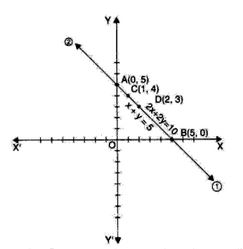
In the figure we observe that the two lines AB and CD coincide.
Posted by Jatin Pokhriyal 6 years, 5 months ago
- 1 answers
Mayank Sharma 6 years, 5 months ago
Posted by Ritesh Mishra 6 years, 5 months ago
- 0 answers
Posted by Mahavar Megha 6 years, 5 months ago
- 0 answers
Posted by Alexis Carter 6 years, 5 months ago
- 0 answers
Posted by Prachi Agarwal 6 years, 5 months ago
- 1 answers
Posted by Sudhanshu Verma 6 years, 5 months ago
- 3 answers
Mayank Sharma 6 years, 5 months ago
Posted by Pankaj Ganguly 6 years, 5 months ago
- 1 answers
Sia ? 6 years, 5 months ago
The given equations are
{tex}\frac { 1 } { 2 ( x + 2 y ) } + \frac { 5 } { 3 ( 3 x - 2 y ) } = - \frac { 3 } { 2 }{/tex}.....(1)
and {tex}\frac { 5 } { 4 ( x + 2 y ) } - \frac { 3 } { 5 ( 3 x - 2 y ) } = \frac { 61 } { 60 }{/tex}....(2)
Putting {tex}\frac 1{x+2y}{/tex}=u and {tex}\frac 1{3x-2y}{/tex}= v in equation (1) & equation (2) so that we may get two linear equations in the variables u & v as following:-
{tex}\frac { 1 } { 2 } u + \frac { 5 } { 3 } v = - \frac { 3 } { 2 }{/tex}.....................(1)
{tex}\frac { 5 } { 4 } u - \frac { 3 } { 5 } v = \frac { 61 } { 60 }{/tex}.................(2)
Multiplying (1) by 36 and (2) by 100, we get
{tex}{/tex}
{tex}{/tex}
{tex}18u + 60v = -54{/tex}...............(3)
{tex}125 u - 60 v = \frac { 305 } { 3 }{/tex}.............(4)
Adding (3) and (4),we get
{tex}143 u = \frac { 305 } { 3 } - 54 = \frac { 305 - 162 } { 2 } = \frac { 143 } { 3 }{/tex}
{tex}\therefore \quad u = \frac { 1 } { 3 } = \frac { 1 } { x + 2 y }{/tex}
{tex}\therefore{/tex}{tex} x + 2y = 3{/tex}...........(5)
Putting value of u in (3), we get
{tex}1 + 10v = -9{/tex} (after dividing by 3)
{tex}\therefore 10 \mathrm { v } = - 10{/tex} or {tex}\mathrm { v } = - 1 {/tex}
{tex}\Rightarrow - 1 = \frac { 1 } { 3 x - 2 y }{/tex}
{tex}\Rightarrow 3 x - 2 y = - 1{/tex}......(6)
Adding (5) and (6), we get
{tex}4 x = 2 \quad{/tex}
{tex} \therefore x = \frac { 1 } { 2 }{/tex}
Putting value of x in (5),
{tex}\frac { 1 } { 2 } + 2 y = 3{/tex}
{tex} \text { or } 2 y = 3 - \frac { 1 } { 2 } = \frac { 5 } { 2 }{/tex}
{tex}\therefore \quad y = \frac { 5 } { 4 }{/tex}
The required solution is {tex}\mathrm { x } = \frac { 1 } { 2 } , \mathrm { y } = \frac { 5 } { 4 }{/tex}
Posted by Account Deleted 6 years, 5 months ago
- 1 answers
Posted by Vidya Parsad 6 years, 5 months ago
- 0 answers
Posted by Aditi Khetan 6 years, 5 months ago
- 2 answers
Posted by Smitha Janani 6 years, 5 months ago
- 1 answers
Akash Lal 6 years, 5 months ago
Find LCM of 48,60&72
Which would be 720km.after covering 720km each they will meet,till then they all have covered two times the field
Posted by Dora Masa 6 years, 5 months ago
- 1 answers
Posted by Rushan Shaikh 6 years, 5 months ago
- 0 answers
Posted by Abhiraj Sewa 6 years, 5 months ago
- 1 answers
Posted by Monu Kumar 6 years, 5 months ago
- 1 answers
Pk . 6 years, 5 months ago
Posted by Yash Kumar 6 years, 5 months ago
- 1 answers
Posted by Pooja K. R 6 years, 5 months ago
- 6 answers
Mugdha Kumari 6 years, 5 months ago
Pk . 6 years, 5 months ago
Posted by Asha Misale 6 years, 5 months ago
- 1 answers
Posted by Shivam Yadav 6 years, 5 months ago
- 0 answers
Posted by Adada. Sanyasirao 6 years, 5 months ago
- 1 answers
Mugdha Kumari 6 years, 5 months ago
Posted by Sudha Rani 6 years, 5 months ago
- 2 answers
Shruti Jha 6 years, 5 months ago
Sia ? 6 years, 5 months ago
let us assume that {tex}\sqrt 3{/tex} be a rational number.
{tex}\sqrt { 3 } = \frac { a } { b }{/tex}, where a and b are integers and co-primes and b{tex} \neq{/tex}0
Squaring both sides, we have
{tex}\frac { a ^ { 2 } } { b ^ { 2 } } = 3{/tex}
or, {tex}a ^ { 2 } = 3 b ^ { 2 }{/tex}--------(i)
a2 is divisible by 3.
Hence a is divisible by 3..........(ii)
Let a = 3c ( where c is any integer)
squaring on both sides we get
(3c)2 = 3b2
9c2 = 3b2
b2 = 3c2
so b2 is divisible by 3
hence, b is divisible by 3..........(iii)
From equation(ii) and (iii), we have
3 is a factor of a and b which is contradicting the fact that a and b are co-primes.
Thus, our assumption that {tex}\sqrt 3{/tex} is rational number is wrong.
Hence, {tex}\sqrt 3{/tex} is an irrational number.
Posted by Arpit Sharma 6 years, 5 months ago
- 0 answers
Posted by Tina Dagar 6 years, 5 months ago
- 1 answers
Sia ? 6 years, 5 months ago
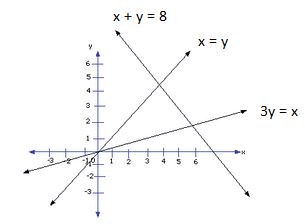
When y = x
|
x |
1 |
2 |
|
y |
1 |
2 |
When 3y = x,
|
x |
6 |
3 |
|
y |
2 |
1 |
when x + y = 8 or y = 8 - x
|
x |
4 |
5 |
|
y |
4 |
3 |
Posted by Jayesh Panwar 6 years, 5 months ago
- 2 answers
Jayesh Panwar 6 years, 5 months ago
Robbo Blb 6 years, 5 months ago

myCBSEguide
Trusted by 1 Crore+ Students

Test Generator
Create papers online. It's FREE.

CUET Mock Tests
75,000+ questions to practice only on myCBSEguide app

Sia ? 6 years, 5 months ago
The given equations are:

{tex}\frac{x}{a}{/tex} + {tex}\frac{y}{b}{/tex} {tex}=(a+b){/tex} {tex}\Rightarrow{/tex}{tex}bx + ay = ab(a + b){/tex}
{tex}\Rightarrow{/tex}{tex}bx + ay - ab(a + b) = 0{/tex} ....(i)
and {tex}\frac { x } { a ^ { 2 } } + \frac { y } { b ^ { 2 } } = 2{/tex} {tex}\Rightarrow{/tex} {tex}b^2x + a^2y = 2a^2b^2{/tex}
{tex}\Rightarrow{/tex}{tex} b^2x + a^2y -2a^2b^2 = 0{/tex}....(ii)
From eq. (i) and (ii), we get
{tex}\Rightarrow{/tex} {tex}\frac { x } { - 2 a ^ { 3 } b ^ { 2 } + a ^ { 3 } b ( a + b ) }{/tex} = {tex}\frac { - y } { - 2 a ^ { 2 } b ^ { 3 } + a b ^ { 3 } ( a + b ) }{/tex} = {tex}\frac { 1 } { a ^ { 2 } b - a b ^ { 2 } }{/tex}
{tex}\Rightarrow{/tex}{tex}\frac { x } { - a ^ { 3 } b ( 2 b - a - b ) }{/tex} = {tex}\frac { - y } { - a b ^ { 3 } ( 2 a - a - b ) }{/tex} = {tex}\frac { 1 } { a b ( a - b ) }{/tex}
{tex}\Rightarrow{/tex}{tex}\frac { x } { - a ^ { 3 } b ( b - a ) }{/tex} = {tex}\frac { y } { a b ^ { 3 } ( a - b ) }{/tex} = {tex}\frac { 1 } { a b ( a - b ) }{/tex}
{tex}\Rightarrow{/tex} {tex}x = \frac { a ^ { 3 } b ( a - b ) } { a b ( a - b ) }{/tex} = a2; {tex}y = \frac { a b ^ { 3 } ( a - b ) } { a b ( a - b ) } = b ^ { 2 }{/tex}
The solution is {tex}x = a^2, y = b^2{/tex} .
0Thank You