
Ask questions which are clear, concise and easy to understand.
Ask QuestionPosted by Sujit Waghmare 6 years, 5 months ago
- 3 answers
Sia ? 6 years, 5 months ago
Let a be any positive integer and b = 6
∴ by Euclid’s division lemma
a = bq + r, 0≤ r and q be any integer q ≥ 0
∴ a = 6q + r,
where, r = 0, 1, 2, 3, 4, 5
If a is even then then remainder by division of 6 is 0,2 or 4
Hence r=0,2,or 4
or A is of form 6q,6q+2,6q+4
As, a = 6q = 2(3q), or
a = 6q + 2 = 2(3q + 1), or
a = 6q + 4 = 2(3q + 2).
If these 3 cases a is an even integer.
but if the remainder is 1,3 or 5 then r=1,3 or 5
or A is of form 6q+1,,6q+3 or,6q+5
Case 1:a = 6q + 1 = 2(3q) + 1 = 2n + 1,
Case 2: a = 6q + 3 = 6q + 2 + 1,
= 2(3q + 1) + 1 = 2n + 1,
Case 3: a = 6q + 5 = 6q + 4 + 1
= 2(3q + 2) + 1 = 2n + 1
This shows that odd integer is of the form 6q + 1, or 6q + 3, or 6q + 5, where q is some integer.
Aviral Pal 6 years, 5 months ago
Posted by Lalchand Deshwal 6 years, 5 months ago
- 3 answers
Posted by Prince Bhaman 6 years, 5 months ago
- 0 answers
Posted by Sheik Imran 6 years, 5 months ago
- 1 answers
Posted by Sheik Imran 6 years, 5 months ago
- 1 answers
Posted by Dalvi Sir 6 years, 5 months ago
- 6 answers
Sejal Kathait?????? 6 years, 5 months ago
Yogita Ingle 6 years, 5 months ago
Let us assume that √5 is a rational number.
we know that the rational numbers are in the form of p/q form where p,q are integers.
so, √5 = p/q
p = √5q
we know that 'p' is a rational number. so √5 q must be rational since it equals to p
but it doesn't occurs with √5 since its not an integer
therefore, p = √5q
this contradicts the fact that √5 is an irrational number
hence our assumption is wrong and √5 is an irrational number.
Sejal Kathait?????? 6 years, 5 months ago
Rohit Sharma 6 years, 5 months ago
Posted by Pankaj Pant 6 years, 5 months ago
- 1 answers
Sia ? 6 years, 5 months ago
Let A → (6, –6), B → (3, –7) and C → (3, 3).
Let the centre of the circle be I(x, y)
Then, IA = IB = IC [By definition of a circle]
{tex}\Rightarrow{/tex} IA2 = IB2 = IC2
{tex}\Rightarrow{/tex} (x - 6)2 + (y + 6)2 = (x - 3)2 + (y + 7)2 = (x - 3)2 + (y - 3)2
Taking first two, we get
(x - 6)2 + (y + 6)2 = (x - 3)2 + (y + 7)2
{tex}\Rightarrow{/tex} x2 - 12x + 36 + y2 + 12y + 36 = x2 - 6x + 9 + y2 + 14y + 49
{tex}\Rightarrow{/tex} 6x + 2y = 14
{tex}\Rightarrow{/tex} 3x + y = 7 ......(1) ....[Dividing throughout by 2]
Taking last two, we get
(x - 3)2 + (y + 7)2 = (x - 3)2 + (y - 3)2
{tex}\Rightarrow{/tex} (y + 7)2 = (y - 3)2
{tex}\Rightarrow{/tex} (y + 7) = {tex}\pm{/tex}(y-3)
taking +e sign, we get
y + 7 = y - 3
{tex}\Rightarrow{/tex} 7 = -3
which is impossible
Taking -ve sign, we get
y + 7 = -(y - 3)
{tex}\Rightarrow{/tex} y + 7 = -y + 3
{tex}\Rightarrow{/tex} 2y = -4
{tex}\Rightarrow y = \frac{{ - 4}}{2} = - 2{/tex}
Putting y = -2 in equation (1), we get
{tex}\Rightarrow{/tex} 3x - 2 = 7
{tex}\Rightarrow{/tex} 3x = 9
{tex}\Rightarrow{/tex} x = 3
Thus, I {tex}\rightarrow{/tex} (3, -2)
Hence, the centre of the circle is (3, -2).
Posted by Viswa Teja Reddy 6 years, 5 months ago
- 0 answers
Posted by Manjul Mishra 6 years, 5 months ago
- 1 answers
Sia ? 6 years, 5 months ago
Given equations are
{tex}\frac{x}{2} + y = 0.8{/tex}
{tex}\frac{x + 2y}{2} = 0.8{/tex}.
x + 2y = 1.6 ........ (i)
and
{tex}\frac{7}{{x + \frac{y}{2}}} = 10{/tex}
{tex}\frac{{7 \times 2}}{{2x + y}} = 10{/tex}
{tex}\frac{{7}}{{2x + y}} = 5{/tex}
7 = 10x + 5y
10x + 5y = 7 .......... (ii)
Multiply first equation by 10
10x + 20y = 16............ (iii)
Subtracting the equations (ii) from (iii) , we get
15y = 9
{tex}y = \frac{9}{{15}} = \frac{3}{5}{/tex}
Put value of y in (i)
{tex}x = 1.6 - 2\left( {\frac{3}{5}} \right) = 1.6 - \frac{6}{5} = \frac{2}{5}{/tex}
Solution is {tex}\left( {\frac{2}{5},\;\frac{3}{5}} \right){/tex}
Posted by Simhachalam G 6 years, 5 months ago
- 2 answers
Posted by Subhash Kumar 6 years, 5 months ago
- 2 answers
Posted by Sumna Thakur 6 years, 5 months ago
- 1 answers
Posted by Jasmeen Aulakh 6 years, 5 months ago
- 1 answers
Sia ? 6 years, 5 months ago
Given equations are
mx - ny = m2 + n2 .................(i)
x + y = 2m ....................(ii)
Here
a1 = m, b1 = -n, c1 = -(m2 + n2)
a2 = 1, b2 = 1, c2 = -(2m)
By cross multiplication method
{tex}\frac{x}{{{{( 2mn + m^2 + n^2)} }}} = \frac{{ - y}}{{ - {2m^2} + m^2 + n^2 }} = \frac{1}{{m + n}}{/tex}
{tex}\frac{x}{{{{(m + n)}^2}}} = \frac{{ - y}}{{ - {m^2} + {n^2}}} = \frac{1}{{m + n}}{/tex}
Now, {tex}\frac{x}{{{{(m + n)}^2}}} = \frac{1}{{m + n}} {/tex}
{tex}⇒ x = m + n{/tex}
And, {tex}\frac{{ - y}}{{ - {m^2} + {n^2}}} = \frac{1}{{m + n}}{/tex}
{tex} ⇒ y = m - n{/tex}
The solutions of the given pair of equations are x = m + n and y = m - n.
Posted by Jasmeen Aulakh 6 years, 5 months ago
- 1 answers
Sia ? 6 years, 5 months ago
The given system of equation is {tex}4x - 3y + 4 = 0{/tex} and {tex}4x + 3y - 20 = 0{/tex}
Now, {tex}4x - 3y + 4 = 0{/tex}
{tex}x = \frac{{3y - 4}}{4}{/tex}
Solution table for {tex}4x - 3y + 4 = 0{/tex}
| x | 2 | -1 |
| y | 4 | 0 |
We have,
{tex}4x + 3y - 20 = 0{/tex}
{tex}x = \frac{{20 - 3y}}{4}{/tex}
Solution table for {tex}4x + 3y - 20 = 0{/tex}
| x | 5 | 2 |
| y | 0 | 4 |
Graph of the given system is:
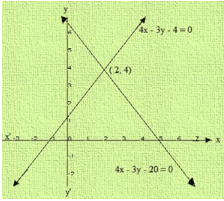
Clearly, the two lines intersect at A(2, 4)
We also observe that the lines meet x - axis B(-1, 0) and C(5, 0)
Thus x = 2 and y = 4 is the solution of the given system of equations.
AD is drawn perpendicular A on x - axis. Clearly we have,
AD = y - coordinate point A(2, 4)
AD = 3 and BC = 5 - (-1) = 4 + 1 = 6
Area of the shaded region = {tex}\frac{1}{2}{/tex} × base × altitude
{tex} = \frac{1}{2} \times 6 \times 4{/tex}
= 12 sq. units
Posted by Sunil Pundir 6 years, 5 months ago
- 1 answers
Sia ? 6 years, 5 months ago
Let us suppose that the ten's digit of required number be x and its unit digit be y respectively.
Therefore, required number = 10x + y
According to the given conditions
10x + y = 4(x + y) + 3
{tex} \Rightarrow{/tex} 10x + y = 4x + 4y + 3
or, 10x +y - 4x - 4y = 3
{tex} \Rightarrow{/tex} 6x - 3y = 3
{tex} \Rightarrow{/tex} 2x - y = 1...........(i)
and
10x + y + 18 = 10y + x
{tex}\Rightarrow{/tex}10x + y - 10y - x = - 18
{tex} \Rightarrow{/tex}9x - 9y = -18
{tex} \Rightarrow{/tex}9(x - y) = -18
{tex} \Rightarrow ( x - y ) = \frac { - 18 } { 9 }{/tex}
{tex} \Rightarrow{/tex}x - y = - 2 .........(ii)
Subtracting equation (ii) from equation (i), we get
x - y - ( 2x - y) = - 2 - 1
x - y - 2x +y = - 3
- x = -3
{tex} \therefore{/tex}x = 3
Put the value of x = 3 in equation (i), we get
2{tex} \times{/tex}3 - y = 1
{tex} \Rightarrow{/tex}y = 6 - 1 = 5
{tex} \therefore{/tex} x = 3, y = 5
Required number = 10x + y
= 10 {tex} \times{/tex}3 + 5
= 30 + 5
= 35
Therefore the required number is 35.
Posted by Vansh Jain 6 years, 5 months ago
- 1 answers
Posted by Akshit Kumar 6 years, 5 months ago
- 0 answers
Posted by Raghul Roshan 6 years, 5 months ago
- 1 answers
Posted by Nainu Choudhary 6 years, 5 months ago
- 1 answers
Sia ? 6 years, 5 months ago
Let a be the first term and d be the common difference of the given AP. Then,
Sn= {tex}\frac{n}{2}{/tex}{tex} \cdot {/tex}[2a+(n-l)d],
{tex}\therefore{/tex} {tex}3(S_8-S_4) = 3{/tex}[{tex}\frac{8}{2}{/tex}{tex}(2a+7d)-{/tex}{tex}\frac{4}{2}{/tex}{tex}(2a+3d)]{/tex}
= {tex}3[4(2a+7d)- 2(2a+3d)] = 6(2a+11d){/tex}
{tex}= \frac { 12 } { 2 } \cdot ( 2 a + 11 d ) = S _ { 12 }{/tex}.
Hence, S12= 3(S8-S4).
Posted by Prabha Karan 6 years, 5 months ago
- 1 answers
Posted by Mukul Raghav 6 years, 5 months ago
- 0 answers
Posted by Mukesh Nayak 6 years, 5 months ago
- 1 answers
Kumkumpandey123@Gmail. Com. Dgh 6 years, 5 months ago
Posted by Md Aarif 6 years, 5 months ago
- 2 answers
?? D ?? 6 years, 5 months ago
Posted by Ramesh Badarda 6 years, 5 months ago
- 1 answers
Posted by Neha Das 6 years, 5 months ago
- 0 answers

myCBSEguide
Trusted by 1 Crore+ Students

Test Generator
Create papers online. It's FREE.

CUET Mock Tests
75,000+ questions to practice only on myCBSEguide app

Sia ? 6 years, 5 months ago
For sphere Radius (r) = 4.2 cm
{tex}\therefore{/tex} Volume = {tex}\frac{4}{3}{/tex}{tex}\pi{/tex}r3
= {tex}\frac{4}{3}\pi{/tex}(4.2)3 cm3
For cylinder Radius (R) = 6 cm
Let the height of the cylinder be H cm.
Then, volume = {tex}\pi{/tex}R2H = {tex}\pi{/tex}(6)2H cm3
According the question,
Volume of the sphere = Volume of the cylinder
{tex}\Rightarrow{/tex} {tex}\frac{4}{3} \pi(4.2)^{3}=\pi(6)^{2} \mathrm{H} \Rightarrow \mathrm{H}=\frac{4(4.2)^{3}}{3(6)^{2}} \Rightarrow 2.74{/tex}
Hence, the height of the cylinder is 2.74 cm.
0Thank You