
Ask questions which are clear, concise and easy to understand.
Ask QuestionPosted by Anusha_Devisetty Cherry 6 years, 5 months ago
- 2 answers
Shubham Pandey 6 years, 5 months ago
Sia ? 6 years, 5 months ago
If a number ends with zero then it is divisible by 5.
For unit’s digit to be 0, then 4n should have 2 and 5 as its prime factors, but 4n = (22)n = 22n.
As n {tex}\in{/tex} N we take n=1,2,3,4...etc
So above becomes 41,42 ...etc
As it does not contain 5 as one of its prime factors.
Therefore, 4n will not end with digit 0 for n {tex}\in{/tex} N.
Posted by Brajlal Meena 6 years, 5 months ago
- 1 answers
Posted by Nm ???? 6 years, 5 months ago
- 4 answers
Nm ???? 6 years, 5 months ago
Suba Natarajan 6 years, 5 months ago
Posted by Somnath Chakrabarti 6 years, 5 months ago
- 1 answers
Sia ? 6 years, 5 months ago
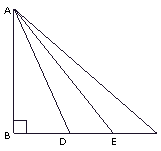
Let third side = x cm
Then by Pythagoras theorem,
p2 = q2 + x2
x2 = p2 - q2
= (p + q) ( p - q)
= (p + q) {tex} \times{/tex} 1 ( {tex}\because {/tex} p - q = 1)
= q + 1 + q
= 2q + 1
{tex}\therefore {/tex} x ={tex}\sqrt {2q + 1} {/tex}
Posted by Somnath Chakrabarti 6 years, 5 months ago
- 1 answers
Yogita Ingle 6 years, 5 months ago
Let ABCD be the rhombus where AC = 10 cm and BD = 24 cm.

Let AC and BD intersect each other at O.
Now, diagonals of rhombus bisect each other at right angles.
Thus, we have
AO = 1/2 AC = 1/2 (10) = 5 cm and
BO = 1/2 BD = 1/2 (24) = 12 cm
Since AOB is a right angled triangle, by Pythagoras theorem, we have
AB2 = AO2 + BO2
AB2 = 52 + 122 = 25 + 144 = 169
Hence, AB = 13
Thus, length of each side of rhombus is 13 cm.
Posted by Mind Devloper 6 years, 5 months ago
- 5 answers
Posted by Krishna Kumar 6 years, 5 months ago
- 1 answers
Sia ? 6 years, 5 months ago
Posted by Debaraj Panigrahy 6 years, 5 months ago
- 1 answers
Mohammad Amaan 6 years, 5 months ago
Posted by Nirmala Dabral 6 years, 5 months ago
- 3 answers
Shivangi Rawat 6 years, 5 months ago
Posted by Yash Yadav 6 years, 5 months ago
- 6 answers
Deepak Gunday ?. 6 years, 5 months ago
Sakshi Bhadouriya 6 years, 5 months ago
Abcd Singh ?? 6 years, 5 months ago
Posted by Ankit Anand 6 years, 5 months ago
- 0 answers
Posted by Anurag Pathak 6 years, 5 months ago
- 5 answers
Mohammad Amaan 6 years, 5 months ago
Posted by Ikra Khatoon 6 years, 5 months ago
- 0 answers
Posted by Shivam Sharma 6 years, 5 months ago
- 0 answers
Posted by Savita Suman 6 years, 5 months ago
- 1 answers
Posted by Anubhav Raj 6 years, 5 months ago
- 1 answers
Posted by Ayesha Jawed 6 years, 5 months ago
- 2 answers
Posted by Rachit Verma 6 years, 5 months ago
- 2 answers
Rachit Verma 6 years, 5 months ago
Posted by Hemant Yadav 6 years, 5 months ago
- 1 answers
Posted by Vansh Kukreja 6 years, 5 months ago
- 1 answers
Posted by Rashi Rajneesh 6 years, 5 months ago
- 0 answers
Posted by Jaya Singh 6 years, 5 months ago
- 1 answers
Sia ? 6 years, 5 months ago
LHS = (1 + cot A + tan A)(sin A - cos A)
= sin A - cos A + cot A sin A - cot A cos A + tan A sin A - tan A cos A
=sin A - cos A + {tex}\frac{cos A}{sin A}{/tex} {tex}\times{/tex} sin A - cot A cos A + tan A sin A - {tex}\frac{sin A}{cos A}{/tex} {tex}\times{/tex} cos A
=sin A - cos A + cos A - cot A cos A + tan A sin A - sin A
=sin A tan A - cot A cos A
=RHS.
Posted by Daksh Sharma 6 years, 5 months ago
- 1 answers
Sia ? 6 years, 5 months ago
Check NCERT solutions here : https://mycbseguide.com/ncert-solutions.html
Posted by Piyush Aggarwal 6 years, 5 months ago
- 1 answers

myCBSEguide
Trusted by 1 Crore+ Students

Test Generator
Create papers online. It's FREE.

CUET Mock Tests
75,000+ questions to practice only on myCBSEguide app

Yogita Ingle 6 years, 5 months ago
5x² - 2√5 x - 3 = 0
Using the quadratic formula
a = 5
b= -2√5
c = -3
x = [-(-2√5) +/-√(-2√5)² - 4(5)(-3)]/ 2(5)
x = [2√5 +/- √80] / 10
x = [2√5 +/- 4√5] / 10
x = (2√5 + 4√5)/10 = 3/5 (√5)
or
x = [2√5 - 4/5] / 10 = 1/5 (√5)
Both the zeros are related to the coefficient of x²
2Thank You