
Ask questions which are clear, concise and easy to understand.
Ask QuestionPosted by Pushpalatha K M 6 years, 5 months ago
- 3 answers
Posted by Swati ........ 6 years, 3 months ago
- 1 answers
Sia ? 6 years, 3 months ago
7y2 - {tex}\frac { 11 } { 3 } y - \frac { 2 } { 3 }{/tex}
= {tex}\frac 13{/tex}(21y2 - 11y - 2)
= {tex}\frac 13{/tex}(21y2 - 14y + 3y - 2)
= {tex}\frac 13{/tex}[7y(3y - 2) + 1(3y - 2)]
= {tex}\frac 13{/tex}(3y - 2)(7y + 1)
{tex}\Rightarrow y = \frac { 2 } { 3 } , \frac { - 1 } { 7 }{/tex} are zeroes of the polynomial.
Posted by Vivek Das 6 years, 5 months ago
- 3 answers
Rishabh Kasaudhan 6 years, 5 months ago
Anjana Ghosh 6 years, 5 months ago
Swati ........ 6 years, 5 months ago
Posted by Akhilas Akhilas Tk 6 years, 5 months ago
- 2 answers
Posted by Tripti Pandey 6 years, 5 months ago
- 1 answers
Posted by Gowri Shankar 6 years, 5 months ago
- 1 answers
Sia ? 6 years, 5 months ago
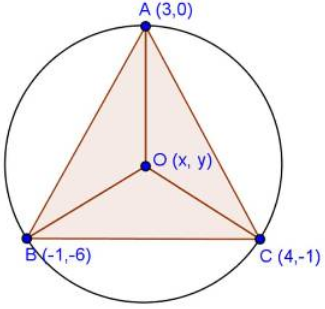
Let A(3, 0), B(-1, -6) and C(4, -1) be the given points.
Let O(x, y) be the circumcentre of the triangle.
OA = OB = OC
OA2 = OB2
(x - 3)2 + (y - 0)2 = (x + 1)2 + (y + 6 )2
{tex}\Rightarrow{/tex} x2 + 9 - 6x + y2 = x2 + 1 +2x + y2 + 36 + 12y
{tex}\Rightarrow{/tex} x2 - 6x + y2 - x2 - 2x - y2 - 12y = 1 + 36 - 9
{tex}\Rightarrow{/tex} -8x - 12y = 28
{tex}\Rightarrow{/tex} -2x - 3y = 7
{tex}\Rightarrow{/tex} 2x + 3y = -7 ........(i)
Again,
OB2 = OC2
(x + 1)2 + (y + 6)2 = (x - 4)2 + (y + 1)2
{tex}\Rightarrow{/tex} x2 + 1 + 2x + y2 + 36 +12y = x2 +16 - 8x + y2 + 1 + 2y
{tex}\Rightarrow{/tex} x2 + 2x + y2 + 12y - x2 + 8x + y2 - 2y = 16 + 1 - 1 - 36
10x + 10y = -20
x + y = -2 ....... (ii)
Solving (i) and (ii), we get
x = 1, y = -3
Hence circumcentre of the triangle is (1, -3)
Circumradius {tex}= \sqrt { ( 1 + 1 ) ^ { 2 } + ( - 3 + 6 ) ^ { 2 } }{/tex}
{tex}= \sqrt { ( 2 ) ^ { 2 } + ( 3 ) ^ { 2 } }{/tex}
{tex}= \sqrt { 4 + 9 }{/tex}
{tex}= \sqrt { 13 }{/tex} units.
Posted by Sunil B Sunil 6 years, 5 months ago
- 2 answers
Anjana Ghosh 6 years, 5 months ago
Posted by Suganthi Senthil 6 years, 5 months ago
- 1 answers
Posted by Arun Sha 6 years, 5 months ago
- 2 answers
Posted by Mananshu Pawar 6 years, 5 months ago
- 4 answers
Yogita Ingle 6 years, 5 months ago
8x +5y =9 …(1)
3x +2y =4 …(2)
8x +5y =9
Subtract 8x both sides we get
5y = 9 – 8x
Divide by 5
Y = (9 – 8 x)/5 …(3)
Plug this value of y in equation second we get
3x +2y =4
3x + 2(9 – 8 x)/5) = 4
Multiply by 5 we get
15 x + 18 - 16 x = 20
-x = 2
x = - 2
Plug this value back in equation (3) we get
y = (9- 8(-2))/5
y = 25/5
y = 5
Posted by Mananshu Pawar 6 years, 5 months ago
- 1 answers
Anjana Ghosh 6 years, 5 months ago
Posted by Abhishek Yadav 6 years, 5 months ago
- 0 answers
Posted by Anshul Kumar 6 years, 5 months ago
- 0 answers
Posted by Shivani Kumari 6 years, 5 months ago
- 1 answers
Sia ? 6 years, 5 months ago
Let the radius of the hemisphere be r m.
Inside surface area = 249.48 m2
{tex}\Rightarrow{/tex} 2{tex}\pi {/tex}r2 = 249.48
{tex}\Rightarrow{/tex}2 × {tex}22\over7{/tex}× r2 = 249.48
{tex}\Rightarrow{/tex}r2 = {tex}{249.48\times7}\over2\times22{/tex}
{tex}\Rightarrow{/tex}r2 = 39.69
{tex}\Rightarrow{/tex}r = {tex}\sqrt{39.69}{/tex}
{tex}\Rightarrow{/tex}r = 6.3 m
{tex}\therefore{/tex} Volume of the air inside the dome = {tex}{2\over3}\pi r^3{/tex}
{tex}={2\over3}\times{22\over7}\times(6.3)^3{/tex} = 523.9 m3
Posted by Minaal Gupta 6 years, 5 months ago
- 1 answers
Sia ? 6 years, 5 months ago
Let a be any positive integer.
Applying Euclid’s division lemma with divisor = 2, we get
{tex}\begin{array}{l}a=2q+r\;\;\;\;\;\;\;\;\;0\leq r<2\\So\;r=0,1\\\end{array}{/tex}
When r = 0,
a = 2q
So a2= (2q)2 = 4q2 = 4m--------(1) ( where m = q2, which is an integer)
When r = 1
Then a= 2q+1
a2= (2q + 1) 2 = 4q2 + 4q + 1 = 4(q2 + q ) +1 = 4m+1 --------(2) (where m = q2 + q, which is an integer)
From (1) and (2) We Can conclude that
The square of any positive integer is of the form 4m or 4m +1 for some integer m.
Posted by Nitish Kumar 6 years, 5 months ago
- 3 answers
Ankit ?? Kumar 6 years, 5 months ago
Moulik Goel 6 years, 5 months ago
Posted by Subha Devi 6 years, 5 months ago
- 1 answers
Posted by Amit Saxena 6 years, 5 months ago
- 1 answers
Sia ? 6 years, 5 months ago
The given polynomial
f(x)=6x2-7x-3
= (3x + 1)(2x - 3)
f(x)=0 if 3x+1=0 or 2x-3=0
So zeros of the polynomials are {tex}\frac{3}{2}{/tex} and {tex}\frac{{ - 1}}{3}{/tex}
In f(x)=6x2-7x-3
Sum of the zero= {tex}\frac32-\frac13=\frac76=-\frac{\mathrm b}{\mathrm a}{/tex}
Product of zeros = {tex}\frac32\times-\frac13=-\frac12=\frac{\mathrm c}{\mathrm a}{/tex}
Hence, the relationship is verified.
Posted by Pooja K. R 6 years, 5 months ago
- 1 answers
Posted by Gurtaj Singh 6 years, 5 months ago
- 0 answers
Posted by Manutur Manutur 6 years, 5 months ago
- 1 answers
Hemlata Mahajan 6 years, 5 months ago
Posted by Ramesh Kumar 6 years, 5 months ago
- 0 answers
Posted by Mohd Nadeem 6 years, 5 months ago
- 1 answers
Sia ? 6 years, 5 months ago
Let x (in years) be the present age of Jacob's son and y (in years) be the present age of Jacob. 5 years hence, it has relation:
(y + 5) = 3(x + 5)
or, y + 5 = 3x + 15
3x + 15 - y - 5 = 0
or, 3 x - y + 10 = 0 .......(i)
5 years ago, it has relation
(y - 5) = 7(x - 5)
y - 5 = 7x - 35
or, 7x - 35 - y + 5 = 0
or, 7 x - y - 3 0 = 0 ....(ii)
From eqn. (i), y = 3x + 10 ....(iii)
On substituting the value of y in eqn. (ii), we get
7x-(3x + 10) - 30 = 0
7x - 3x - 10 - 30 = 0
or, 4x - 40 = 0
or, 4x = 40
x=10
On substituting x = 10 in eqn. (iii),
{tex}y = 3 \times 10 + 10{/tex}
y = 30 + 10
{tex}\therefore {/tex} y = 40
Hence, the present age of Jacob = 40 years and son's age = 10 years
Posted by Urja Patwary 6 years, 5 months ago
- 1 answers
Posted by Roshan Yadav 6 years, 5 months ago
- 1 answers
Posted by Ankur Tiwari 6 years, 5 months ago
- 4 answers
Yogita Ingle 6 years, 5 months ago
a³ – b³ = (a – b)(a² + ab + b²)
you know that
(a – b)³ = a³ + 3ab(a – b) – b³
then a³ – b³ = (a – b)³ + 3ab(a – b)
= (a – b)[(a – b)² + 3ab]
= (a – b)(a² – 2ab + b² + 3ab)
= (a – b)(a² + ab + b² )
Posted by Aditi Pandey 6 years, 5 months ago
- 1 answers
Sia ? 6 years, 5 months ago
Given system of equations are:
{tex}2x + y = 6{/tex} ...(i)
{tex}2x - y + 2 = 0{/tex} ...(ii)
Graph of the equation {tex}2x + y = 6:{/tex}
We have,
{tex}2x + y = 6{/tex} {tex} \Rightarrow {/tex} {tex}y = 6 - 2x{/tex}
When x = 0, we have y = 6 - 2(0) = 6
When x =3, we have y = 6 - 2(3) = 6 - 6 = 0
Thus, we have the following table giving two points on the line represented by the equation {tex}2x + y = 6{/tex}
| x | 0 | 3 |
| y | 6 | 0 |
Graph of the equation {tex}2x - y + 2 = 0{/tex}:
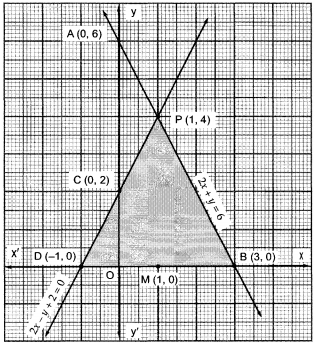
We have,
{tex}2 x - y + 2 = 0 {/tex}{tex} \Rightarrow {/tex} y = 2x + 2
When x = 0, we have y = 2(0) + 2 = 2
When x = -1, we have y = 2(-1) + 2 = 2 - 2 = 0
Thus, we have the following table giving two points on the line representing the given equation
| x | 0 | -1 |
| y | 2 | 0 |
Thus, x = 1, y = 4 is the solution of the given system of equations. Draw PM perpendicular from P on x-axis
Clearly, we have
PM = y-coordinate of point P(1, 4)
{tex} \Rightarrow{/tex} PM=4
and, DB = 4
{tex} \therefore{/tex} Area of the shaded region =Area of {tex} \triangle{/tex}PBD
{tex}\Rightarrow{/tex} Area of the shaded region {tex}= \frac { 1 } { 2 } ( \text { Base } \times \text { Height } ){/tex}
{tex}\Rightarrow{/tex} Area of the shaded region {tex}= \frac { 1 } { 2 } ( D B \times P M ){/tex}
{tex}\Rightarrow{/tex} Area of the shaded region {tex}= \left( \frac { 1 } { 2 } \times 4 \times 4 \right) \text { sq. units } = 8 s q. units.{/tex}
Posted by Noor Wraich 6 years, 5 months ago
- 0 answers

myCBSEguide
Trusted by 1 Crore+ Students

Test Generator
Create papers online. It's FREE.

CUET Mock Tests
75,000+ questions to practice only on myCBSEguide app

Sia ? 6 years, 5 months ago
2
0Thank You