
Ask questions which are clear, concise and easy to understand.
Ask QuestionPosted by Noor Wraich 6 years, 5 months ago
- 1 answers
Posted by Ankur Tiwari 6 years, 5 months ago
- 2 answers
Posted by Tanish Binayke 6 years, 5 months ago
- 1 answers
Anjana Ghosh 6 years, 5 months ago
Posted by Ravikant Prajapati 6 years, 5 months ago
- 1 answers
Posted by Anand Dwivedi 6 years, 5 months ago
- 1 answers
Sia ? 6 years, 5 months ago
Given points are collinear. Therefore
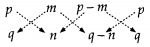
[p {tex}\times{/tex} n + m(q - n) + (p - m) q] - [m {tex}\times{/tex} q + (p - m) n + p (q - n)] = 0
{tex}\Rightarrow{/tex} (pn + qm - mn + pq - mq) - (mq + pn - mn + pq - pn) = 0
{tex}\Rightarrow{/tex} (pn + p q - mn) - (mq - mn + pq) = 0
{tex}\Rightarrow{/tex} pn - mq = 0
{tex}\Rightarrow{/tex} pn = qm
Posted by Lõvêrbôy Vîshãl 6 years, 5 months ago
- 1 answers
Sia ? 6 years, 5 months ago
Let n = 4q + 1 (an odd integer)
{tex}\therefore \quad n ^ { 2 } - 1 = ( 4 q + 1 ) ^ { 2 } - 1{/tex}
{tex}= 16 q ^ { 2 } + 1 + 8 q - 1 \quad \text { Using Identity } ( a + b ) ^ { 2 } = a ^ { 2 } + 2 a b + b ^ { 2 }{/tex}
{tex}= 16{q^2} + 8q{/tex}
{tex}= 8 \left( 2 q ^ { 2 } + q \right){/tex}
= 8m, which is divisible by 8.
Posted by Dibyaranjan Nayak 6 years, 5 months ago
- 0 answers
Posted by Rajnandini Jaiswal 6 years, 5 months ago
- 1 answers
Sandeep Dubey 6 years, 5 months ago
Posted by Guna Sekaran 6 years, 5 months ago
- 4 answers
Posted by Raman Virk 6 years, 5 months ago
- 2 answers
Posted by Divya Angnani 6 years, 5 months ago
- 1 answers
Yogita Ingle 6 years, 5 months ago
2x2 + kx - 3 = 0
Comparing equation with ax2 + bx + c = 0, we get
a = 2, b = k and c = -3
Discriminant = b2 - 4ac
= (k)2 - 4(2) (-3)
= k2 + 24
For equal roots,
Discriminant = 0
k2 + 24 = 0
k2 = - 24
k = -√24 = -2√6
Posted by Aman Beniwal 6 years, 5 months ago
- 2 answers
Nm ???? 6 years, 5 months ago
Posted by Yashashvi Jaiswal 6 years, 5 months ago
- 2 answers
Nm ???? 6 years, 5 months ago
Posted by Ananthrama Bhimanna 6 years, 5 months ago
- 1 answers
Posted by Tushar Kakran 6 years, 5 months ago
- 0 answers
Posted by Sagar Av 6 years, 5 months ago
- 1 answers
Posted by Sagar Av 6 years, 5 months ago
- 1 answers
Sia ? 6 years, 5 months ago
{tex}\because{/tex} x = {tex}\frac{2}{3}{/tex} is a root of {tex}ax^2 + 7x + b = 0{/tex}
{tex}\therefore{/tex} a({tex}\frac{2}{3}{/tex})2 + 7{tex}\times{/tex}{tex}\frac{2}{3}{/tex} + b = 0
{tex}\Rightarrow{/tex}{tex}\frac{4a + 42 + 9b}{9}{/tex} = 0 {tex}\Rightarrow{/tex} {tex}4a + 9b + 42 = 0{/tex} ...(i)
Also x = 3 is a root
{tex}\therefore{/tex} {tex}a(3)^2 + 7\times3 + b = 0{/tex}
{tex}\Rightarrow{/tex}{tex}9a + b + 21 = 0{/tex}
{tex}\Rightarrow{/tex}{tex}9(9a + b + 21) = 9\times0{/tex}
{tex}\Rightarrow{/tex}{tex}81a + 9b + 189 = 0 {/tex}...(ii)
(ii) and (i), we get
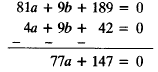
{tex}\Rightarrow{/tex} 77a = -147 {tex}\Rightarrow{/tex} a = {tex}\frac{-147}{77}{/tex} = {tex}\frac{-21}{11}{/tex}
When a = {tex}\frac{-21}{11}{/tex}, eq.(i) becomes
-4{tex}\times{/tex}{tex}\frac{21}{11}{/tex} + 9b + 42 = 0
{tex}\Rightarrow{/tex}{tex}\frac { - 84 + 99 b + 462 } { 11 }{/tex} = 0
{tex}\Rightarrow{/tex}99b + 378 = 0 b = {tex}\frac{-378}{99}{/tex} = {tex}\frac{-42}{11}{/tex}
{tex}\therefore{/tex} a = {tex}\frac{-21}{11}{/tex}, b = {tex}\frac{-42}{11}{/tex}.
Posted by Mukesh Mire 6 years, 5 months ago
- 2 answers
Vibha Kumari Pehu 6 years, 5 months ago
Posted by Abhishek Patel 6 years, 5 months ago
- 2 answers
Posted by Shubham Yadav 6 years, 5 months ago
- 1 answers
Sia ? 6 years, 5 months ago
S1 = 1 + 2 + 3 + ....n
S2 = 1 + 3 + 5 + ...upto n terms
S3 = 1 + 4 + 7 + ...upto n terms
{tex}S _ { n} = \frac { n } { 2 } [ 2a + ( n - 1 ) d ]{/tex}
{tex}S _ { 1} = \frac { n } { 2} [ 2 (1) + ( n - 1 ) 1 ]{/tex}
{tex}S _ { 1} = \frac { n } { 2} [ 2 + n - 1 ]{/tex}
or, {tex}S _ { 1 } = \frac { n ( n + 1 ) } { 2 }{/tex}
Also, {tex}S _ { 2 } = \frac { n } { 2 } [ 2 \times 1 + ( n - 1 ) 2 ]{/tex}
{tex}S _ { 2 } = \frac { n } { 2 } [ 2 + 2n - 2 ]{/tex}
{tex}= \frac { n } { 2 } [ 2 n ] = n ^ { 2 }{/tex}
and {tex}S _ { 3 } = \frac { n } { 2 } [ 2 \times 1 + ( n - 1 ) 3 ]{/tex}
{tex}S _ { 3 } = \frac { n } { 2 } [ 2 + 3n - 3 ]{/tex}
{tex}= \frac { n ( 3 n - 1 ) } { 2 }{/tex}
Now, {tex}S _ { 1 } + S _ { 3 } = \frac { n ( n + 1 ) } { 2 } + \frac { n ( 3 n - 1 ) } { 2 }{/tex}
{tex}= \frac { n [ n + 1 + 3 n - 1 ] } { 2 }{/tex}
{tex}= \frac { n [ 4 n ] } { 2 }{/tex}
= 2n2 = 2S2
Hence Proved.
Posted by Sejal Chhikara 6 years, 5 months ago
- 2 answers
Posted by Vjlaxmi Saini 6 years, 5 months ago
- 1 answers
Tanushree Mathur 6 years, 5 months ago
Posted by Simran Sharma 6 years, 5 months ago
- 1 answers
Posted by Ashnoor Kaur 6 years, 5 months ago
- 1 answers
Anuj Srivastav 6 years, 5 months ago
Posted by Vaibhav Jai 6 years, 5 months ago
- 1 answers
Sagar Av 6 years, 5 months ago

myCBSEguide
Trusted by 1 Crore+ Students

Test Generator
Create papers online. It's FREE.

CUET Mock Tests
75,000+ questions to practice only on myCBSEguide app

Urja Patwary 6 years, 5 months ago
1Thank You