
Ask questions which are clear, concise and easy to understand.
Ask QuestionPosted by Anshul Badgujar 6 years, 5 months ago
- 6 answers
Posted by Mukesh Kumar 6 years, 5 months ago
- 1 answers
Sia ? 6 years, 5 months ago
Algorithm is a set of rules to be followed in calculations or other problem-solving operations, especially by a computer.
Posted by Vashu Jaiswal 6 years, 5 months ago
- 1 answers
Sia ? 6 years, 5 months ago
Here we are having a=3
and d=15-3=12
Let nth term Tn =T21+120
so a+(n-1)d = a+20d+120
or (n-1){tex}\times{/tex}12 = 20 {tex}\times{/tex} 12+120
12n -12 = 240+120
12n = 372
{tex}\style{font-size:12px}{\text{n=}\frac{372}{12}=31}{/tex}
Hence, 31st term is the required term.
Posted by Narender Kumar 6 years, 5 months ago
- 5 answers
Posted by Pallavi Sharma 6 years, 5 months ago
- 1 answers
Sia ? 6 years, 5 months ago
Let a = 3q + r {tex}: 0 \leq r < 3{/tex}
{tex}\therefore \quad a = 3 q ; \text { then } a ^ { 3 } = 27 q ^ { 3 } = 9 m ; \text { where } m = 3 q ^ { 3 }{/tex}
{tex}\text { when } a = 3 q + 1 ; \text { then } a = 27 q ^ { 2 } + 27 q ^ { 2 } + 9 q + 1{/tex}
{tex}= 9 \left( 3 q ^ { 3 } + 3 q ^ { 2 } + q \right) + 1{/tex}
{tex}= 9 m + 8 \quad \left( \text { where } m = 3 q ^ { 3 } + 3 q ^ { 2 } + q \right){/tex}
{tex}\text { when } a = 3 q + 2 ; \text { then } a ^ { 3 } = ( 3 q + 2 ) ^ { 2 }{/tex}
{tex}= 27 q ^ { 3 } + 54 q ^ { 2 } + 36 q + 8{/tex}
{tex}= 9 m + 8 \quad \left( \text { where } m = 3 q ^ { 3 } + 6 q ^ { 2 } + 4 q \right){/tex}
{tex}= 9 m + 8 \quad \left( \text { where } m = 3 q ^ { 3 } + 6 q ^ { 2 } + 4 q \right){/tex}
Hence, cubes of any positive integer is either of the from 9m, (9m + 1) or (9m + 8).
Posted by Savita Suman 6 years, 5 months ago
- 1 answers
Posted by Suryah Medico 6 years, 5 months ago
- 1 answers
Posted by Savita Suman 6 years, 5 months ago
- 2 answers
Posted by Pragya Narayan 6 years, 5 months ago
- 2 answers
Posted by M Harini 6 years, 5 months ago
- 1 answers
Posted by Priyanshu Vijay 6 years, 3 months ago
- 1 answers
Sia ? 6 years, 3 months ago
Let P and Q be the points of trisection as shown below
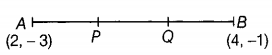
Then, AP : PB = 1 : 2
and AQ : QB = 2 : 1
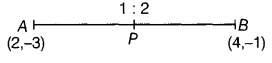
Here, {tex}\frac{m_{1}}{m_{2}}=\frac{1}{2},{/tex} A(x1, y1) = (2, -3) and B(x2, y2) = (4, -1)
For internally, {tex}P=\left(\frac{m_{1} x_{2}+m_{2} x_{1}}{m_{1}+m_{2}}, \frac{m_{1} y_{2}+m_{2} y_{1}}{m_{1}+m_{2}}\right){/tex}
{tex}\Rightarrow \quad P=\left(\frac{1 \times 4+2 \times 2}{1+2}, \frac{1 \times(-1)+2 \times(-3)}{1+2}\right){/tex}
{tex}\Rightarrow \quad P=\left(\frac{4+4}{3}, \frac{-1-6}{3}\right) \Rightarrow P=\left(\frac{8}{3}, \frac{-7}{3}\right){/tex}- Here, {tex}\frac{m_{1}}{m_{2}}=\frac{2}{1}{/tex}, A(x1, y1) = (2, -3)
and B(x2, y2) = (4, -1)
For internally, {tex}Q=\left(\frac{m_{1} x_{2}+m_{2} x_{1}}{m_{1}+m_{2}}, \frac{m_{1} y_{2}+m_{2} y_{1}}{m_{1}+m_{2}}\right){/tex}
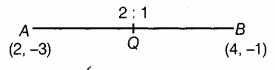
{tex}\Rightarrow \quad Q=\left(\frac{2 \times 4+1 \times 2}{2+1}, \frac{2 \times(-1)+1 \times(-3)}{2+1}\right){/tex}
{tex}\Rightarrow \quad Q=\left(\frac{8+2}{3}, \frac{-2-3}{3}\right) \Rightarrow Q=\left(\frac{10}{3}, \frac{-5}{3}\right){/tex}
Posted by Neha Billava 6 years, 5 months ago
- 0 answers
Posted by Deependra Dewangan 6 years, 5 months ago
- 0 answers
Posted by Sakshi Agrawal 6 years, 5 months ago
- 1 answers
Yogita Ingle 6 years, 5 months ago
0.2x + 0.3y = 1.3 ... (i)
0.4x + 0.5y = 2.3 ... (ii)
Solving equation (i), we get
0.2x = 1.3 – 0.3y
Dividing by 0.2, we get
x = 1.3/0.2 - 0.3/0.2
x = 6.5 – 1.5 y
Putting the value in equation (ii), we get
0.4x + 0.5y = 2.3
(6.5 – 1.5y) × 0.4x + 0.5y = 2.3
2.6 – 0.6y + 0.5y = 2.3
-0.1y = 2.3 – 2.6
y = -0.3/-0.1
y = 3
Putting this value in equation (i) we get x = 2
| x = 2 and y = 3 |
Posted by Ayu Gupta 6 years, 3 months ago
- 1 answers
Sia ? 6 years, 3 months ago
We know that, cos0°=1 =sin90°, sin45°=(1/√2)= cos45° & sin30°=(1/2)=cos60°, putting these values in the given expression, we get:-
{tex}\left( {\cos 0^\circ +\sin 45^\circ +\sin 30^\circ }\right)\left( {\sin 90^\circ -\cos 45^\circ +\cos 60^\circ } \right){/tex}
{tex} = \left( {1 + \frac{1}{{\sqrt 2 }} + \frac{1}{2}} \right)\left( {1 - \frac{1}{{\sqrt 2 }} + \frac{1}{2}} \right){/tex}
{tex} = \left( {\frac{{2\sqrt 2 + 2 + \sqrt 2 }}{{2\sqrt 2 }}} \right)\left( {\frac{{2\sqrt 2 - 2 + \sqrt 2 }}{{2\sqrt 2 }}} \right){/tex}
{tex} = \left( {\frac{{3\sqrt 2 + 2}}{{2\sqrt 2 }}} \right)\left( {\frac{{3\sqrt 2 - 2}}{{2\sqrt 2 }}} \right){/tex}
{tex} = \frac{{{{\left( {3\sqrt 2 } \right)}^2} - {{\left( 2 \right)}^2}}}{8}{/tex} [Identity (a + b)(a - b) = a2 - b2]
{tex} = \frac{{18 - 4}}{8}{/tex}
{tex} = \frac{{14}}{8} = \frac{7}{4}{/tex}
Posted by Kuldeep Solanki 6 years, 5 months ago
- 0 answers
Posted by Kuldeep Solanki 6 years, 5 months ago
- 0 answers
Posted by Sher Singh 6 years, 5 months ago
- 0 answers
Posted by Armaan Dhillon 6 years, 5 months ago
- 1 answers
Posted by Anonymous * 6 years, 5 months ago
- 5 answers
Raj Singh 6 years, 5 months ago
Posted by Kushal Kumawat 6 years, 5 months ago
- 1 answers
Posted by Laxmi Suthar 6 years, 5 months ago
- 2 answers
Posted by Rohit Choudhary 6 years, 5 months ago
- 1 answers
Urja Patwary 6 years, 5 months ago
Posted by Mr Ab 6 years, 5 months ago
- 1 answers
Posted by Vivek Singh 6 years, 5 months ago
- 0 answers
Posted by Saquib Ahmad 6 years, 3 months ago
- 1 answers
Sia ? 6 years, 3 months ago
The given equation is {tex}ax^2 + bx + c = 0{/tex}
sin {tex}\alpha{/tex} and cos {tex}\alpha{/tex} are roots of the given equation.
{tex}\therefore{/tex} sin {tex}\alpha{/tex} + cos {tex}\alpha{/tex} = -{tex}\frac{b}{a}{/tex} ...(i)
and {tex}sin{/tex} {tex}\alpha{/tex}{tex}.cos{/tex} {tex}\alpha{/tex} = {tex}\frac{c}{a}{/tex}...(ii)
Squaring both sides of equation (i),
{tex}\Rightarrow {/tex}(sin {tex}\alpha{/tex} + cos {tex}\alpha{/tex})2 = {tex}\frac { b ^ { 2 } } { a ^ { 2 } }{/tex}
{tex}\Rightarrow{/tex}{tex}sin^2{/tex} {tex}\alpha{/tex} {tex}+ cos^2{/tex} {tex}\alpha{/tex} + 2 sin {tex}\alpha{/tex}cos {tex}\alpha{/tex} = {tex}\frac { b ^ { 2 } } { a ^ { 2 } }{/tex}
{tex}\Rightarrow{/tex}1 + 2{tex}\frac{c}{a}{/tex} = {tex}\frac { b ^ { 2 } } { a ^ { 2 } }{/tex} {tex}\Rightarrow{/tex} {tex}\frac{a + 2c}{a}{/tex} = {tex}\frac { b ^ { 2 } } { a ^ { 2 } }{/tex}
{tex}\Rightarrow{/tex}{tex}a^2 + 2ac = b^2{/tex}
Posted by Kushal Singh Kathuriya 6 years, 5 months ago
- 0 answers

myCBSEguide
Trusted by 1 Crore+ Students

Test Generator
Create papers online. It's FREE.

CUET Mock Tests
75,000+ questions to practice only on myCBSEguide app

Sia ? 6 years, 5 months ago
15
1Thank You