
Ask questions which are clear, concise and easy to understand.
Ask QuestionPosted by Parvathi Sankaran 6 years, 5 months ago
- 3 answers
Posted by Manish K 6 years, 3 months ago
- 1 answers
Sia ? 6 years, 3 months ago
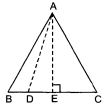
In equilateral {tex}\triangle{/tex}ABC. 4BD = BC
Construction: Draw AE {tex}\perp{/tex} BC. {tex}\therefore{/tex} BE = {tex}\frac{1}{2}{/tex}BC.
In right {tex}\triangle{/tex}AED, AD2 = DE2 + AE2 {tex}\Rightarrow{/tex} AE2 = AD2 - DE2 ..(i)
In right {tex}\triangle{/tex}AEB, AB2 = AE2 + BE2 {tex}\Rightarrow{/tex} AB2 = AD2 - DE2 + BE2 [using (i)]
{tex}\Rightarrow{/tex} AB2 + DE2 - BE2 = AD2
{tex}\Rightarrow{/tex} AB2 + (BE - BD)2 - BE2 = AD2
{tex}\Rightarrow{/tex} AB2 + BE2 + BD2 - 2BE.BD - BE2 = AD2
{tex}\Rightarrow{/tex} AB2 + ({tex}\frac{1}{2}{/tex}BC)2 - {tex}2 \times \frac{1}{2}{/tex}BC{tex}\times \frac{1}{4}{/tex}BC = AD2
{tex}\Rightarrow{/tex} AB2 + {tex}\frac{1}{16}{/tex}BC2 - {tex}\frac{1}{4}{/tex}BC2 = AD2
{tex}\Rightarrow{/tex} BC2 - {tex}\frac{3}{16}{/tex}BC2 = AD2 [{tex}\because{/tex} AB = BC]
{tex}\Rightarrow{/tex} {tex}\frac { 13 \mathrm { BC } ^ { 2 } } { 16 }{/tex} = AD2
{tex}\Rightarrow{/tex} 13BC2 = 16AD2
Posted by Ꭾꮢꮛꮛꮦ Ꭾꭷꮢꮗꮧꮭ 6 years, 5 months ago
- 4 answers
Yogita Ingle 6 years, 5 months ago
Let us assume √2 is rational number.
a rational number can be written into he form of p/q
√2=p/q
p=√2q
Squaring on both sides
p²=2q²__________(1)
.·.2 divides p² then 2 also divides p
.·.p is an even number
Let p=2a (definition of even number,'a' is positive integer)
Put p=2a in eq (1)
p²=2q²
(2a)²=2q²
4a²=2q²
q²=2a²
.·.2 divides q² then 2 also divides q
Both p and q have 2 as common factor.
But this contradicts the fact that p and q are co primes or integers.
Our supposition is false
.·.√2 is an irrational number.
Niveditha C S 6 years, 5 months ago
Posted by Amrita Sahoo 6 years, 5 months ago
- 1 answers
Posted by Arpita Saxsena 6 years, 5 months ago
- 3 answers
Sagar Yadav 6 years, 5 months ago
Posted by Sanjay Nayak 6 years, 5 months ago
- 0 answers
Posted by Meet Jain 6 years, 3 months ago
- 1 answers
Sia ? 6 years, 3 months ago
We know that
sec2A - tan2A = 1
{tex}\Rightarrow ( 2 x ) ^ { 2 } - \left( \frac { 2 } { x } \right) ^ { 2 }{/tex} = 1
{tex}\Rightarrow 4 x ^ { 2 } - \frac { 4 } { x ^ { 2 } }{/tex} = 1
{tex}\Rightarrow 4 \left( x ^ { 2 } - \frac { 1 } { x ^ { 2 } } \right){/tex} = 1
{tex}\Rightarrow \left( x ^ { 2 } - \frac { 1 } { x ^ { 2 } } \right) = \frac { 1 } { 4 }{/tex}
Posted by Yukta Solanki 6 years, 5 months ago
- 0 answers
Posted by Suraj Kumar 6 years, 5 months ago
- 2 answers
Posted by Shashi Dhussa 6 years, 5 months ago
- 1 answers
Iron Man 6 years, 5 months ago
Posted by Geetha Venkat Yadav 6 years, 5 months ago
- 2 answers
Posted by Aman Kumar 6 years, 5 months ago
- 2 answers
Posted by Suyeb Alam 6 years, 5 months ago
- 0 answers
Posted by Iron Man 6 years, 5 months ago
- 3 answers
Posted by Suma N Sumaprakash 6 years, 5 months ago
- 2 answers
Harshita Talib 6 years, 5 months ago
Posted by Mohd Kaif 6 years, 5 months ago
- 1 answers
Posted by Neha Verma 6 years, 5 months ago
- 1 answers
Posted by Arun Tyagi 6 years, 5 months ago
- 1 answers
Prashasti Prabhakar 6 years, 5 months ago
Posted by Rakhee Swarnkar 6 years, 5 months ago
- 1 answers
Sia ? 6 years, 3 months ago
Now, sec A - tan A = 4........(i)
We know that
(sec A - tan A)(sec A + tan A) = 1
{tex}\Rightarrow{/tex} 4(secA + tanA) = 1
{tex}\Rightarrow{/tex} secA + tanA = {tex}\frac{1}{4}{/tex} .......(ii)
Adding (i) and (ii) we get,
2 secA = {tex}\frac{{17}}{4}{/tex}
{tex}\Rightarrow{/tex} secA = {tex}\frac{{17}}{8}{/tex}
{tex}\Rightarrow{/tex} cosA = {tex}\frac{8}{{17}}{/tex}
Posted by Rhythm Garg 6 years, 5 months ago
- 6 answers
Posted by Vk Starboy 6 years, 5 months ago
- 1 answers
Posted by Bhagyashri Kumbar 6 years, 5 months ago
- 1 answers
Rakhee Swarnkar 6 years, 5 months ago
Posted by Vikram Singh 6 years, 5 months ago
- 1 answers
Harshita Talib 6 years, 5 months ago
Posted by Vikram Singh 6 years, 5 months ago
- 0 answers
Posted by Santosh Soni 6 years, 5 months ago
- 3 answers
Posted by Sameer Khan 6 years, 5 months ago
- 2 answers
Posted by Shruthi B 6 years, 5 months ago
- 3 answers
Harshita Talib 6 years, 5 months ago
Bhuwaneshwar Prasad Verma 6 years, 5 months ago
Posted by Teena Dahiya 6 years, 5 months ago
- 1 answers

myCBSEguide
Trusted by 1 Crore+ Students

Test Generator
Create papers online. It's FREE.

CUET Mock Tests
75,000+ questions to practice only on myCBSEguide app

Ashish Jirwan 6 years, 5 months ago
0Thank You