
Ask questions which are clear, concise and easy to understand.
Ask QuestionPosted by Madhu Pooja 6 years, 5 months ago
- 3 answers
Posted by Pratyush Jadhav 6 years, 3 months ago
- 1 answers
Sia ? 6 years, 3 months ago
We have, AL = x - 3, AC = 2x, BM = x - 2 and BC = 2x + 3, and we need to find the value of x.
In {tex}\Delta{/tex}ABC, we have
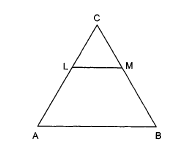
{tex}L M \| A B{/tex}
{tex}\therefore \quad \frac { A L } { L C } = \frac { B M } { M C }{/tex} [By Thaley's Theorem]
{tex}\Rightarrow \quad \frac { A L } { A C - A L } = \frac { B M } { B C - B M }{/tex}
{tex}\Rightarrow \quad \frac { x - 3 } { 2 x - ( x - 3 ) } = \frac { x - 2 } { ( 2 x + 3 ) - ( x - 2 ) }{/tex}
{tex}\Rightarrow \quad \frac { x - 3 } { x + 3 } = \frac { x - 2 } { x + 5 }{/tex}
{tex} \Rightarrow{/tex} (x - 3) (x + 5) = (x - 2) (x + 3)
{tex} \Rightarrow{/tex} x2 + 2x -15 = x2 + x - 6
{tex} \Rightarrow{/tex} x = 9
Posted by Piyush Singh 6 years, 5 months ago
- 1 answers
Sia ? 6 years, 5 months ago
The given equations are:
7(y + 3) - 2(x + 2) = 14
4(y - 2) + 3(x - 3) = 2
So, 7(y + 3) - 2(x + 2) = 14
⇒ 7y + 21 - 2x - 4 = 14
⇒ 7y - 2x = 14 + 4 - 21
⇒ - 2x + 7y = -3 ........ (i)
And 4(y - 2) + 3(x - 3) = 2
⇒ 4y - x + 3x - 9 = 2
⇒ 4y + 3x = 2 + 8 + 9
⇒ 3x + 4y = 19 .............(ii)
Multiplying (i) by 4 and (ii) by 7, we get
-8x + 28y = -12........(iii)
21x + 28y = 133......(iv)
Subtracting (iii) and (iv),we get
29x = 145
x = 5
Substituting x = 5 in (i),we get
7y = -3 + 10
⇒ 7y = 7
⇒ y = 1
{tex}\therefore{/tex} Solution is x = 5, y = 1
Posted by Sanket Saxena 6 years, 5 months ago
- 1 answers
Posted by Adi Pandey 4 years, 9 months ago
- 2 answers
Posted by Jayesh Wani 6 years, 5 months ago
- 1 answers
Iron Man 6 years, 5 months ago
Posted by Karan Pandiyan 6 years, 5 months ago
- 2 answers
Kavita Raghav 6 years, 5 months ago
Iron Man 6 years, 5 months ago
Posted by Arzoo Ansari 6 years, 5 months ago
- 1 answers
Posted by Samarth Bhardwaj 6 years, 5 months ago
- 3 answers
Ꭾꮢꮛꮛꮦ Ꭾꭷꮢꮗꮧꮭ 6 years, 5 months ago
Posted by Vikas Dhran 6 years, 5 months ago
- 2 answers
Yogita Ingle 6 years, 5 months ago
For a pair of given positive integers ‘a’ and ‘b’, there exist unique integers ‘q’ and ‘r’ such that
a=bq+r , where 0≤r<b
Explanation: Thus, for any pair of two positive integers a and b; the relation
a=bq+r , where 0≤r<b
will be true where q is some integer.
Anisha Mishra 6 years, 5 months ago
Posted by Anshul Badgujar 6 years, 5 months ago
- 3 answers
Sia ? 6 years, 5 months ago
Let the four parts be (a - 3d), (a - d), (a + d) and (a + 3d). Then,
Sum of the numbers = 32
{tex}\Rightarrow{/tex}(a - 3d) + (a - d) + (a + d) + (a + 3d) = 32 {tex}\Rightarrow{/tex} 4a = 32 {tex}\Rightarrow{/tex} a = 8
It is given that
{tex}\frac { ( a - 3 d ) ( a + 3 d ) } { ( a - d ) ( a + d ) } = \frac { 7 } { 15 }{/tex}
{tex}\Rightarrow \quad \frac { a ^ { 2 } - 9 d ^ { 2 } } { a ^ { 2 } - d ^ { 2 } } = \frac { 7 } { 15 }{/tex}
{tex}\Rightarrow \quad \frac { 64 - 9 d ^ { 2 } } { 64 - d ^ { 2 } } = \frac { 7 } { 15 } \Rightarrow{/tex}128d2 = 512 {tex}\Rightarrow{/tex} d2 = 4 {tex}\Rightarrow{/tex}d = ± 2
Thus, the four parts are a - 3d, a - d, a + d and a + 3d i.e., 2,6,10,14.
Posted by Suba Sri Meenatchi Anandhan 6 years, 5 months ago
- 2 answers
Iron Man 6 years, 5 months ago
Posted by Iqbal Singh 6 years, 5 months ago
- 2 answers
Sia ? 6 years, 5 months ago
Check syllabus here : https://mycbseguide.com/cbse-syllabus.html
Posted by Munnidanu Devi 6 years, 5 months ago
- 1 answers
Posted by Mukesh Bhat 6 years, 5 months ago
- 0 answers
Posted by Hineri . 6 years, 3 months ago
- 1 answers
Sia ? 6 years, 3 months ago
Let the numerator and the denominator of the fraction be x and y respectively.
Then the fraction is {tex}\frac{x}{y}{/tex}.
Given, The sum of the numerator and the denominator of the fraction is 3 less than the twice of the denominator.
Thus, we have
{tex}x + y = 2y - 3{/tex}
{tex}\Rightarrow{/tex} {tex}x + y - 2y + 3 = 0{/tex}
{tex}\Rightarrow{/tex} {tex}x - y + 3 = 0{/tex}..............(1)
Also given, If the numerator and the denominator both are decreased by 1, the numerator becomes half the denominator. Thus, we have
{tex}x - 1 = \frac{1}{2}(y - 1){/tex}
{tex}{/tex}
{tex}\Rightarrow{/tex} {tex}2(x - 1) = (y - 1){/tex}
{tex}\Rightarrow{/tex} 2x - 2 = (y - 1)
{tex}\Rightarrow{/tex} 2x - y - 1 = 0.......................(2)
So, we have formed two linear equations in x & y as following:-
x - y + 3 = 0
2x - y - 1 = 0
Here x and y are unknowns.
We have to solve the above equations for x and y.
By using cross-multiplication method , we have
{tex}\frac{x}{{( - 1) \times ( - 1) - ( - 1) \times 3}}{/tex} {tex}= \frac{{ - y}}{{1 \times ( - 1) - 2 \times 3}}{/tex} {tex}= \frac{1}{{1 \times ( - 1) - 2 \times ( - 1)}}{/tex}
{tex}\Rightarrow \frac{x}{{1 + 3}}{/tex} {tex}= \frac{{ - y}}{{ - 1 - 6}} = \frac{1}{{ - 1 + 2}}{/tex}
{tex}\Rightarrow \frac{x}{4} = \frac{{ - y}}{{ - 7}} = \frac{1}{1}{/tex}
{tex}\Rightarrow \frac{x}{4} = \frac{y}{7} = 1{/tex}
Using Part I & III , we get x = 4
& From part II & III, we get y = 7 {tex}{/tex}
{tex}\Rightarrow{/tex} x = 4, y = 7
Hence, The fraction is {tex}\frac{x}{y}{/tex} = {tex}\frac{4}{7}{/tex}
Posted by Shakib Khan 6 years, 5 months ago
- 0 answers
Posted by Paritush Borah 6 years, 5 months ago
- 1 answers
Sia ? 6 years, 5 months ago
According to the question,the sum of first 10 terms of an AP is -150 and the sum of its next 10 terms is -550
Let a be the first term and d be the common difference of the given AP.
Then, we have
S10=-150
{tex}\Rightarrow \frac { 10 } { 2 } [ 2 a + 9 d ] = - 150{/tex}
{tex}\Rightarrow{/tex}5[2a+9d]=-150
{tex}\Rightarrow{/tex}2a+9d=-30...(i)
Clearly, the sum of first 20 terms =-150+(-550)=-700
{tex}\therefore{/tex}S20=-700
{tex}\Rightarrow \frac { 20 } { 2 } [ 2 a + 19 d ] = - 700{/tex}
{tex}\Rightarrow{/tex}10[2a+19d]=-700
{tex}\Rightarrow{/tex}2a+19d=-70...(iii)
Subtracting (i) from (ii), we get
10d=-40
{tex}\Rightarrow{/tex}d=-4
{tex}\Rightarrow{/tex}2a=-30-9(-4)=-30+36=6
{tex}\Rightarrow{/tex}a=3
Thus, we have
First term=a=3
Second term= a+d=3+2(-4)=-1
Third term=a+2d=3+2(-4)=3-8=-5
Fourth term=a+3d=3+3(-4)=3-12=-9
Thus, the given AP is 3,-1,-5,-9,....
Posted by Kaushik Herle 6 years, 5 months ago
- 1 answers
Sia ? 6 years, 5 months ago
Given: The diagonals of a quadrilateral ABCD intersect each other at the point O such that {tex}\frac{{AO}}{{BO}} = \frac{{CO}}{{DO}}{/tex}
To prove: ABCD is trapezium.
Construction: Through O draw a line OE||BA intersecting AD at E.
Proof: In {tex}\triangle DBA{/tex}{tex}\because OE||BA{/tex}
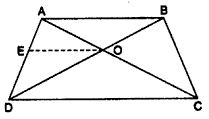
{tex}\therefore \frac{{DO}}{{BO}} = \frac{{DE}}{{AE}} \Rightarrow \frac{{CO}}{{AO}} = \frac{{DE}}{{AE}}{/tex}
{tex}\because \frac{{AO}}{{BO}} = \frac{{CO}}{{DO}}\,[Given]{/tex}
{tex}\Rightarrow \frac{{DO}}{{BO}} = \frac{{CO}}{{AO}} \Rightarrow \frac{{AO}}{{CO}} = \frac{{AE}}{{DE}}{/tex}.........[Taking reciprocals]
{tex}\therefore {/tex}In {tex}\triangle ADC{/tex}
OE {tex}\parallel{/tex} CD ...........[By converse basic proportionality theorem]
But OE {tex}\parallel{/tex} BA
BA {tex}\parallel{/tex} CD........[By construction]
The quadrilateral ABCD is a Trapezium.
Posted by Kajol Chanchlani 6 years, 5 months ago
- 3 answers
Posted by Janvi Bhatia 6 years, 5 months ago
- 0 answers
Posted by Vikash Kumar 6 years, 5 months ago
- 1 answers
Sia ? 6 years, 5 months ago
Statics is the branch of mechanics concerned with bodies at rest and forces in equilibrium.
Posted by Monika Maheshwari 6 years, 5 months ago
- 3 answers
Posted by Neha Verma 6 years, 5 months ago
- 1 answers
Iron Man 6 years, 5 months ago
Posted by Sohail Mateen 6 years, 5 months ago
- 1 answers
Posted by Ramprikh Yadav 6 years, 5 months ago
- 0 answers
Posted by Balrajsiwach Balraj 6 years, 5 months ago
- 1 answers
Tec Om 6 years, 5 months ago
e.g -- 2x+3y -- 1
..... eq 1st 2x+2y -- 0
..... eq 2nd (-) (-) -- (-)
y -- 1 then put the value of yin eq 1nd /2nd 2x+3y -- 1
2x+3 -- 1
2x -- 1-3
x-- -1
Posted by Niraj Rajput 6 years, 5 months ago
- 2 answers
Prachi Janwani 6 years, 5 months ago

myCBSEguide
Trusted by 1 Crore+ Students

Test Generator
Create papers online. It's FREE.

CUET Mock Tests
75,000+ questions to practice only on myCBSEguide app

Iron Man 6 years, 5 months ago
0Thank You