
Ask questions which are clear, concise and easy to understand.
Ask QuestionPosted by Premchand Patidar 6 years, 3 months ago
- 1 answers
Sia ? 6 years, 3 months ago
We have, α and β are the roots of the quadratic polynomial. f(x) =x2 - 5x + 4
Sum of zeros: {tex}\alpha+\beta=-\frac{b}{a}=-\frac{\text { coefficient of } x}{\text { coefficient of } x^{2}}{/tex}
product of zeros: {tex}\alpha \beta=\frac{c}{a}=\frac{\text { constant term }}{\text { coefficient of } x^{2}}{/tex}
We have a=1,b=-5 and c= 4.
Sum of the roots = α + β = 5
Product of the roots = αβ = 4
So,
{tex}\frac{1}{\alpha } + \frac{1}{\beta } - 2\alpha \beta = \frac{{\beta + \alpha }}{{\alpha \beta }} - 2\alpha \beta{/tex}
{tex}5/4-2\times4=5/4-8{/tex} ={tex}\left(5-32\right)/4{/tex}={tex}-27/4{/tex}
Hence,we get the result of {tex}\frac{{ 1 }}{\alpha} + \frac{{ 1 }}{\beta} - 2\alpha\beta{/tex} = {tex}-\frac{{ 27 }}{ 4}{/tex}
Posted by Harshit Tiwari 6 years, 4 months ago
- 2 answers
Sia ? 6 years, 4 months ago
You can get question papers here : https://mycbseguide.com/cbse-question-papers.html
Posted by Ashraful Hassan 6 years, 4 months ago
- 1 answers
Sia ? 6 years, 4 months ago
The given equations may be written as
{tex}a^2x - b^2y = a^2b + ab^2{/tex} ....... (i)
{tex}ax - by = 2ab{/tex} ......... (ii)
Multiplying (ii) by b and subtracting the result from (i),
{tex}(a^2 - ab)x = a^2b - ab^2{/tex}
{tex}\Rightarrow{/tex} {tex}(a^2 - ab)x = b(a^2 - ab){/tex}
{tex}\Rightarrow{/tex} {tex}x = b.{/tex}
Putting {tex}x = b{/tex} in (ii), we get
{tex}a b - b y = 2 a b {/tex}
{tex}\Rightarrow b y = - a b{/tex}
{tex} \Rightarrow y = \frac { - a b } { b } = - a{/tex}
Hence, x = b and y = -a.
Posted by Tanish Jangid 6 years, 4 months ago
- 1 answers
Sia ? 6 years, 4 months ago
On dividing n by 3, let q be the quotient and r be the remainder.
Then, {tex}n = 3q + r{/tex}, where {tex}0 \leq r < 3{/tex}
{tex}\Rightarrow\;n = 3q + r{/tex} , where r = 0,1 or 2
{tex}\Rightarrow{/tex} {tex}n = 3q \;or \;n = (3q + 1) \;or\; n = (3q + 2){/tex}.
Case I If n = 3q then n is clearly divisible by 3.
Case II If {tex}\;n = (3q + 1)\; {/tex} then {tex} (n + 2)= (3q + 1 + 2) = (3q + 3) = 3(q + 1){/tex}, which is clearly divisible by 3.
In this case, {tex}(n + 2){/tex} is divisible by 3.
Case III If n = {tex}(3q + 2){/tex} then {tex}(n + 1) = (3q + 2 + 1) = (3q + 3) = 3(q + 1){/tex}, which is clearly divisible by 3.
In this case,{tex} (n + 1){/tex} is divisible by 3.
Hence, one and only one out of {tex}n, (n + 1){/tex} and {tex}(n + 2){/tex} is divisible by 3.
Posted by Nandini Singh 6 years, 4 months ago
- 0 answers
Posted by Kekhriengunuo Sachii 6 years, 4 months ago
- 1 answers
Divyanshu Roy 6 years, 4 months ago
Posted by Abhishek Jain 6 years, 4 months ago
- 1 answers
Sia ? 6 years, 4 months ago
Let the AP be a - 4d, a - 3d, a - 2d, a - d, a, a + d, a + 2d, a + 3d,...
Then, a3 = a - 2d, a7 = a + 2d
{tex} \Rightarrow {/tex} a3 + a7 = a - 2d + a + 2d = 6
{tex} \Rightarrow {/tex} 2a = 6 {tex} \Rightarrow {/tex} a = 3 ..... (i)
Also (a - 2d) (a + 2d) = 8
{tex} \Rightarrow {/tex} a2 - 4d2 = 8 {tex} \Rightarrow {/tex} 4d2 = a2 - 8 {tex} \Rightarrow {/tex} 4d2 = 32 - 8
{tex} \Rightarrow {/tex} 4d2 = 1 {tex} \Rightarrow {d^2} = \frac{1}{4} \Rightarrow d = \pm \frac{1}{2}{/tex}
Taking {tex}d = \frac{1}{2},{/tex}
{tex}{S_{16}} = \frac{{16}}{2}\left[ {2 \times (a - 4d) + (16 - 1)d} \right]{/tex}{tex} = 8\left[ {2 \times \left( {3 - 4 \times \frac{1}{2}} \right) + 15 \times \frac{1}{2}} \right]{/tex}
{tex} = 8\left[ {2 + \frac{{15}}{2}} \right] = 8 \times \frac{{19}}{2} = 76{/tex}
Taking {tex}d = \frac{{ - 1}}{2}{/tex},
{tex}{S_{16}} = \frac{{16}}{2}\left[ {2 \times (a - 4d) + (16 - 1)d} \right]{/tex}{tex} = 8\left[ {2 \times \left( {3 - 4 \times \frac{1}{2}} \right) + 15 \times \frac{1}{2}} \right]{/tex}
{tex} = 8\left[ {\frac{{20 - 15}}{2}} \right] = 8 \times \frac{5}{2} = 20{/tex}
{tex}\therefore {/tex} S16 = 20 and 76
Posted by Akanksha Awasthi 6 years, 4 months ago
- 1 answers
Posted by Avnish Kumar 6 years, 4 months ago
- 0 answers
Posted by Avnish Kumar 6 years, 4 months ago
- 0 answers
Posted by Piyush Pandey 6 years, 4 months ago
- 1 answers
Posted by Poonam Gupta 6 years, 4 months ago
- 2 answers
Iron Man 6 years, 4 months ago
Posted by Sukhvinder Kaur 6 years, 4 months ago
- 4 answers
Posted by Anjana Kumari 6 years, 4 months ago
- 1 answers
Sia ? 6 years, 4 months ago
The given equations are
4x - 5y = k
So, 4x - 5y - k = 0......... (i)
And 2x - 3y = 12
So, 2x - 3y - 12 = 0 ......... (ii)
The system of linear equations is in the form of
a1x + b1y + c1 = 0
a2x + b2y + c2 = 0
Compare (i) and (ii), we get
a1= 4 ,b1= -5, c1 = -k,
a2=2 ,b2= -3 ,c2 = -12
For a unique solution, we must have
{tex} \frac { a _ { 1 } } { a _ { 2 } } \neq \frac { b _ { 1 } } { b _ { 2 } }{/tex}
{tex}\frac { 4 } { 2 } \neq \frac { - 5 } { - 3 }{/tex}
{tex}2 \neq \frac { 5 } { 3 } \Rightarrow 6 \neq 5{/tex}
Thus, for all real value of k, the given system of equations will have a unique solution.
Posted by Vicky Kushwaha 6 years, 4 months ago
- 0 answers
Posted by Aman Singh 6 years, 4 months ago
- 3 answers
Posted by Deepa Satsangi 6 years, 4 months ago
- 1 answers
Posted by Brijmohan Kumar 6 years, 4 months ago
- 5 answers
Posted by Vijay Pandey 6 years, 4 months ago
- 1 answers
Posted by Harsh Mishra 6 years, 4 months ago
- 1 answers
Posted by Kritika Mathur 6 years, 4 months ago
- 1 answers
Posted by Luv Sharma 6 years, 4 months ago
- 1 answers
Anamika Gangwar 6 years, 4 months ago
Posted by Aryan Agrawal 6 years, 4 months ago
- 0 answers
Posted by Gaurav Singh 6 years, 3 months ago
- 1 answers
Sia ? 6 years, 3 months ago
Given that the pth, qth and rth terms of an AP be a, b, c respectively.
Suppose, x be the first term and d be the common difference of the given arithmetic progression. Therefore,
Tp = x+(p-1)d, Tq =x+(q-1)d and Tr =x+(r-1)d
Now, Tp = a {tex}\Rightarrow{/tex} x+(p-1)d = a ....(i)
Tq = b {tex}\Rightarrow{/tex} x+(q-1)d = b....(ii)
Tr = c {tex}\Rightarrow{/tex} x+(r-1)d = c....(iii)
On multiplying (i) by (q-r), (ii) by (r-p) and (iii) by (p-q), we get,
(q-r)[x+(p-1)d]=a(q-r)....(iv)
(r-p)[x+(q-1)d]=b(r-p)....(v)
(p-q)[x+(r-1)d]=c(p-q)....(vi)
Now adding we get,
a(q - r) + b(r - p) + c(p - q) = x{(q - r) + (r - p) + (p - q)} + d{(p - 1)(q - r)+ (q - 1)(r - p)+ (r - 1)(p - q)}
= (x {tex}\times{/tex} 0) + (d {tex}\times{/tex} 0) = 0
Therefore, a(q - r) + b(r - p) + c(p - q) = 0.
Hence proved.
Posted by Shashi Dhussa 6 years, 4 months ago
- 1 answers
Posted by Prine Ji 6 years, 4 months ago
- 1 answers

myCBSEguide
Trusted by 1 Crore+ Students

Test Generator
Create papers online. It's FREE.

CUET Mock Tests
75,000+ questions to practice only on myCBSEguide app

Sia ? 6 years, 3 months ago
Let the cost of 1 book be Rs.x and that of 1 pen be Rs.y.
Then, according to the question,
5x + 7y = 79 ...(1)
and 7x + 5y = 77 ...(2)
Let us draw the graphs of the equation (1) and (2) be finding two solutions.
These two solutions of the equations (1) and (2) are given below in table 1 and table 2 respectively.
For equation (1) 5x + 7y = 79
{tex}\Rightarrow{/tex} 7y = 79 - 5x {tex}\Rightarrow y = \frac{{79 - 5x}}{7}{/tex}
Table 1 of solutions
For equation (2) 7x + 5y = 77
{tex}\Rightarrow{/tex} 5y = 77 - 7x
{tex}\Rightarrow y = \frac{{77 - 7x}}{5}{/tex}
Table 2 of solutions
We plot the points A(6, 7) and B(-8, 13) on a graph paper and join these points to form the line AB representing the equation (1) as shown in the figure. Also, we plot the points C(1, 14) and D(-4, 21) on the same graph paper and join these points to form the line CD representing the equation (2) as shown in the same figure.
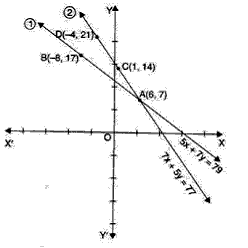
In the figure, we observe that the two lines intersect at the points A(6, 7). So, x = 6 and y = 7 is the required solution of the pair of linear equation formed, i.e., the cost of 1 book is Rs.6 and of 1 pen is Rs.7.
Therefore the cost of 1 book and 2 pens = 6 + 2 {tex}\times{/tex} 7 = Rs.20.
0Thank You