
Ask questions which are clear, concise and easy to understand.
Ask QuestionPosted by Nancy Rajput 7 years, 9 months ago
- 1 answers
Posted by Varsha Jaiswal 7 years, 9 months ago
- 3 answers
Posted by Kaur Deep 7 years, 9 months ago
- 3 answers
Posted by Love Punjabi 7 years, 9 months ago
- 2 answers
Posted by Anurag Mishra 7 years, 9 months ago
- 9 answers
Posted by Amit Singh 7 years, 9 months ago
- 2 answers
Posted by Su Sahu 6 years, 5 months ago
- 1 answers
Sia ? 6 years, 5 months ago
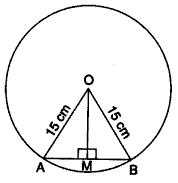
r = 15 cm, θ = 60o
Area of the minor sector = {tex}\frac\theta{360^\circ}\mathrm{πr}^2\;=\;\frac{\displaystyle60^\circ}{\displaystyle360^\circ}\times3.14\;\times15\times15{/tex} = 117.75 cm2
In {tex}\triangle{/tex}AOB, draw OM {tex}\perp{/tex} AB
In right triangle OMA and OMB,
OA = OB .........Radii of the same circle
OM = OM .........Common side
{tex}\therefore{/tex} {tex}\triangle{/tex}OMA {tex}\cong{/tex} {tex}\triangle{/tex}OMB .........RHS congruence criterion
{tex}\therefore{/tex} AM = BM .......CPCT
{tex}\Rightarrow{/tex} AM = BM = {tex}\frac 12{/tex}AB
{tex}\angle{/tex}AOM = {tex}\angle{/tex}BOM .......CPCT
{tex}\Rightarrow{/tex} {tex}\angle{/tex}AOM = {tex}\angle{/tex}BOM = {tex}\frac 12{/tex}{tex}\angle{/tex}AOB = {tex}\frac 12{/tex} {tex}\times{/tex} 60o = 30o
{tex}\therefore{/tex} In right triangle OMA, cos30o = {tex}\frac {OM}{OA}{/tex}
{tex}\Rightarrow{/tex} {tex}\frac{\sqrt3}2{/tex}= {tex}\frac {OM}{15}{/tex}
{tex}\Rightarrow{/tex} OM = {tex}\frac{15\sqrt3}2{/tex}cm
sin30o = {tex}\frac {AM}{OA}{/tex}
{tex}\Rightarrow{/tex} {tex}\frac 12{/tex}= {tex}\frac {AM}{15}{/tex}
{tex}\Rightarrow{/tex} AM = {tex}\frac{15}2{/tex}cm
{tex}\Rightarrow{/tex} AB = 15 cm
{tex}\therefore{/tex} Area of {tex}\triangle{/tex}AOB = {tex}\frac 12{/tex} {tex}\times{/tex} AB {tex}\times{/tex} OM
= {tex}\frac 12{/tex} {tex}\times{/tex} 15 {tex}\times{/tex} {tex}\frac{15\sqrt3}2{/tex} = {tex}\frac{225\sqrt3}4{/tex}
= {tex}\frac {225 × 1.73}4{/tex} = 97.3125 cm2
{tex}\therefore{/tex} Area of the corresponding minor segment of the circle = Area of minor sector - Area of {tex}\triangle{/tex}AOB
= 117.75 - 97.3125 = 20.4375 cm2
and, area of the corresponding major segment of the circle = {tex}\pi{/tex}r2 - area of the corresponding minor segment of the circle
= 3.14 {tex}\times{/tex} 15 {tex}\times{/tex} 15 - 20.4375
= 706.5 - 20.4375 = 686.0625 cm2
Posted by Raj Raghuvanshi 7 years, 9 months ago
- 1 answers
Himangshu Maji 7 years, 9 months ago
Posted by Devesh Yadav 6 years, 5 months ago
- 1 answers
Sia ? 6 years, 5 months ago
Let ABCD be a square and B (x, y) be the unknown vertex.
AB = BC
{tex} \Rightarrow {/tex} AB2 = BC2
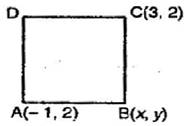
{tex} \Rightarrow {/tex} (x + 1)2 + (y - 2)2 = (x - 3)2 + (y - 2)2
{tex} \Rightarrow {/tex} x2 + 1 + 2x + y2 + 4 - 4x = x2 - 6x + 9 + y2 + 4 - 4x
{tex} \Rightarrow {/tex} 2x + 1 = - 6x + 9
{tex} \Rightarrow {/tex} 8x = 8
{tex} \Rightarrow {/tex} x = 1 ........ (i)
In {tex}\triangle{/tex}ABC, AB2 + BC2 = AC2
{tex} \Rightarrow {/tex} (x + 1)2 + (y - 2)2 + (x - 3)2 + (y - 2)2 = (3 + 1)2 + (2 - 2)2
{tex} \Rightarrow {/tex}x2 + 1 + 2x + y2 - 4x + 4 + x2 + 9 - 6x + y2 + 4 - 2y = 16 + 0
{tex} \Rightarrow {/tex} 2x2 + 2y2 + 2x - 4y - 6x - 4y + 1 + 4 + 9 + 4 = 16
{tex} \Rightarrow {/tex} 2x2 + 2y2 - 4x - 8y + 2 = 0
{tex} \Rightarrow {/tex} x2 + y2 - 2x - 4y + 1 = 0 ..... (ii)
Putting the value of x in eq. (ii),
1 + y2 - 2 - 4y + 1 = 0
{tex} \Rightarrow {/tex} y2 - 4y = 0
{tex} \Rightarrow {/tex} y(y - 4) = 0
{tex} \Rightarrow {/tex} y = 0 or 4
Hence the other vertices are (1, 0) and (1, 4).
Posted by Nancy Rajput 7 years, 9 months ago
- 6 answers
Posted by Sandhiya Nandhini 6 years, 4 months ago
- 1 answers
Sia ? 6 years, 4 months ago
The five highest cards in each suit (A- K - Q - J - 10) are called the honours or honour cards.
Posted by Miss Universe 7 years, 9 months ago
- 7 answers
Posted by Subash Kumar 7 years, 9 months ago
- 2 answers
Posted by Mahek Radadia 7 years, 9 months ago
- 0 answers
Posted by Sonal Gaur 6 years, 5 months ago
- 1 answers
Sia ? 6 years, 5 months ago
If any numbr ends with 0, then it must be divisible by 10 .Hence it should have 5 and 2 as a factors. Now the factorization of 8n are:
{tex}\therefore 8 ^ { n } = ( 2 \times 2 \times 2 ) ^ { n } = 2 ^ { n } \times 2 ^ { n } \times 2 ^ { n }{/tex}
Hence 5 is not in the factors of 8n.
From the fundamental theorem of arithmetic, we know that the prime factorization of every composite number is unique.
So it is clear that 8n is not divisible by 10.
{tex}\therefore{/tex} 8n can never end with 0.
Posted by Shubham Gupta 7 years, 9 months ago
- 0 answers
Posted by Amit Lingwal 7 years, 9 months ago
- 0 answers
Posted by Shashank Jain 7 years, 9 months ago
- 1 answers
Posted by Nancy Rajput 7 years, 9 months ago
- 0 answers
Posted by Arjun Singh 7 years, 9 months ago
- 0 answers
Posted by Mousami Gurung 7 years, 9 months ago
- 3 answers
Nivedita Singh 7 years, 9 months ago

myCBSEguide
Trusted by 1 Crore+ Students

Test Generator
Create papers online. It's FREE.

CUET Mock Tests
75,000+ questions to practice only on myCBSEguide app

Anurag Mishra 7 years, 9 months ago
0Thank You