
Ask questions which are clear, concise and easy to understand.
Ask QuestionPosted by Nancy Rajput 7 years, 9 months ago
- 3 answers
Aditya Raj 7 years, 9 months ago
Posted by Samriddhi Sharma 7 years, 9 months ago
- 1 answers
Sakshi Thakran 7 years, 9 months ago
Posted by Himanshu Khandwal 7 years, 9 months ago
- 5 answers
Subhash Ganeah Kumar 7 years, 9 months ago
Samriddhi Sharma 7 years, 9 months ago
S S 7 years, 9 months ago
Paul Bhai 7 years, 9 months ago
Samriddhi Sharma 7 years, 9 months ago
Posted by Himanshu Khandwal 7 years, 9 months ago
- 1 answers
Posted by Abdul Samad Saifi 7 years, 9 months ago
- 2 answers
Anurag Mishra 7 years, 9 months ago
Posted by Himanshu Khandwal 7 years, 9 months ago
- 2 answers
Posted by Himanshu Khandwal 7 years, 9 months ago
- 2 answers
Posted by Keshav Sharma 7 years, 9 months ago
- 3 answers
Posted by Arun Vikal 7 years, 9 months ago
- 0 answers
Posted by Anurag Mishra 7 years, 9 months ago
- 8 answers
Riddhi Khandalwal 7 years, 9 months ago
Posted by Arav Arav 7 years, 9 months ago
- 3 answers
Posted by Divyanshi Agarwal 7 years, 9 months ago
- 0 answers
Posted by Yashika Kapoor 7 years, 9 months ago
- 1 answers
Janu Sinha 7 years, 9 months ago
Posted by Tanuj Shrivastava 6 years, 4 months ago
- 1 answers
Sia ? 6 years, 4 months ago
Given: The diagonal BD of a parallelogram ABCD intersects the line segment AE at the point F, where E is any point on the side BC
To prove: DF {tex} \times{/tex} EF = FB {tex} \times{/tex} FA
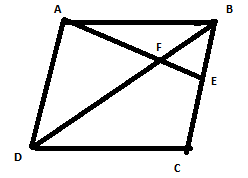
Proof: In {tex}\triangle {/tex} FBE and {tex}\triangle {/tex} FDA,
{tex}\angle{/tex} FBE = {tex}\angle{/tex} FDA ........(1) .........[Alt.Int. {tex}\angle{/tex} s]
{tex}\angle{/tex} BFE = {tex}\angle{/tex} AFD (2) ............[Vert. opp. {tex}\angle{/tex} s]
In view of (1) and (2),
{tex}\triangle {/tex}FBE ~ {tex}\triangle {/tex}FDA ..........AA similarity criterion
{tex}\therefore {/tex} {tex}\frac{{EF}}{{AF}} = \frac{{FB}}{{FD}}{/tex} .......... {tex}\because {/tex} Corresponding sides of two similar
{tex}\Rightarrow {/tex} {tex}\frac{{EF}}{{FA}} = \frac{{FB}}{{DF}}{/tex}
{tex}\Rightarrow {/tex} DF {tex} \times{/tex} EF = FB {tex} \times{/tex} FA
Posted by Harsh Khubchandani 7 years, 9 months ago
- 2 answers
Posted by ∂Αяѕнαиαα ყα∂Αѵ ??? 7 years, 9 months ago
- 0 answers
Posted by Aniket Tiwari 7 years, 9 months ago
- 2 answers
Posted by Shrishti Seth 7 years, 9 months ago
- 1 answers
Posted by Anurag Mishra 7 years, 9 months ago
- 8 answers
Posted by Anita Kesharwani 7 years, 9 months ago
- 0 answers
Posted by Nancy Rajput 7 years, 9 months ago
- 8 answers
Posted by Devangi Gajjar 7 years, 9 months ago
- 0 answers
Posted by Akhila Mihil 6 years, 5 months ago
- 1 answers
Sia ? 6 years, 5 months ago
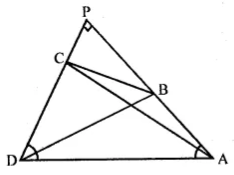
Given: In quadrilateral ABCD,
{tex}\angle A + \angle D = 90 ^ { \circ }{/tex}
AC and BD are joined
To prove: AC2 + BD2 = AD2 + BC2
Construction: Produce AB and DC to meet at P.
Proof: In {tex}\triangle{/tex}APD,
{tex}\angle A + \angle D = 90 ^ { \circ }{/tex}(given)
{tex}\therefore \angle P = 90 ^ { \circ }{/tex} {tex}\left( \because \angle A + \angle P + \angle D = 180 ^ { \circ } \right){/tex}
Now in right {tex}\triangle A C P , \angle A P D = 90 ^ { \circ }{/tex}
AC2 = PA2 + PC2 ....(i)
(Pythagoras Theorem)
and in {tex}\triangle{/tex}BPD
BD2 = PB2 + PD2
Adding (i) and (ii)
AC2 + BD2 = PA2 + PC2 + PB2 + PD2
= (PA2 + PD2) + (PC2 + PB2)
= AD2 + BD2
({tex}\therefore{/tex} In right {tex}\triangle{/tex}APD, PA2 + PD2 = AD2 and similarly PC2 + PB2 = BD2)
Posted by Anureeta Sinha 6 years, 4 months ago
- 1 answers
Posted by Savya Saachein 6 years, 5 months ago
- 1 answers
Sia ? 6 years, 5 months ago
We have,
Diameter of the sphere = 6 cm
{tex}\therefore{/tex} Radius of the sphere = {tex}\frac { 6 } { 2 } \mathrm { cm } = 3 \mathrm { cm }{/tex}
{tex}\Rightarrow{/tex} Volume of the sphere ={tex}= \frac { 4 } { 3 } \times \pi \times 3 ^ { 3 } \mathrm { cm } ^ { 3 } = 36 \pi \mathrm { cm } ^ { 3 }{/tex} {tex}\left[ \text { Using } V = \frac { 4 } { 3 } \pi r ^ { 3 } \right]{/tex}
Let the radius of cross-section of wire be r cm. It is given that the length of the cylindrical shaped wire is 36 m.
{tex}\therefore{/tex} Volume of the wire = {tex}\left( \pi r ^ { 2 } \times 3600 \right) \mathrm { cm } ^ { 3 }{/tex}
Since metallic sphere is converted into cylindrical shaped wire. Therefore, Volume of the wire = Volume of the sphere
{tex}\Rightarrow \quad \pi r ^ { 2 } \times 3600 = 36 \pi{/tex}
{tex}\Rightarrow \quad r ^ { 2 } = \frac { 36 \pi } { 3600 \pi } = \frac { 1 } { 100 }{/tex}
{tex}\Rightarrow \quad r = \frac { 1 } { 10 } \mathrm { cm } = 1 \mathrm { mm }{/tex}
Posted by Varad Thakur 7 years, 9 months ago
- 0 answers
Posted by Diya Dutta 6 years, 5 months ago
- 1 answers
Sia ? 6 years, 5 months ago
Let P (x1, y1) Q(x2, y2) and R(x3, y3) be the points which divide the line segment AB into four equal parts.

Then, P divides AB in the ratio 1 : 3 internally.
{tex}x=\frac{mx_2+nx_1}{m+n}{/tex}
{tex}\therefore x _ { 1 } = \frac { ( 1 ) ( 2 ) + ( 3 ) ( - 2 ) } { 1 + 3 }{/tex}
{tex}= \frac { 2 - 6 } { 4 } = - \frac { 4 } { 4 } = - 1{/tex}
{tex}y=\frac{my_2+ny_1}{m+n}{/tex}
{tex}y _ { 1 } = \frac { ( 1 ) ( 8 ) + ( 3 ) ( 2 ) } { 1 + 3 }{/tex}
{tex}= \frac { 8 + 6 } { 4 } = \frac { 14 } { 4 } = \frac { 7 } { 2 }{/tex}
So, {tex}\mathrm { P } \rightarrow \left( - 1 , \frac { 7 } { 2 } \right){/tex}
Also, Q divides AB in the ratio 1 : 1 i.e.
Q is the mid point of AB
{tex}x _ { 2 } = \frac { - 2 + 2 } { 2 } = 0{/tex}
{tex}y _ { 2 } = \frac { 2 + 8 } { 2 } = \frac { 10 } { 2 } = 5{/tex}
So, {tex}Q \rightarrow ( 0,5 ){/tex}
and, R divides AB in the ratio 3 : 1
{tex}\therefore x _ { 2 } = \frac { ( 3 ) ( 2 ) + ( 1 ) ( - 2 ) } { 3 + 1 }{/tex}
{tex}= \frac { 6 - 2 } { 4 } = \frac { 4 } { 4 } = 1{/tex}
{tex}y _ { 3 } = \frac { ( 3 ) ( 8 ) + ( 1 ) ( 2 ) } { 3 + 1 }{/tex}
{tex}= \frac { 24 + 2 } { 4 } = \frac { 26 } { 4 } = \frac { 13 } { 2 }{/tex}
So, {tex}\mathrm { R } \rightarrow \left( 1 , \frac { 13 } { 2 } \right){/tex}
Posted by Samaayra Bharti 7 years, 9 months ago
- 7 answers

myCBSEguide
Trusted by 1 Crore+ Students

Test Generator
Create papers online. It's FREE.

CUET Mock Tests
75,000+ questions to practice only on myCBSEguide app

Nancy Rajput 7 years, 9 months ago
0Thank You