
Ask questions which are clear, concise and easy to understand.
Ask QuestionPosted by Sangeeta Adhikari 7 years, 9 months ago
- 4 answers
Posted by Pranav Chaudhari 7 years, 9 months ago
- 5 answers
Posted by Bhumika Goyal 7 years, 9 months ago
- 0 answers
Posted by Reet Kaur 7 years, 9 months ago
- 8 answers
Posted by Arav Arav 7 years, 9 months ago
- 10 answers
Posted by Arav Arav 7 years, 9 months ago
- 0 answers
Posted by Divya Nanaware 6 years, 4 months ago
- 1 answers
Sia ? 6 years, 4 months ago
We know,
{tex}{T_n} = {\sin ^n}\theta + {\cos ^n}\theta {/tex}
{tex}\therefore {T_3} = {\sin ^3}\theta + {\cos ^3}\theta {/tex}
{tex}{T_5} = {\sin ^5}\theta + {\cos ^5}\theta {/tex}
{tex}{T_1} = \sin \theta + \cos \theta {/tex}
{tex}{T_7} = {\sin ^7}\theta + {\cos ^7}\theta {/tex}+ cot{tex}\theta{/tex} = m and cosec{tex}\theta{/tex} - cot{tex}\theta{/tex} = n,
LHS {tex} = \frac{{{T_3} - {T_5}}}{{{T_1}}}{/tex}
{tex} = \frac{{{{\sin }^3}\theta + {{\cos }^3}\theta - \left( {{{\sin }^5}\theta + {{\cos }^5}\theta } \right)}}{{\sin \theta + \cos \theta }}{/tex}
{tex} = \frac{{{{\sin }^3}\theta + {{\cos }^3}\theta - {{\sin }^5}\theta - {{\cos }^5}\theta }}{{\sin \theta + \cos \theta }}{/tex}
{tex} = \frac{{{{\sin }^3}\theta - {{\sin }^5}\theta + {{\cos }^3}\theta - {{\cos }^5}\theta }}{{\sin \theta + \cos \theta }}{/tex}
{tex} = \frac{{{{\sin }^3}\theta (1 - {{\sin }^2}\theta ) + {{\cos }^3}\theta (1 - {{\cos }^2}\theta )}}{{\sin \theta + \cos \theta }}{/tex}
{tex} = \frac{{{{\sin }^3}\theta {{\cos }^2}\theta + {{\cos }^3}\theta {{\sin }^2}\theta }}{{\sin \theta + \cos \theta }}{/tex} {tex}\left[ \begin{gathered} \because 1 - {\sin ^2}\theta = {\cos ^2}\theta \hfill \\ 1 - {\cos ^2}\theta = {\sin ^2}\theta \hfill \\ \end{gathered} \right]{/tex}
{tex} = \frac{{{{\sin }^2}\theta {{\cos }^2}\theta (\sin \theta + \cos \theta )}}{{(\sin \theta + \cos \theta )}}{/tex}
{tex} = {\sin ^2}\theta {\cos ^2}\theta {/tex}
RHS {tex} = \frac{{{T_5} - {T_7}}}{{{T_3}}}{/tex}
{tex} = \frac{{{{\sin }^5}\theta + {{\cos }^5}\theta - ({{\sin }^7}\theta + {{\cos }^7}\theta )}}{{\left( {{{\sin }^3}\theta + {{\cos }^3}\theta } \right)}}{/tex}
{tex} = \frac{{{{\sin }^5}\theta + {{\cos }^5}\theta - {{\sin }^7}\theta - {{\cos }^7}\theta }}{{({{\sin }^3}\theta + {{\cos }^3}\theta )}}{/tex}
{tex} = \frac{{{{\sin }^5}\theta - {{\sin }^7}\theta + {{\cos }^5}\theta - {{\cos }^7}\theta }}{{{{\sin }^3}\theta + {{\cos }^3}\theta }}{/tex}
{tex} = \frac{{{{\sin }^5}\theta \left( {1 - {{\sin }^2}\theta } \right) + {{\cos }^5}\theta \left( {1 - {{\cos }^2}\theta } \right)}}{{{{\sin }^3}\theta + {{\cos }^3}\theta }}{/tex}
{tex} = \frac{{{{\sin }^5}\theta {{\cos }^2}\theta + {{\cos }^5}\theta {{\sin }^2}\theta }}{{{{\sin }^3}\theta + {{\cos }^3}\theta }}{/tex}
{tex} = \frac{{{{\sin }^2}\theta {{\cos }^2}\theta \left( {{{\sin }^3}\theta + {{\cos }^3}\theta } \right)}}{{\left( {{{\sin }^3}\theta + {{\cos }^3}\theta } \right)}}{/tex}
{tex} = {\sin ^2}\theta {\cos ^2}\theta {/tex}
LHS = RHS
Hence proved.
Posted by Riddhi Khandalwal 7 years, 9 months ago
- 8 answers
Anurag Mishra 7 years, 9 months ago
Ananya Mishra 7 years, 9 months ago
Posted by Arav Arav 7 years, 9 months ago
- 2 answers
Arav Arav 7 years, 9 months ago
Posted by Manish Narang 6 years, 5 months ago
- 1 answers
Sia ? 6 years, 5 months ago
According to the question,the given equation is,
(a2 + b2)x2 - 2(ac + bd)x + (c2 + d2) = 0
The discriminant of the given equation is given by
D = [-2(ac + bd)]2 - 4 {tex}\times{/tex} (a2 + b2) {tex}\times{/tex} (c2 + d2)
{tex}\Rightarrow{/tex} D = 4(ac + bd)2 - 4(a2c2 + a2d2 + b2c2 + b2d2)
{tex}\Rightarrow{/tex} D = 4(a2c2 + b2d2 + 2abcd) - 4(a2c2 + a2d2 + b2c2 + b2d2)
{tex}{/tex}
{tex}{/tex}D= 4(2abcd - a2d2 - b2c2)
{tex}\Rightarrow{/tex} D = -4[(ad)2 + (bc)2 - 2(ad)(bc)]
{tex}\Rightarrow{/tex} D = -4(ad - bc)2
Since the roots of the given equation are given to be equal, therefore,
Discriminant, D = 0
{tex}\Rightarrow{/tex} -4(ad - bc)2 = 0
{tex}\Rightarrow{/tex} (ad - bc)2 = 0 [as -4 {tex}\ne{/tex} 0]
{tex}\Rightarrow{/tex} ad - bc = 0
{tex}\Rightarrow{/tex} ad = bc
{tex} \Rightarrow \frac{a}{b} = \frac{c}{d}{/tex}
Posted by Satyam Choudhary 7 years, 9 months ago
- 1 answers
Posted by Yash Jangra 7 years, 9 months ago
- 2 answers
Posted by Samriddhi Sharma 7 years, 9 months ago
- 7 answers
Samriddhi Sharma 7 years, 9 months ago
Samriddhi Sharma 7 years, 9 months ago
Dream Girl 7 years, 9 months ago
Posted by Arav Arav 7 years, 9 months ago
- 0 answers
Posted by Pratham Gulati 6 years, 4 months ago
- 1 answers
Sia ? 6 years, 4 months ago
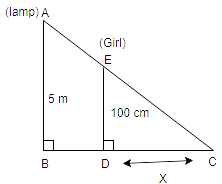
Let AB be the lamp-post, DE be the girl and D be the position of girl after 4s.
Again, let DC = xm be the length of shadow of the girl.
Given, DE = 100 cm =1 m, AB =5 m and speed of the girl= 1.9 m/s
{tex}\therefore{/tex} Distance of the girl from lamp-post after 4 s = BD = {tex}1.9\times4=7.6\;m{/tex} [{tex}\;\because{/tex} Distance = speed {tex}\times{/tex} time ]
In {tex}\triangle ABC{/tex} and {tex}\triangle EDC{/tex}, {tex}\angle B=\angle D{/tex}
[{tex}\;\because{/tex}each {tex}90^o{/tex}]
{tex}\angle C=\angle C{/tex} [ {tex}\;\because{/tex}common angle ]
{tex}\therefore \triangle ABC\sim \triangle EDC{/tex} [{tex}\;\because{/tex} by AA similarity criterion ]
{tex}\Rightarrow \frac{BC}{DC}=\frac{AB}{DE}{/tex} {tex}\;\because{/tex}[since, corresponding sides of similar triangles are proportional]...(i)
On substituting all the values in Eq(i), we get
{tex}\frac{7.6+x}{x}=\frac{5}{1}{/tex}
{tex}\Rightarrow 7.6+x=5x{/tex}
{tex}\Rightarrow 7.6 =5x- x{/tex}
{tex}\Rightarrow 7.6 =4x{/tex}
{tex}\Rightarrow x =\frac{7.6}{4}{/tex}
{tex}\Rightarrow x=1.9\;m{/tex}
Hence the length of her shadow after 4 s is 1.9 m.
Posted by Bitthal Patel 7 years, 9 months ago
- 2 answers
Paul Bhai 7 years, 9 months ago
Posted by D R 7 years, 9 months ago
- 0 answers
Posted by Nancy Rajput 7 years, 9 months ago
- 0 answers
Posted by Rakesh Singh 6 years, 5 months ago
- 1 answers
Sia ? 6 years, 5 months ago
Flow rate {tex}= \frac { \text { Volumetric flow rate } } { \text { Area } }{/tex}
Area = {tex}\pi r ^ { 2 }{/tex}
{tex}= \frac { 22 } { 7 } \times \frac { 7 } { 2 } \times \frac { 7 } { 2 } = 38.5 \mathrm { cm } ^ { 2 }{/tex}
Volumetric flow rate = 192.5 l/min.
Since 1 l = 0.001 m3 = 1000 cm3
So, volumetric flow rate = 192.5 {tex}\times{/tex} 1000 cm3/min
So, flow rate per 38.5 cm2 {tex}= \frac { 192.5 \times 1000 \space cm^3 /min} { 38.5\space cm^2 } {/tex}
{tex}\Rightarrow{/tex} flow rate = 5000 cm/min
{tex}= \frac { 5000 \times 0.00001 \mathrm { km } } { \left( \frac { 1 } { 60 } \right) \mathrm { h } }{/tex}
= 3 km/hr
Thus, water is flowing at the speed of 3 km/hr in the water pipe
Posted by Rishi Jain 7 years, 9 months ago
- 0 answers
Posted by Savar Jaiswal 7 years, 9 months ago
- 0 answers
Posted by Rishi Jain 6 years, 5 months ago
- 1 answers
Sia ? 6 years, 5 months ago
Let the four numbers be {tex}a - 3d, a - d, a + d, a + 3d{/tex}
{tex}\therefore{/tex} {tex}a - 3d + a - d + a + d + a + 3d {/tex}= 56
or, {tex}4a = 56{/tex}
or, {tex}a = 14{/tex}
Hence numbers are {tex}14 - 3d, 14 - d, 14 + d, 14 + 3d{/tex}
Now, according to question,
{tex}\frac { ( 14 - 3 d ) ( 14 + 3 d ) } { ( 14 - d ) ( 14 + d ) } = \frac { 5 } { 6 }{/tex}
or, {tex}\frac { 196 - 9 d ^ { 2 } } { 196 - d ^ { 2 } } = \frac { 5 } { 6 }{/tex}
or, {tex}6(196 - 9d^2) = 5(196 - d^2){/tex}
or, {tex}6 \times 196 - 54 d ^ { 2 } = 5 \times 196 - 5 d ^ { 2 }{/tex}
or, {tex}6 \times 196 - 5 \times 196 = 54 d ^ { 2 } - 5 d ^ { 2 }{/tex}
or, {tex}( 6 - 5 ) \times 196 = 49 d ^ { 2 }{/tex}
or, {tex} 196 = 49 d ^ { 2 }{/tex}
or, {tex}d ^ { 2 } = \frac { 196 } { 49 } = 4{/tex}
or, {tex}d = \pm 2{/tex}
Therefore, Numbers are
{tex}14 - 3 \times 2 , \quad 14 - 2 , \quad 14 + 2 , \quad 14 + 3 \times 2{/tex}
{tex}14 - 6, 12, 16, 14 + 6{/tex}
{tex}8, 12, 16, 20{/tex}
Posted by Savar Jaiswal 7 years, 9 months ago
- 2 answers
Posted by Rajiv Prasad 6 years, 5 months ago
- 1 answers
Sia ? 6 years, 5 months ago

Let AB and CD be the two posts such that AB = 2CD.
and the distance between the two posts given as k
Let M be the mid-point of CA. Let {tex}\angle{/tex}CMD = {tex}\theta{/tex}
and {tex}\angle{/tex}AMB = 90° -{tex}\theta{/tex}
Clearly, {tex}\mathrm { CM } = M A = \frac { 1 } { 2 } k{/tex}
Let CD = h, then AB = 2h
Now, {tex}\frac { A B } { A M } = \tan \left( 90 ^ { \circ } - \theta \right) = \cot \theta{/tex}
{tex}\Rightarrow \quad \frac { 2 h } { \left( \frac { k } { 2 } \right) } = \cot \theta{/tex}
{tex}\Rightarrow \quad \cot \theta = \frac { 4 h } { k }{/tex} ...(i)
Also in {tex}\triangle {/tex}CMD, {tex}\frac { C D } { C M } = \tan \theta{/tex}
{tex}\Rightarrow \quad \frac { h } { \frac { k } { 2 } } = \tan \theta{/tex}
{tex}\Rightarrow \quad \tan \theta = \frac { 2 h } { k }{/tex} ........(ii)
Multiplying (i) and (ii), {tex}\frac { 4 h } { k } \times \frac { 2 h } { k } = 1{/tex}
{tex}\therefore \quad h ^ { 2 } = \frac { k ^ { 2 } } { 8 }{/tex}
{tex}\Rightarrow \quad h = \frac { k } { 2 \sqrt { 2 } } = \frac { k \sqrt { 2 } } { 4 }{/tex}

myCBSEguide
Trusted by 1 Crore+ Students

Test Generator
Create papers online. It's FREE.

CUET Mock Tests
75,000+ questions to practice only on myCBSEguide app

Haardik Ravat 7 years, 9 months ago
0Thank You