
Ask questions which are clear, concise and easy to understand.
Ask QuestionPosted by Muhammed Fahim 7 years, 9 months ago
- 0 answers
Posted by Amit Singh 7 years, 9 months ago
- 3 answers
Nishant Verma 7 years, 9 months ago
Deepali Bhardwaj 7 years, 9 months ago
Posted by Goldi Soni 7 years, 9 months ago
- 0 answers
Posted by Madhav Gautam 7 years, 9 months ago
- 3 answers
Namrata Nath 7 years, 9 months ago
Posted by Samiksha Srivastava 7 years, 9 months ago
- 1 answers
Posted by Kunal Arya 7 years, 9 months ago
- 1 answers
Rashi Malik 7 years, 9 months ago
Posted by Namrata Nath 7 years, 9 months ago
- 0 answers
Posted by Sidharth Rana 6 years, 4 months ago
- 1 answers
Sia ? 6 years, 4 months ago
Given points are collinear. Therefore
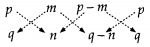
[p {tex}\times{/tex} n + m(q - n) + (p - m) q] - [m {tex}\times{/tex} q + (p - m) n + p (q - n)] = 0
{tex}\Rightarrow{/tex} (pn + qm - mn + pq - mq) - (mq + pn - mn + pq - pn) = 0
{tex}\Rightarrow{/tex} (pn + p q - mn) - (mq - mn + pq) = 0
{tex}\Rightarrow{/tex} pn - mq = 0
{tex}\Rightarrow{/tex} pn = qm
Posted by Ziya Sharma 7 years, 9 months ago
- 4 answers
Posted by Nishu Jaat 7 years, 9 months ago
- 2 answers
Cutiee Princess 7 years, 9 months ago
Posted by Namrata Nath 7 years, 9 months ago
- 3 answers
Cutiee Princess 7 years, 9 months ago
Posted by Sakshi Chauhan 7 years, 9 months ago
- 6 answers
Posted by Navi Saggu 7 years, 9 months ago
- 1 answers
Nikhil Raj Mehta 7 years, 9 months ago
Posted by Vijay Kumar 6 years, 4 months ago
- 1 answers
Sia ? 6 years, 4 months ago
According to the question, A(0, - 1),D(1, 0) and E(0,1).
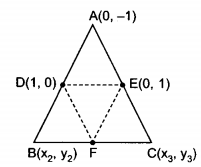
Let coordinates of B and C are (x2, y2) and (x3, y3) respectively.
D is mid-point of AB,
{tex}\therefore{/tex} 1 = {tex}\frac { 0 + x _ { 2 } } { 2 }{/tex}
{tex}\Rightarrow{/tex} x2 = 2
and 0 = {tex}\frac { - 1 + y _ { 2 } } { 2 }{/tex}
{tex}\Rightarrow{/tex} y2 = 1
{tex}\therefore{/tex} Coordinates of B are (2, 1)
E is mid-point of AC
{tex}\therefore{/tex} 0 = {tex}\frac { 0 + x _ { 3 } } { 2 }{/tex}
{tex}\Rightarrow{/tex} x3 = 0
and 1 = {tex}\frac { - 1 + y _ { 3 } } { 2 }{/tex}
{tex}\Rightarrow{/tex} y3 = 3
{tex}\therefore{/tex} Coordinates of C are (0, 3)
Area of {tex}\triangle{/tex}ABC
{tex}= \frac { 1 } { 2 }{/tex} {tex}[0(1 - 3) + 2(3 + 1) + 0(-1 + -1)]{/tex}
{tex}= \frac { 1 } { 2 }{/tex} {tex}\times{/tex} 8 = 4 sq. units
F is mid-point of BC
{tex}\therefore{/tex} Coordiantes F are {tex}\left( \frac { 2 + 0 } { 2 } , \frac { 1 + 3 } { 2 } \right){/tex}, i.w, (1, 2).
Area {tex}\triangle{/tex}DEF
{tex}= \frac { 1 } { 2 }{/tex} {tex}[1(2 - 1) + (1 - 0) + 0(0 - 2)]{/tex}
{tex}= \frac { 1 } { 2 }{/tex} [1 + 1] = 1 sq. units
Posted by Kajal Bhatotia 7 years, 9 months ago
- 1 answers
Posted by Viahal Pandat 7 years, 9 months ago
- 3 answers
Posted by Vikash Kumar 7 years, 9 months ago
- 4 answers
Posted by Naveen Singh 7 years, 9 months ago
- 2 answers
Garima Gupta 7 years, 9 months ago
Rex Cartin 7 years, 9 months ago
Posted by Rahul Kumar 7 years, 9 months ago
- 2 answers
Posted by Rinkle Prajapati 7 years, 9 months ago
- 4 answers
Rex Cartin 7 years, 9 months ago
Posted by Rinkle Prajapati 7 years, 9 months ago
- 4 answers
Posted by Rinkle Prajapati 7 years, 9 months ago
- 2 answers
Posted by Nancy Rajput 7 years, 9 months ago
- 9 answers
Posted by Evlia Saiju 6 years, 5 months ago
- 1 answers
Sia ? 6 years, 5 months ago
Let A be the first term and D be the common difference ofthe given AP. Then,
Tp = a {tex}\Rightarrow{/tex} A + (p - 1) D = a ...(i)
and Tq = b {tex}\Rightarrow{/tex} A + (q - 1) D = b ...(ii)
On subtracting Eq. (ii) from Eq. (i), we get
(p - q) D = a - b {tex}\Rightarrow{/tex} D = {tex}\frac { a - b } { p - q }{/tex} ...(iii)
On adding Eqs. (i) and (ii), we get
2A + (p + q - 2) D = a + b
{tex}\Rightarrow{/tex} 2A + pD + qD - 2D = a + b
{tex}\Rightarrow{/tex} 2A + pD + qD - D = a + b + D
{tex}\Rightarrow{/tex} 2A + (p + q - 1) D = a + b + D
2A + (p + q - 1) D = a + b + {tex}\left( \frac { a - b } { p - q } \right){/tex} [from Eq. (iii)] ...(iv)
Now, Sp+q = {tex}\frac { p + q } { 2 }{/tex} [2A + (p + q - 1) D]
= {tex}\frac { p + q } { 2 }{/tex} [a+ b + {tex}\frac { a - b } { p - q }{/tex}] [from Eq. (iv)]
Hence proved.
Posted by Armaan D 7 years, 9 months ago
- 5 answers
Posted by Vivek Chauhan 7 years, 9 months ago
- 1 answers

myCBSEguide
Trusted by 1 Crore+ Students

Test Generator
Create papers online. It's FREE.

CUET Mock Tests
75,000+ questions to practice only on myCBSEguide app
