
Ask questions which are clear, concise and easy to understand.
Ask QuestionPosted by Prince Yadav 7 years, 8 months ago
- 0 answers
Posted by Yatin Mandotia 7 years, 8 months ago
- 0 answers
Posted by Ankit Shukla 7 years, 8 months ago
- 1 answers
Manan Khandelwal 7 years, 8 months ago
Posted by Shah Fahad 7 years, 8 months ago
- 0 answers
Posted by Sauravroy Roy 7 years, 8 months ago
- 0 answers
Posted by Rajesh Thapa 7 years, 8 months ago
- 1 answers
Posted by Arvind Kumar 7 years, 8 months ago
- 2 answers
Ankit Shukla 7 years, 8 months ago
Akshay Kumar 7 years, 8 months ago
Posted by Hrugved Lakhapati 7 years, 8 months ago
- 0 answers
Posted by Anshul Sharma 7 years, 8 months ago
- 0 answers
Posted by Anshul Sharma 7 years, 8 months ago
- 0 answers
Posted by Renu Singh 7 years, 8 months ago
- 0 answers
Posted by Dori Nobi Em 7 years, 8 months ago
- 1 answers
Posted by Manish Simgh 7 years, 8 months ago
- 2 answers
Saurav Kumar 7 years, 8 months ago
Posted by Shaik Mohseen 7 years, 8 months ago
- 0 answers
Posted by Arjun Agarwal 6 years, 6 months ago
- 1 answers
Sia ? 6 years, 6 months ago
If possible, let {tex}\sqrt { 6 }{/tex} be rational and let its simplest form be {tex}\frac { a } { b }{/tex} then, a and b are integers having no common factor other than 1, and {tex}b \neq 0{/tex}.
Now, {tex}\sqrt { 6 } = \frac { a } { b } {/tex}
{tex}\Rightarrow 6 = \frac { a ^ { 2 } } { b ^ { 2 } }{/tex} [on squaring both sides]
{tex}\Rightarrow 6b^2 = a^2{/tex} .................(i)
{tex}\Rightarrow{/tex} 6 divides {tex}a^2{/tex} [{tex}\because{/tex} 6 divides {tex}6b^2{/tex}]
{tex}\Rightarrow{/tex} 6 divides {tex}a{/tex}
Let {tex}a = 6c{/tex} for some integer {tex}c{/tex}
putting {tex} a = 6c{/tex} in (i), we get
{tex}a^2 = 36c^2{/tex}
{tex}6b^2 = 36c^2 \;\;\;[6b^2 = a^2] {/tex}
{tex}\Rightarrow b^2 = 6c^2{/tex}
{tex}\Rightarrow{/tex} 6 divides {tex}b^2{/tex} [{tex}\because{/tex} 6 divides {tex}6c^2{/tex}]
{tex}\Rightarrow{/tex} 6 divides {tex}b{/tex} [{tex}\because{/tex} 6 divides {tex}b^2 = 6{/tex} divides {tex}b{/tex}]
Thus, 6 is a common factors of {tex}a{/tex} and {tex}b{/tex}
But, this contradicts the fact that {tex}a{/tex} and {tex}b{/tex} have no common factor other than 1
The contradiction arises by assuming that {tex}\sqrt { 6 }{/tex} is rational.
Hence {tex}\sqrt { 6 }{/tex} is irrational.
Posted by Jatin Saini 6 years, 5 months ago
- 1 answers
Sia ? 6 years, 5 months ago
Given: {tex}\Delta ABC \sim \Delta PQR{/tex}
Since we know that ,the ratio of area of two similar triangles is equal to the square of ratio of their corresponding sides. Thus,
{tex}\frac{\text { ar } \triangle \mathrm{ABC}}{\text { ar } \triangle \mathrm{PQR}}{/tex} = {tex}\frac{\mathrm{AB}^{2}}{\mathrm{PQ}^{2}}{/tex} = {tex}\left(\frac{1}{3}\right)^{2}{/tex} = {tex}\frac{1}{9}{/tex}
Posted by Krishika Pandhi 6 years, 5 months ago
- 1 answers
Sia ? 6 years, 5 months ago
Let take that 6 + √2 is a rational number.
So we can write this number as
6 + √2 = a/b
Here a and b are two co-prime number and b is not equal to 0
Subtract 6 both side we get
√2 = a/b – 6
√2 = (a-6b)/b
Here a and b are an integer so (a-6b)/b is a rational number so √2 should be a rational number But √2 is an irrational number so it is contradicting
Hence result is 6 + √2 is a irrational number
Posted by Monisha Ishu 7 years, 8 months ago
- 2 answers
Ash Ketchup 7 years, 8 months ago
Pavan Parthu 7 years, 8 months ago
Posted by Nemarki Bamon 7 years, 8 months ago
- 0 answers
Posted by Pranay Ghangare 6 years, 6 months ago
- 1 answers
Sia ? 6 years, 6 months ago
If a and b are odd numbers then it should be in 2q+1 or 2q+3 form where q is a positive integer.
Let a = 2q + 3 , b = 2q + 1 and a > b
Now, {tex}\frac{a + b } {2} = \frac{ 2q + 3 + 2q + 1}{2}{/tex}
{tex}= \frac { 4 q + 4 } { 2 }{/tex}
= 2q + 2
{tex}\frac{a+b}{2}{/tex}=2(q+1) = an even number..........(1)
Now,
{tex}\frac { a - b } { 2 } = \frac { ( 2 q + 3 ) - ( 2 q + 1 ) } { 2 }{/tex}
{tex}= \frac { 2 q + 3 - 2 q - 1 } { 2 }{/tex}
{tex}\frac{a-b}{2}= \frac { 2 } { 2 }{/tex} = 1 = an odd number..........(2)
Hence From (1) and (2) {tex}\frac{a+b}{2}{/tex} and {tex}\frac{a-b}{2}{/tex} are even and odd numbers respectively
Posted by Amit Kumar 7 years, 8 months ago
- 0 answers
Posted by Sneha Gupta 7 years, 8 months ago
- 0 answers
Posted by Advent Holy 7 years, 8 months ago
- 2 answers
Posted by Swaneet Singh 7 years, 8 months ago
- 1 answers
Posted by Niharika Choudhary 6 years, 6 months ago
- 1 answers
Sia ? 6 years, 6 months ago
In {tex}\triangle P Q R{/tex}
{tex}\because \angle Q = 90 ^ { \circ }{/tex}
{tex}\therefore P R ^ { 2 } = P Q ^ { 2 } + Q R ^ { 2 }{/tex} By Pythagoras theorem
{tex}\Rightarrow ( 25 - \mathrm { QR } ) ^ { 2 } = ( 5 ) ^ { 2 } + \mathrm { QR } ^ { 2 }{/tex} {tex}\therefore \mathrm { PR } + \mathrm { QR } = 25 ( \mathrm { given } ){/tex}
{tex}\Rightarrow 625 + \mathrm { QR } ^ { 2 } - 50 \mathrm { QR } = 25 + \mathrm { QR } ^ { 2 }{/tex}
{tex}\Rightarrow 50 \mathrm { QR } = 600 \Rightarrow \mathrm { QR } = \frac { 600 } { 50 } = 12 \mathrm { cm }{/tex}
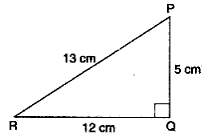
Now, {tex}\mathrm { PR } + \mathrm { QR } = 25 \Rightarrow \mathrm { PR } + 12 = 25{/tex}
{tex}\Rightarrow \mathrm { PR } = 25 - 12 \Rightarrow \mathrm { Pr } = 13 \mathrm { cm }{/tex}
So, {tex}\sin \mathrm { P } = \frac { \mathrm { QR } } { \mathrm { PR } } = \frac { 12 } { 13 }{/tex}
{tex}\cos P = \frac { P Q } { P R } = \frac { 5 } { 13 }{/tex}
and {tex}\tan P = \frac { Q R } { P Q } = \frac { 12 } { 5 }{/tex}
Posted by Niharika Choudhary 6 years, 6 months ago
- 1 answers
Sia ? 6 years, 6 months ago
In {tex}\triangle P Q R{/tex}
{tex}\because \angle Q = 90 ^ { \circ }{/tex}
{tex}\therefore P R ^ { 2 } = P Q ^ { 2 } + Q R ^ { 2 }{/tex} By Pythagoras theorem
{tex}\Rightarrow ( 25 - \mathrm { QR } ) ^ { 2 } = ( 5 ) ^ { 2 } + \mathrm { QR } ^ { 2 }{/tex} {tex}\therefore \mathrm { PR } + \mathrm { QR } = 25 ( \mathrm { given } ){/tex}
{tex}\Rightarrow 625 + \mathrm { QR } ^ { 2 } - 50 \mathrm { QR } = 25 + \mathrm { QR } ^ { 2 }{/tex}
{tex}\Rightarrow 50 \mathrm { QR } = 600 \Rightarrow \mathrm { QR } = \frac { 600 } { 50 } = 12 \mathrm { cm }{/tex}
Now, {tex}\mathrm { PR } + \mathrm { QR } = 25 \Rightarrow \mathrm { PR } + 12 = 25{/tex}
{tex}\Rightarrow \mathrm { PR } = 25 - 12 \Rightarrow \mathrm { Pr } = 13 \mathrm { cm }{/tex}
So, {tex}\sin \mathrm { P } = \frac { \mathrm { QR } } { \mathrm { PR } } = \frac { 12 } { 13 }{/tex}
{tex}\cos P = \frac { P Q } { P R } = \frac { 5 } { 13 }{/tex}
and {tex}\tan P = \frac { Q R } { P Q } = \frac { 12 } { 5 }{/tex}
Posted by Shubham Gupta 7 years, 8 months ago
- 0 answers

myCBSEguide
Trusted by 1 Crore+ Students

Test Generator
Create papers online. It's FREE.

CUET Mock Tests
75,000+ questions to practice only on myCBSEguide app
