
Ask questions which are clear, concise and easy to understand.
Ask QuestionPosted by Sumit Kashyap 7 years, 8 months ago
- 1 answers
Posted by Shanthi Menon 6 years, 6 months ago
- 1 answers
Sia ? 6 years, 6 months ago
We have to find out that whether 18n can end with the digit 0 or 5 for any natural number n
If any number ends with the digit 0 then its factors must be in the form : 2m {tex} \times {/tex} 5n
If any number ends with the digit 5 then its factors must be in form : 5m {tex} \times {/tex} 3n or 5m {tex} \times {/tex} 7n
So for any number to end with the digit 0 or 5 its factors must be in form 5m {tex} \times {/tex} 3n or 5m {tex} \times {/tex} 7n or 2m {tex} \times {/tex} 5n (where m and n are positive integers)
Now, 18 = 2 × 9 = 2 × 3 × 3 = 2 × 32
So, 18n = (2 × 32)n = 2n × (32)n= 2n × 32n
18n is not in the form of 5m × 3n or 5m × 7n or 2m × 5n
So, 18n cannot end with 0 or 5 for any natural number n.
Posted by Keshav Kumar 7 years, 8 months ago
- 1 answers
Posted by Dhanashree Bhokrikar 7 years, 8 months ago
- 0 answers
Posted by Sneha Singh 7 years, 8 months ago
- 1 answers
Posted by Adarsh Kumar 7 years, 8 months ago
- 0 answers
Posted by Ajeet Kumar 7 years, 8 months ago
- 0 answers
Posted by Pranav Goenka 7 years, 8 months ago
- 0 answers
Posted by Deepak Jadhawar 7 years, 8 months ago
- 1 answers
Posted by Aaliyah Rauf 7 years, 8 months ago
- 0 answers
Posted by Karl Joshua 7 years, 8 months ago
- 1 answers
Posted by Sarat Chandra 7 years, 8 months ago
- 0 answers
Posted by Darshan Jain 7 years, 8 months ago
- 0 answers
Posted by Aryan Vishwakarma 7 years, 8 months ago
- 1 answers
Posted by Gagandeep Yadav 7 years, 8 months ago
- 0 answers
Posted by Neha Argade 7 years, 8 months ago
- 0 answers
Posted by Nisha Saharia 7 years, 8 months ago
- 2 answers
Joy Dutta 7 years, 8 months ago
Posted by Bablu Yadav 7 years, 8 months ago
- 3 answers
Posted by Pratham Pandit 7 years, 8 months ago
- 4 answers
Posted by Kamlesh Sati 7 years, 8 months ago
- 0 answers
Posted by Priya Rajshekhar 6 years, 6 months ago
- 1 answers
Sia ? 6 years, 6 months ago
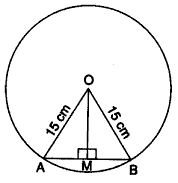
r = 15 cm, θ = 60o
Area of the minor sector = {tex}\frac\theta{360^\circ}\mathrm{πr}^2\;=\;\frac{\displaystyle60^\circ}{\displaystyle360^\circ}\times3.14\;\times15\times15{/tex} = 117.75 cm2
In {tex}\triangle{/tex}AOB, draw OM {tex}\perp{/tex} AB
In right triangle OMA and OMB,
OA = OB .........Radii of the same circle
OM = OM .........Common side
{tex}\therefore{/tex} {tex}\triangle{/tex}OMA {tex}\cong{/tex} {tex}\triangle{/tex}OMB .........RHS congruence criterion
{tex}\therefore{/tex} AM = BM .......CPCT
{tex}\Rightarrow{/tex} AM = BM = {tex}\frac 12{/tex}AB
{tex}\angle{/tex}AOM = {tex}\angle{/tex}BOM .......CPCT
{tex}\Rightarrow{/tex} {tex}\angle{/tex}AOM = {tex}\angle{/tex}BOM = {tex}\frac 12{/tex}{tex}\angle{/tex}AOB = {tex}\frac 12{/tex} {tex}\times{/tex} 60o = 30o
{tex}\therefore{/tex} In right triangle OMA, cos30o = {tex}\frac {OM}{OA}{/tex}
{tex}\Rightarrow{/tex} {tex}\frac{\sqrt3}2{/tex}= {tex}\frac {OM}{15}{/tex}
{tex}\Rightarrow{/tex} OM = {tex}\frac{15\sqrt3}2{/tex}cm
sin30o = {tex}\frac {AM}{OA}{/tex}
{tex}\Rightarrow{/tex} {tex}\frac 12{/tex}= {tex}\frac {AM}{15}{/tex}
{tex}\Rightarrow{/tex} AM = {tex}\frac{15}2{/tex}cm
{tex}\Rightarrow{/tex} AB = 15 cm
{tex}\therefore{/tex} Area of {tex}\triangle{/tex}AOB = {tex}\frac 12{/tex} {tex}\times{/tex} AB {tex}\times{/tex} OM
= {tex}\frac 12{/tex} {tex}\times{/tex} 15 {tex}\times{/tex} {tex}\frac{15\sqrt3}2{/tex} = {tex}\frac{225\sqrt3}4{/tex}
= {tex}\frac {225 × 1.73}4{/tex} = 97.3125 cm2
{tex}\therefore{/tex} Area of the corresponding minor segment of the circle = Area of minor sector - Area of {tex}\triangle{/tex}AOB
= 117.75 - 97.3125 = 20.4375 cm2
and, area of the corresponding major segment of the circle = {tex}\pi{/tex}r2 - area of the corresponding minor segment of the circle
= 3.14 {tex}\times{/tex} 15 {tex}\times{/tex} 15 - 20.4375
= 706.5 - 20.4375 = 686.0625 cm2
Posted by Harshvardhan Singh 7 years, 8 months ago
- 0 answers
Posted by Anji Rajput 7 years, 8 months ago
- 1 answers
Posted by Prabhash Dutta 6 years, 6 months ago
- 1 answers
Sia ? 6 years, 6 months ago
Let p(x) ={tex} x^3 + 2x^2 + kx + 3{/tex}
Now, x - 3 = 0
{tex}\Rightarrow{/tex} x = 3
By the remainder theorem, we know that when p(x) is divided by (x - 3), the remainder is p(3).
Now, p(3) = (3)3 + 2(3)2 + k(3) + 3
= 27 + 2(9) + 3k + 3
= 30 + 18 + 3k
= 48 + 3k
But, remainder = 21
{tex}\Rightarrow{/tex} 48 + 3k = 21
{tex}\Rightarrow{/tex} 3k = 21 - 48
{tex}\Rightarrow{/tex} 3k = -27
{tex}\Rightarrow{/tex} k = {tex}\frac{-27}3{/tex}
{tex}\Rightarrow{/tex} k = -9
So, the value of k is -9.
Posted by Muskan Khatri 7 years, 8 months ago
- 0 answers
Posted by Sarah Panjwani 7 years, 8 months ago
- 0 answers
Posted by Anchit Gandhi 6 years, 6 months ago
- 1 answers
Sia ? 6 years, 6 months ago
We know that HCF of two numbers is a divisor of their LCM. Here, 18 is not a divisor of 380.
But 380 = 18×21+2
Here 2 is remainder so 380 is not divisible by 18.
So, 18 and 380 cannot be respectively HCF and LCM of two numbers.

myCBSEguide
Trusted by 1 Crore+ Students

Test Generator
Create papers online. It's FREE.

CUET Mock Tests
75,000+ questions to practice only on myCBSEguide app
