
Ask questions which are clear, concise and easy to understand.
Ask QuestionPosted by Khushmeet Kaur 7 years, 7 months ago
- 1 answers
Posted by Ramprakash Karishma 7 years, 7 months ago
- 0 answers
Posted by Anantha Lakshmi 6 years, 4 months ago
- 1 answers
Sia ? 6 years, 4 months ago
The given equations are:
{tex}\frac { x + y - 8 } { 2 } = \frac { x + 2 y - 14 } { 3 } = \frac { 3 x + y - 12 } { 11 }{/tex}
Therefore, we have
{tex}\frac { x + y - 8 } { 2 } = \frac { 3 x + y - 12 } { 11 }{/tex}
By cross multiplication,we get
{tex}11x + 11y - 88 = 6x + 2y - 24{/tex}
{tex}11x - 6x + 11y -2y = -24 + 88{/tex}
{tex}5x + 9y = 64 {/tex}..........(i)
and {tex}\frac { x + 2 y - 14 } { 3 } = \frac { 3 x + y - 12 } { 11 }{/tex}
By cross multiplication,we get
{tex}11x + 22y -154 = 9x + 3y - 36{/tex}
{tex}11x - 9x + 22y -3y = -36 + 154{/tex}
{tex}2x + 19y = 118{/tex}.........(ii)
Multiplying (i) by 19 and (ii) by 9, we get
{tex}95x + 171y = 1216{/tex} .......(iii)
{tex}18x + 171y = 1062{/tex} .......(iv)
Subtracting (iv) from (iii),we get
{tex}77 x = 154 \Rightarrow x = 2{/tex}
Substituting x = 2 in (i),we get
{tex}5 \times 2 + 9 y = 64 \Rightarrow 9 y - 54{/tex}
{tex}\therefore{/tex} Solution is x = 2, y = 6
Posted by Aanchal Sharma 7 years, 7 months ago
- 0 answers
Posted by Ankit Boss 7 years, 7 months ago
- 2 answers
Posted by Anil Shrungare 7 years, 7 months ago
- 0 answers
Posted by Xy Z 6 years, 4 months ago
- 1 answers
Sia ? 6 years, 4 months ago
{tex}\frac { x } { a } + \frac { y } { b } = 2{/tex}
{tex}\frac { b x + a y } { a b } = 2{/tex}
{tex}bx + ay = 2ab{/tex}........(i)
{tex}ax - by = (a^2 - b^2){/tex}...(ii)
Multiplying (i) by b and (ii) by a
{tex}b^2x + bay = 2ab^2{/tex}.............(iii)
{tex}a^2x - bay = a(a^2 - b^2){/tex}........(iv)
Adding (iii) and (iv),we get
{tex}b^2x + a^2x = 2ab^2 + a^3 - ab^2{/tex}
{tex}x(b^2 + a^2) = 2ab^2 + a^3 - ab^2{/tex}
{tex}x(b^2 + a^2) = ab^2 + a^3{/tex}
{tex}x(b^2 + a^2) =a(b^2 + a^2){/tex}
{tex}x = \frac { a \left( b ^ { 2 } + a ^ { 2 } \right) } { \left( b ^ { 2 } + a ^ { 2 } \right) } = a{/tex}
Putting x = a in (i),we get
{tex}b \times a + a y = 2 a b{/tex}
{tex}a y = 2 a b - a b \Rightarrow a y = a b{/tex} or y = b
{tex}\therefore{/tex} solution is x = a, y = b
Posted by Mudit Singh 7 years, 7 months ago
- 0 answers
Posted by Vikash Kumar 7 years, 7 months ago
- 1 answers
Nivedita Gupta 7 years, 7 months ago
Posted by Rajshwa Pal 7 years, 7 months ago
- 1 answers
Posted by Dhan Jeet 7 years, 7 months ago
- 1 answers
Ashu Sharma 7 years, 7 months ago
Posted by Amirtharaj . 7 years, 7 months ago
- 2 answers
Nivedita Gupta 5 years, 8 months ago
Posted by Pauly Varghese 7 years, 7 months ago
- 1 answers
Posted by Akif Israr 7 years, 7 months ago
- 1 answers
Yashika Upadhyay 7 years, 7 months ago
Posted by Satyaveer Singh 7 years, 7 months ago
- 0 answers
Posted by Uchhab Hati 7 years, 7 months ago
- 0 answers
Posted by Gokul Chawla 7 years, 7 months ago
- 0 answers
Posted by Aditya Srivastava 7 years, 7 months ago
- 0 answers
Posted by Dharshini G.S.Dora 7 years, 7 months ago
- 1 answers
Nivedita Gupta 7 years, 7 months ago
Posted by Sid Siddharth 7 years, 7 months ago
- 1 answers
Unnati Pragya 7 years, 7 months ago
Posted by Sumit Pal 7 years, 7 months ago
- 1 answers
Md.Mehwar Ansari 7 years, 7 months ago
Posted by Sohel Shek 7 years, 7 months ago
- 2 answers
Nivedita Gupta 7 years, 7 months ago
Dharshini G.S.Dora 7 years, 7 months ago
Posted by Khushi Singh 6 years, 4 months ago
- 1 answers
Sia ? 6 years, 4 months ago
Here α and β are the zeros of polynomial f(x) = x2 - px + q
So a=1,b=-p,c=q
Sum of the zeroes α + β={tex}-\frac ba{/tex} = p
Product of the zeroes αβ=q
{tex}\frac{{{\alpha ^2}}}{{{\beta ^2}}} + \frac{{{\beta ^2}}}{{{\alpha ^2}}}{/tex}
{tex}= \frac{{{\alpha ^4} + {\beta ^4}}}{{{\alpha ^2}{\beta ^2}}}{/tex}
{tex}=\frac{\left(\mathrm\alpha^2+\mathrm\beta^2\right)^2-2\left(\mathrm{αβ}\right)^2}{\left(\mathrm{αβ}\right)^2}=\frac{\{(\mathrm\alpha+\mathrm\beta)^2-2\mathrm{αβ}\}^2-2\left(\mathrm{αβ}\right)^2}{\left(\mathrm{αβ}\right)^2}{/tex}
{tex}=\frac{(\mathrm p^2-2\mathrm q)^2-2\mathrm q^2}{\mathrm q^2}=\frac{\mathrm p^4+4\mathrm q^2-4\mathrm p^2\mathrm q-2\mathrm q^2}{\mathrm q^2}=\frac{\mathrm p^4+2\mathrm q^2-4\mathrm p^2\mathrm q}{\mathrm q^2}{/tex}
{tex}=\frac{\mathrm p4}{\mathrm q^2}-\frac{4\mathrm p^2\mathrm q}{\mathrm q^2}+\frac{2\mathrm q^2}{\mathrm q^2}=\frac{\mathrm p4}{\mathrm q^2}-\frac{4\mathrm p^2}{\mathrm q}+2=\mathrm{RHS}{/tex}
Hence, proved.
Posted by Sahith Panga 6 years, 4 months ago
- 1 answers
Sia ? 6 years, 4 months ago
Draw AD {tex}\perp{/tex} BC
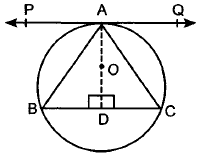
In {tex} ADB \ and \ ADC {/tex}
{tex}AB = AC{/tex} [Given]
{tex}AD = AD{/tex}
{tex}ADB = ADC [Each \ 90^o]{/tex}
{tex}\therefore{/tex} {tex}\triangle \mathrm { ADB } \cong \triangle \mathrm { ADC }{/tex}
{tex}\Rightarrow{/tex} {tex}BD = CD{/tex}
{tex}\therefore{/tex} AC passes through O,centre of the circle
{tex}\therefore{/tex} Perpendicular bisector of the chord passes through the centre of the circle
Now OA {tex}\perp{/tex} PQ (radius through the point of contact)
{tex}\therefore{/tex} {tex}\angle{/tex}PAO = 90o
Also {tex} ADB = 90^o{/tex}
{tex}\therefore{/tex} {tex}\angle \mathrm { PAO } + \angle \mathrm { ADB } = 180 ^ { \circ }{/tex}
{tex}\therefore{/tex} AP||BC
Posted by Siddhant Waghmare 7 years, 7 months ago
- 1 answers
Sahith Panga 4 years, 10 months ago
Posted by Sai Yashwanth Yadav 7 years, 7 months ago
- 0 answers

myCBSEguide
Trusted by 1 Crore+ Students

Test Generator
Create papers online. It's FREE.

CUET Mock Tests
75,000+ questions to practice only on myCBSEguide app

Muky Thakur 7 years, 7 months ago
2Thank You