
Ask questions which are clear, concise and easy to understand.
Ask QuestionPosted by Ganesh Kushwah 7 years, 6 months ago
- 2 answers
Posted by S Singh 7 years, 6 months ago
- 0 answers
Posted by Cutiepie ❤ 5 years, 8 months ago
- 1 answers
Kunal Rajour 7 years, 6 months ago
Posted by Bhanu Saini 7 years, 6 months ago
- 0 answers
Posted by Riya Joshi 7 years, 6 months ago
- 1 answers
Susai Raj 7 years, 6 months ago
Radius of the sector = 6 cm
Angle of the sector (A) = 60°
Area of the sector =( A/360)× πr^2 sq.cm
= (60/360)× π×6×6 square.cm
=6π square.cm.
Posted by Dheeraj Chander 7 years, 6 months ago
- 1 answers
Amol Khatri 7 years, 6 months ago
Posted by Shubham Jaat 7 years, 6 months ago
- 0 answers
Posted by Agnel Elizabeth 7 years, 6 months ago
- 0 answers
Posted by Vanshika Aamrit 7 years, 6 months ago
- 1 answers
Posted by Xyz Abc 7 years, 6 months ago
- 1 answers
Kunal Rajour 7 years, 6 months ago
Posted by Vikrant Kasana 7 years, 6 months ago
- 3 answers
Kunal Rajour 7 years, 6 months ago
Posted by Vikrant Kasana 7 years, 6 months ago
- 1 answers
Susai Raj 7 years, 6 months ago
So n(S) = 36. Let A be the event of getting a sum which is a perfect cube and divisible by 3.
Then A = { }. So n(A) = 0
So. P(A) = n(A)/n(S)
= 0/36 = 0
Posted by Vaishnavi Rajkumar 6 years, 6 months ago
- 1 answers
Sia ? 6 years, 6 months ago
Since, any odd positive integer n is of the form 4m + 1 or 4m + 3.
if n = 4m + 1
n2 = (4m + 1)2
= 16m2 + 8m + 1
= 8(2m2 + m) + 1
So n2 = 8q + 1 ........... (i)) (where q = 2m2 + m is a positive integer)
If n = (4m + 3)
n2 = (4m + 3)2
= 16m2 + 24m + 9
= 8(2m2 + 3m + 1) + 1
So n2 = 8q + 1 ...... (ii) (where q = 2m2 + 3m + 1 is a positive integer)
From (i) and (ii) we conclude that the square of an odd positive integer is of the form 8q + 1, for some integer q.
Posted by Manish Pandey 7 years, 6 months ago
- 1 answers
Sia ? 6 years, 6 months ago
Check Papers here : <a href="https://mycbseguide.com/cbse-question-papers.html">https://mycbseguide.com/cbse-question-papers.html</a>
Posted by Krishns Shrivastev 7 years, 6 months ago
- 2 answers
Posted by Arsh Sekhon 7 years, 6 months ago
- 1 answers
Dattatreya Swain 7 years, 6 months ago
Posted by Hariom Jha 6 years, 4 months ago
- 1 answers
Sia ? 6 years, 4 months ago
By the given condition of question
{tex}\sec \theta = x + \frac { 1 } { 4 x }{/tex}
{tex}\therefore \quad \tan ^ { 2 } \theta = \sec ^ { 2 } \theta - 1{/tex}
{tex}\Rightarrow \quad \tan ^ { 2 } \theta = \left( x + \frac { 1 } { 4 x } \right) ^ { 2 } - 1 = x ^ { 2 } + \frac { 1 } { 16 x ^ { 2 } } + \frac { 1 } { 2 } - 1 = x ^ { 2 } + \frac { 1 } { 16 x ^ { 2 } } - \frac { 1 } { 2 } = \left( x - \frac { 1 } { 4 x } \right) ^ { 2 }{/tex}
{tex}\Rightarrow \quad \tan \theta = \pm \left( x - \frac { 1 } { 4 x } \right){/tex}
{tex}\Rightarrow \quad \tan \theta = \left( x - \frac { 1 } { 4 x } \right) \text { or, } \tan \theta = - \left( x - \frac { 1 } { 4 x } \right){/tex}
CASE 1: When {tex}\tan \theta = - \left( x - \frac { 1 } { 4 x } \right) :{/tex} In this case,
{tex}\sec \theta + \tan \theta = x + \frac { 1 } { 4 x } + x - \frac { 1 } { 4 x } = 2 x{/tex}
CASE 2: When {tex}\theta = - \left( x - \frac { 1 } { 4 x } \right) :{/tex} In this case,
{tex}\sec \theta + \tan \theta = \left( x + \frac { 1 } { 4 x } \right) - \left( x - \frac { 1 } { 4 x } \right) = \frac { 2 } { 4 x } = \frac { 1 } { 2 x }{/tex}
Hence, {tex}\sec \theta + \tan \theta = 2 x \text { or } , \frac { 1 } { 2 x }{/tex}
Posted by Pj Pavanna Pavanna 7 years, 6 months ago
- 0 answers
Posted by Aditya Bhaskar 7 years, 6 months ago
- 0 answers
Posted by Sapan Arya 7 years, 6 months ago
- 1 answers
Irfan Alam 7 years, 6 months ago
Posted by Hemuraj Kashyap 7 years, 6 months ago
- 1 answers
Amol Khatri 7 years, 6 months ago
Posted by Gangapatrula Hemasudha 6 years, 6 months ago
- 1 answers
Sia ? 6 years, 6 months ago
We know that, Sin30°=(1/2), Cos45°=(1/√2), Sin90°=1, Cos90°=0, Cos0°=1 & tan30°=(1/√3), putting these values in the given expression, we get :-
{tex}{\sin ^2}30^\circ {\cos ^2}45^\circ + 4{\tan ^2}30^\circ + \;\frac{1}{2}{\sin ^2}90^\circ - 2\cos^2 90^\circ + \frac{1}{{24}}{\cos ^2}0^\circ {/tex}
{tex} = {\left( {\frac{1}{2}} \right)^2} \times {\left( {\frac{1}{{\sqrt 2 }}} \right)^2} + 4{\left( {\frac{1}{{\sqrt 3 }}} \right)^2} + \frac{1}{2} \times {\left( 1 \right)^2} - 2 \times {\left( 0 \right)^2} + \frac{1}{{24}}{\left( 1 \right)^2}{/tex}
{tex} = \frac{1}{4} \times \frac{1}{2} + 4 \times \frac{1}{3} + \frac{1}{2} \times 1 - 2 \times 0 + \frac{1}{{24}} \times 1{/tex}
{tex} = \frac{1}{8} + \frac{4}{3} + \frac{1}{2} - 0 + \frac{1}{{24}}{/tex}
{tex} = \frac{{3 + 32 + 12 - 0 + 1}}{{24}}{/tex}
{tex} = \frac{{48}}{{24}} = 2{/tex}
Posted by Surender Pal Pal 7 years, 6 months ago
- 0 answers
Posted by Rupinder Kaur 7 years, 6 months ago
- 5 answers
Amol Khatri 7 years, 6 months ago
Posted by Mona Chawla 6 years, 6 months ago
- 1 answers
Sia ? 6 years, 6 months ago
Let ABC be an equilateral triangle and let D be a point on BC such that {tex} B D = \frac { 1 } { 3 } B C.{/tex} Draw {tex} A E \perp B C.{/tex} Join AD.
In {tex}\Delta{/tex}AEB, and {tex}\Delta{/tex}AEC, we have AB = AC,
{tex}\angle{/tex}AEB = {tex}\angle{/tex}AEC = 90°
and, AE = AE
So, by RHS-criterion of similarity, we have
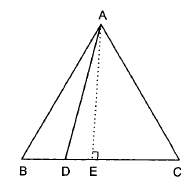
{tex}\Delta{/tex}AEB ~ {tex}\Delta{/tex}AEC
{tex}\Rightarrow{/tex} BE = EC
Thus, we have
{tex}B D = \frac { 1 } { 3 } B C , D C = \frac { 2 } { 3 } B C{/tex} and {tex}B E = E C = \frac { 1 } { 2 } B C{/tex} ...(1)
Since {tex}\angle{/tex} C = 60°. Therefore, {tex}\Delta{/tex}ADC is an acute triangle.
{tex}\therefore \quad A D ^ { 2 } = A C ^ { 2 } + D C ^ { 2 } - 2 D C \times E C{/tex}
{tex}\Rightarrow \quad A D ^ { 2 } = A C ^ { 2 } + \left( \frac { 2 } { 3 } B C \right) ^ { 2 } - 2 \times \frac { 2 } { 3 } B C \times \frac { 1 } { 2 } B C{/tex} [Using(1)]
{tex}\Rightarrow \quad A D ^ { 2 } = A C ^ { 2 } + \frac { 4 } { 9 } B C ^ { 2 } - \frac { 2 } { 3 } B C ^ { 2 }{/tex}
{tex}\Rightarrow \quad A D ^ { 2 } = A B ^ { 2 } + \frac { 4 } { 9 } A B ^ { 2 } - \frac { 2 } { 3 } A B ^ { 2 }{/tex}[{tex}\because{/tex} AB = BC= AC]
{tex}\Rightarrow \quad A D ^ { 2 } = \frac { 9 A B ^ { 2 } + 4 A B ^ { 2 } - 6 A B ^ { 2 } } { 9 } = \frac { 7 } { 9 } A B ^ { 2 }{/tex}
{tex}\Rightarrow{/tex} 9 AD2 = 7AB2
ALITER: Draw {tex}A E \perp B C.{/tex} Triangle ABC is equilateral. Therefore, E is the mid-point of BC.
{tex}\therefore \quad B E = C E = \frac { 1 } { 2 } B C.{/tex}
Applying Pythagoras theorem in right triangles AEB and AED, we obtain
AB2 = AE2 + BE2 and AD2 = AE2 + DE2
{tex}\Rightarrow{/tex} AB2 - AD2 = (AE2 + BE2) - (AE2 + DE2)
{tex}\Rightarrow{/tex} AB2 - AD2 = BE2 - DE2
{tex}\Rightarrow \quad A B ^ { 2 } - A D ^ { 2 } = \left( \frac { 1 } { 2 } A B \right) ^ { 2 } - \left( \frac { 1 } { 6 } A B \right) ^ { 2 }{/tex} {tex}\left[ \because D E = B E - B D = \frac { 1 } { 2 } A B - \frac { 1 } { 3 } A B = \frac { 1 } { 6 } A B \right]{/tex}
{tex}\Rightarrow \quad A B ^ { 2 } - A D ^ { 2 } = \frac { 2 } { 9 } A B ^ { 2 } \Rightarrow \frac { 7 } { 9 } A B ^ { 2 } = A D ^ { 2 }{/tex}
{tex}\Rightarrow 9 A D ^ { 2 } = 7 A B ^ { 2 }{/tex}
Posted by Mona Chawla 6 years, 4 months ago
- 1 answers
Sia ? 6 years, 4 months ago
Let ABC be an equilateral triangle and let D be a point on BC such that {tex} B D = \frac { 1 } { 3 } B C.{/tex} Draw {tex} A E \perp B C.{/tex} Join AD.
In {tex}\Delta{/tex}AEB, and {tex}\Delta{/tex}AEC, we have AB = AC,
{tex}\angle{/tex}AEB = {tex}\angle{/tex}AEC = 90°
and, AE = AE
So, by RHS-criterion of similarity, we have
{tex}\Delta{/tex}AEB ~ {tex}\Delta{/tex}AEC
{tex}\Rightarrow{/tex} BE = EC
Thus, we have
{tex}B D = \frac { 1 } { 3 } B C , D C = \frac { 2 } { 3 } B C{/tex} and {tex}B E = E C = \frac { 1 } { 2 } B C{/tex} ...(1)
Since {tex}\angle{/tex} C = 60°. Therefore, {tex}\Delta{/tex}ADC is an acute triangle.
{tex}\therefore \quad A D ^ { 2 } = A C ^ { 2 } + D C ^ { 2 } - 2 D C \times E C{/tex}
{tex}\Rightarrow \quad A D ^ { 2 } = A C ^ { 2 } + \left( \frac { 2 } { 3 } B C \right) ^ { 2 } - 2 \times \frac { 2 } { 3 } B C \times \frac { 1 } { 2 } B C{/tex} [Using(1)]
{tex}\Rightarrow \quad A D ^ { 2 } = A C ^ { 2 } + \frac { 4 } { 9 } B C ^ { 2 } - \frac { 2 } { 3 } B C ^ { 2 }{/tex}
{tex}\Rightarrow \quad A D ^ { 2 } = A B ^ { 2 } + \frac { 4 } { 9 } A B ^ { 2 } - \frac { 2 } { 3 } A B ^ { 2 }{/tex}[{tex}\because{/tex} AB = BC= AC]
{tex}\Rightarrow \quad A D ^ { 2 } = \frac { 9 A B ^ { 2 } + 4 A B ^ { 2 } - 6 A B ^ { 2 } } { 9 } = \frac { 7 } { 9 } A B ^ { 2 }{/tex}
{tex}\Rightarrow{/tex} 9 AD2 = 7AB2
ALITER: Draw {tex}A E \perp B C.{/tex} Triangle ABC is equilateral. Therefore, E is the mid-point of BC.
{tex}\therefore \quad B E = C E = \frac { 1 } { 2 } B C.{/tex}
Applying Pythagoras theorem in right triangles AEB and AED, we obtain
AB2 = AE2 + BE2 and AD2 = AE2 + DE2
{tex}\Rightarrow{/tex} AB2 - AD2 = (AE2 + BE2) - (AE2 + DE2)
{tex}\Rightarrow{/tex} AB2 - AD2 = BE2 - DE2
{tex}\Rightarrow \quad A B ^ { 2 } - A D ^ { 2 } = \left( \frac { 1 } { 2 } A B \right) ^ { 2 } - \left( \frac { 1 } { 6 } A B \right) ^ { 2 }{/tex} {tex}\left[ \because D E = B E - B D = \frac { 1 } { 2 } A B - \frac { 1 } { 3 } A B = \frac { 1 } { 6 } A B \right]{/tex}
{tex}\Rightarrow \quad A B ^ { 2 } - A D ^ { 2 } = \frac { 2 } { 9 } A B ^ { 2 } \Rightarrow \frac { 7 } { 9 } A B ^ { 2 } = A D ^ { 2 }{/tex}
{tex}\Rightarrow 9 A D ^ { 2 } = 7 A B ^ { 2 }{/tex}
Posted by Sangam Rana 7 years, 6 months ago
- 0 answers
Posted by Nitesh Kumar 7 years, 6 months ago
- 0 answers
Posted by Mahendra Babu 7 years, 6 months ago
- 1 answers

myCBSEguide
Trusted by 1 Crore+ Students

Test Generator
Create papers online. It's FREE.

CUET Mock Tests
75,000+ questions to practice only on myCBSEguide app

Rohit Yadav 7 years, 6 months ago
3Thank You