
Ask questions which are clear, concise and easy to understand.
Ask QuestionPosted by Ruchi Kumari 7 years, 6 months ago
- 0 answers
Posted by Pooja Sarkar 7 years, 6 months ago
- 0 answers
Posted by Ankita ?? Arpita☺️ 7 years, 6 months ago
- 0 answers
Posted by Amisha Singh 7 years, 6 months ago
- 0 answers
Posted by Amisha Singh 7 years, 6 months ago
- 1 answers
Aman Kumar 7 years, 6 months ago
Posted by Shubhang Sethi 7 years, 6 months ago
- 1 answers
Vishal Pratap Singh Vishal 7 years, 6 months ago
Posted by Divanshu Makwana 7 years, 6 months ago
- 1 answers
Vishal Pratap Singh Vishal 7 years, 6 months ago
Posted by Harshit Singh 5 years, 8 months ago
- 0 answers
Posted by Amol Khatri 7 years, 6 months ago
- 2 answers
Posted by Priyanshu Kashyap 7 years, 6 months ago
- 3 answers
Posted by Sahil Singh 6 years, 6 months ago
- 1 answers
Sia ? 6 years, 6 months ago
Suppose that the digits at units and tens place of the given number be x and y respectively.
Thus, the number is {tex}10y + x.{/tex}
The product of the two digits of the number is 20.
Thus, we have {tex}xy = 20{/tex}
After interchanging the digits, the number becomes {tex}10x + y{/tex}
If 9 is added to the number, the digits interchange their places.
Thus, we have
{tex}(10y + x) + 9 = 10x + y{/tex}
{tex}\Rightarrow{/tex} {tex}10y + x + 9 = 10x+ y{/tex}
{tex}\Rightarrow{/tex} {tex}10x + y - 10y - x = 9{/tex}
{tex}9x - 9y = 9{/tex}
{tex}\Rightarrow{/tex}{tex} 9(x - y) = 9{/tex}
{tex}\Rightarrow x - y = \frac{9}{9}{/tex}
{tex}\Rightarrow{/tex} {tex}x - y = 1{/tex}
So, we have the systems of equations
{tex}xy = 20,{/tex}
{tex}x - y = 1{/tex}
Here x and y are unknowns.
We have to solve the above systems of equations for x and y.
Substituting {tex}x = 1 + y{/tex}
from the second equation to the first equation, we get {tex}(1+ y) y = 20{/tex}
{tex}\Rightarrow{/tex} {tex}y + y^2 = 20{/tex}
{tex}\Rightarrow{/tex} {tex}y^2 + y - 20 = 0{/tex}
{tex}\Rightarrow{/tex} {tex}y^2 + 5y - 4y - 20 = 0{/tex}
{tex}\Rightarrow{/tex} {tex}y(y + 5) - 4(y + 5) = 0{/tex}
{tex}\Rightarrow{/tex} {tex}(y + 5)\ or\ (y - 4) = 0{/tex}
{tex}\Rightarrow{/tex} {tex}y = -5\ or\ y = 4{/tex}
Substituting the value of y in the second equation, we have
| x | -5 | 4 |
| y | -4 | 5 |
Hence, the number is 10 {tex}\times{/tex} 4 + 5 = 45 Note that in the first pair of solution the values of x and y are both negative.
But the digits of the number can't be negative. So, we must remove this pair.
Posted by Rohit Kumar 7 years, 6 months ago
- 3 answers
Posted by Samriddhi Shukla 7 years, 6 months ago
- 0 answers
Posted by Shala Man 7 years, 6 months ago
- 1 answers
Posted by Ashu Kushwaha 6 years, 6 months ago
- 1 answers
Sia ? 6 years, 6 months ago
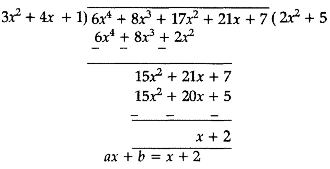
If g(x)=x2 + 2x + k is a factor of f(x) = 2x4 + x3 - 14x2 + 5x + 6
Then remainder is zero when f(x) is divided by g(x)
Let quotient =Q and remainder =R
Let us now divide f(x) by gx)

R = x(7k + 21) + (2k2 + 8k + 6) -------(1)
and Q = 2x2 - 3x - 2(k + 4).------------(2)
{tex}\Rightarrow{/tex}x (7k + 21) + 2 (k2 + 4k + 3) = 0
{tex}\Rightarrow{/tex}7k + 21 = 0 and k2 + 4k + 3 = 0
{tex}\Rightarrow{/tex} 7(k + 3) = 0 and (k + 1) (k + 3) = 0
{tex}\Rightarrow{/tex} k + 3 = 0
{tex}\Rightarrow{/tex}k = -3
Substituting the value of k in the divider x2 + 2x + k, we obtain: x2 + 2x - 3 = (x + 3) (x - 1) as the divisor.
Hence two zeros of g(x) are -3 and 1.------(3)
Putting k=-3 in (2) we get
Q = 2x2 - 3x - 2
= 2x2 - 4x + x - 2
= 2x(x - 2) + 1 (x - 2)
= (x - 2)(2x + 1)
Q=0 if x-2=0 or 2x+1=0
So other two zeros of f(x) are 2 and -{tex}\frac12{/tex}-------(4)
As g(x) is a factor of f(x) so zeros of G(x) are zeros of f(x) also
Hence from (3) and (4) we get
The zeros of f(x) are: -3 ,1,, 2 and {tex}\frac12{/tex}
Posted by Ashu Kushwaha 7 years, 6 months ago
- 0 answers
Posted by Varpreet Singh 7 years, 6 months ago
- 0 answers
Posted by Ashu Kushwaha 7 years, 6 months ago
- 0 answers
Posted by Ashu Kushwaha 7 years, 6 months ago
- 2 answers
Samit Gautam 7 years, 6 months ago
Rahil Aziz 7 years, 6 months ago
Posted by Khushi Sahu 7 years, 6 months ago
- 6 answers
Posted by Shreya Panda 7 years, 6 months ago
- 2 answers
Ankita ?? Arpita☺️ 7 years, 6 months ago
Piyush Gautam 7 years, 6 months ago
Posted by Arvind Kumar 7 years, 6 months ago
- 1 answers
Posted by Karan Bisht 7 years, 6 months ago
- 1 answers
Nishita Tomar 7 years, 6 months ago
Posted by Nikki Gour 6 years, 6 months ago
- 1 answers
Sia ? 6 years, 6 months ago
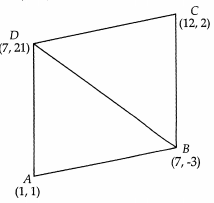
Area of quadrilateral ABCD = ar {tex}\triangle{/tex}ABD + ar {tex}\triangle{/tex}BCD
ar {tex}\triangle{/tex}ABD = {tex}\frac 12{/tex}[ 1(- 3 - 21) + 7(21 - 1) + 7(1 + 3)]
= {tex} \frac { 1 } { 2 } [ - 24 + 7 \times 20 + 7 \times 4 ]{/tex}
{tex}= \frac { 1 } { 2 } {/tex}[-24 + 140 + 28]
{tex}= \frac { 1 } { 2 } \times 144{/tex} = 72 sq. units
ar {tex}\triangle{/tex}BCD
= {tex}\frac { 1 } { 2 }{/tex}[7(2 - 21) + 12(21 + 3) + 7(-3 - 2)]
= {tex}\frac { 1 } { 2 } [ 7 \times - 19 + 12 \times 24 + 7 \times - 5 ]{/tex}
= {tex}\frac12{/tex}[-133 + 288 - 35]
= {tex}\frac 12{/tex}[288 - 168]
{tex}= \frac { 1 } { 2 } \times 120{/tex}
= 60 sq. units
Hence, Area Quadrilateral ABCD = 72 + 60 = 132 sq units
Posted by Satyam Sivam 7 years, 6 months ago
- 0 answers
Posted by Sujal Choudhary 6 years, 6 months ago
- 1 answers
Sia ? 6 years, 6 months ago
n3 - n = n (n2 - 1) = n (n - 1) (n + 1)
Whenever a number is divided by 3, the remainder obtained is either 0 or 1 or 2.
∴ n = 3p or 3p + 1 or 3p + 2, where p is some integer.
If n = 3p, then n is divisible by 3.
If n = 3p + 1, then n – 1 = 3p + 1 –1 = 3p is divisible by 3.
If n = 3p + 2, then n + 1 = 3p + 2 + 1 = 3p + 3 = 3(p + 1) is divisible by 3.
So, we can say that one of the numbers among n, n – 1 and n + 1 is always divisible by 3.
⇒ n (n – 1) (n + 1) is divisible by 3.
Similarly, whenever a number is divided by 2, the remainder obtained is 0 or 1.
∴ n = 2q or 2q + 1, where q is some integer.
If n = 2q, then n is divisible by 2.
If n = 2q + 1, then n – 1 = 2q + 1 – 1 = 2q is divisible by 2 and n + 1 = 2q + 1 + 1 = 2q + 2 = 2 (q + 1) is divisible by 2.
So, we can say that one of the numbers among n, n – 1 and n + 1 is always divisible by 2.
⇒ n (n – 1) (n + 1) is divisible by 2.
Since, n (n – 1) (n + 1) is divisible by 2 and 3.
∴ n (n-1) (n+1) = n3 - n is divisible by 6.( If a number is divisible by both 2 and 3 , then it is divisible by 6)

myCBSEguide
Trusted by 1 Crore+ Students

Test Generator
Create papers online. It's FREE.

CUET Mock Tests
75,000+ questions to practice only on myCBSEguide app
