
Ask questions which are clear, concise and easy to understand.
Ask QuestionPosted by Account Deleted 7 years, 6 months ago
- 2 answers
Shubham Kumar 7 years, 6 months ago
Posted by Mayank Rauthan 7 years, 6 months ago
- 1 answers
Suhani Srivastava 7 years, 6 months ago
Posted by Bhartendu Vibhu 6 years, 6 months ago
- 1 answers
Sia ? 6 years, 6 months ago
{tex} \Rightarrow 3\cos \theta - 4\sin \theta = 2\cos \theta + \sin \theta {/tex}
{tex} \Rightarrow - 4\sin \theta - \sin \theta = 2\cos \theta -3cos \theta {/tex}
{tex} \Rightarrow - 5\sin \theta = - \cos \theta {/tex}
{tex} \Rightarrow 5\sin \theta = \cos \theta {/tex}
{tex} \Rightarrow \frac{{\sin \theta }}{{\cos \theta }} = \frac{1}{5}{/tex}
{tex} \Rightarrow \tan \theta = \frac{1}{5}{/tex}
Posted by Abhishek Sharma 7 years, 6 months ago
- 0 answers
Posted by Account Deleted 7 years, 6 months ago
- 2 answers
Nishi K 7 years, 6 months ago
Shubham Kumar 7 years, 6 months ago
Posted by Ansh Chaudhary 7 years, 6 months ago
- 1 answers
Nishi K 7 years, 6 months ago
Posted by Lavanya Sampath 7 years, 6 months ago
- 1 answers
Account Deleted 7 years, 6 months ago
Posted by Ansh Sharma 7 years, 6 months ago
- 0 answers
Posted by Priya Dharshini 7 years, 6 months ago
- 0 answers
Posted by Anooja Johnson 7 years, 6 months ago
- 1 answers
Account Deleted 7 years, 6 months ago
Posted by Ankit Kumar 7 years, 6 months ago
- 0 answers
Posted by Bharat Rajpal 7 years, 6 months ago
- 1 answers
Shubham Kumar 7 years, 6 months ago
Posted by Neha Rani 7 years, 6 months ago
- 1 answers
Posted by Varsha Sahu 7 years, 6 months ago
- 0 answers
Posted by Eshika Pawar 6 years, 6 months ago
- 1 answers
Sia ? 6 years, 6 months ago
The given system of equation may be written as
2(ax - by) + a + 4b = 0
So, 2ax - 2by + a + 4b ..............(i)
2(bx + ay) + b - 4a = 0
so, 2bx+2ay+b-4a=0................(ii)
compare (i) and (ii) with standard form, we get
a1 = 2a, b1 = -2b, c1 = a + 4b
a2 = 2b, b2 = 2a, c2 = b - 4a
By cross multiplication method
{tex} \frac{x}{{ - 2{b^2} + 8ab - 2{a^2} - 8ab}}{/tex} {tex}= \frac{{ - y}}{{2ab - 8{a^2} - 2ab - 8{b^2}}}{/tex} {tex} = \frac{1}{{4{a^2} + 4{b^2}}}{/tex}
{tex} \frac{x}{{ - 2{b^2} - 2{a^2}}} = \frac{{ - y}}{{ - 8{a^2} - 8{b^2}}} = \frac{1}{{4{a^2} + 4{b^2}}}{/tex}
Now, {tex}\frac{x}{{ - 2{b^2} - 2{a^2}}} = \frac{1}{{4{a^2} + 4{b^2}}} {/tex}
{tex}⇒ x = \frac{{ - 1}}{2}{/tex}
And, {tex}\frac{{ - y}}{{ - 8{a^2} - 8{b^2}}} = \frac{1}{{4{a^2} + 4{b^2}}} {/tex}
{tex}⇒ y = 2{/tex}
Therefore, the solution of the given pair of equations are {tex}\frac{{ - 1}}{2}{/tex} and 2 respectively.
Posted by Manjot Jaj 6 years, 6 months ago
- 1 answers
Sia ? 6 years, 6 months ago
{tex}\frac{\text { ar } \triangle \mathrm{ABC}}{\text { ar } \triangle \mathrm{PQR}}{/tex} = {tex}\frac{\mathrm{AB}^{2}}{\mathrm{PQ}^{2}}{/tex} = {tex}\left(\frac{1}{3}\right)^{2}{/tex} = {tex}\frac{1}{9}{/tex}
Posted by Kannu Kranti Yadav 7 years, 6 months ago
- 1 answers
Posted by Tisha Jain 5 years, 8 months ago
- 1 answers
Shubham Kumar 7 years, 6 months ago
Posted by Pardeep Jatt 7 years, 6 months ago
- 4 answers
Kannu Kranti Yadav 7 years, 6 months ago
Rachana Tewari 7 years, 6 months ago
here sum of the roots, S=-3+4=1
Product of the roots P =(-3)(4)=-12
We know that x2 + (sum of the roots)x + product of roots =0
x2 + x- 12=0
Posted by Sakina Saify 7 years, 6 months ago
- 1 answers
Jigyansh Dara 7 years, 6 months ago
Posted by Jitender Sahoo 7 years, 6 months ago
- 2 answers
Posted by Tanvi Jindal 7 years, 6 months ago
- 1 answers
Posted by Royal Rajput 6 years, 6 months ago
- 1 answers
Sia ? 6 years, 6 months ago
Get formulae from notes : <a href="https://mycbseguide.com/cbse-revision-notes.html">https://mycbseguide.com/cbse-revision-notes.html</a>
Posted by Shubh Agrawal 7 years, 6 months ago
- 1 answers
Posted by Mehal Jain 6 years, 6 months ago
- 1 answers
Sia ? 6 years, 6 months ago
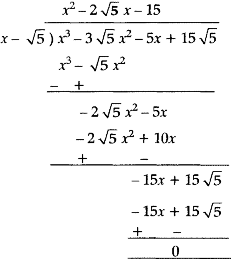
On factorising the quotient, we get
{tex}x ^ { 2 } - 2 \sqrt { 5 } x - 15 = x ^ { 2 } - 3 \sqrt { 5 } x + \sqrt { 5 }x-15{/tex}
{tex}= x ( x - 3 \sqrt { 5 } ) + \sqrt { 5 } ( x - 3 \sqrt { 5 } ){/tex}
{tex}= ( x + \sqrt { 5 } ) ( x - 3 \sqrt { 5 } ){/tex}
{tex}\therefore\ {/tex}{tex}( x + \sqrt { 5 } ) ( x - 3 \sqrt { 5 } ) = 0{/tex}
{tex}\Rightarrow\ x = - \sqrt { 5 } , 3 \sqrt { 5 }{/tex}
Therefore, all the zeroes are {tex}\sqrt { 5 } , - \sqrt { 5 } \text { and } 3 \sqrt { 5 }{/tex}.
Posted by Sunny Kumar 6 years, 6 months ago
- 1 answers
Sia ? 6 years, 6 months ago
We have,
{tex}f(x) = x^2 + x - p(p + 1){/tex}
{tex}= x^2 + (p + 1)x - px - p(p + 1) {/tex}[As x =(p + 1)x - px ]
{tex}= x[ x + (p + 1)] - p[ x + (p + 1)]{/tex}
{tex}= ( x - p)[x + (p + 1)]{/tex}
{tex}{/tex} Now, f(x) = 0
{tex}\Rightarrow{/tex} ( x - p)[x + (p + 1)] = 0
{tex}\Rightarrow{/tex} x - p = 0 or x + (p +1) = 0
{tex}\Rightarrow{/tex} x = p or x = -(p + 1)
Thus, the required zeros of f(x) are p and -(p + 1).
Posted by Subham Deep 7 years, 6 months ago
- 1 answers
Posted by Rishav Kumar 7 years, 6 months ago
- 1 answers
Posted by Jitesh Grewal 7 years, 6 months ago
- 1 answers
Posted by Iqra Aabid 7 years, 6 months ago
- 0 answers

myCBSEguide
Trusted by 1 Crore+ Students

Test Generator
Create papers online. It's FREE.

CUET Mock Tests
75,000+ questions to practice only on myCBSEguide app

Shubham Kumar 7 years, 6 months ago
2Thank You