
Ask questions which are clear, concise and easy to understand.
Ask QuestionPosted by Ayushi Singh 7 years, 5 months ago
- 1 answers
Posted by Shantanu Pradhan 7 years, 5 months ago
- 0 answers
Posted by Akshat Khede 7 years, 5 months ago
- 0 answers
Posted by Shitanshu Pandey 7 years, 5 months ago
- 1 answers
Posted by Shitanshu Pandey 6 years, 6 months ago
- 1 answers
Sia ? 6 years, 6 months ago
Given numbers are 176 and 38220.
Here, 38220 > 17
By using Euclid's division lemma, we get
a = bq + r, where 0<_r < b. Here a as dividend, b as divisor, q as quotient and r as remainder
Dividend = divisor {tex}\times{/tex} quotient + remainder
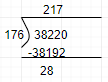
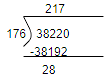
dividend = divisor {tex}\times{/tex} quotient + remainder
38220 = (176 {tex}\times{/tex} 217) + 28
Here r = 28 {tex}\ne{/tex} 0 and b = 176
On taking 176 as the new dividend and 28 as the new divisor and then apply Euclid's division lemma, we get
176 = (28 {tex}\times{/tex} 6) + 8
Here remainder = 8 {tex}\ne{/tex} 0
So, on taking 28 as dividend and 8 as the divisor and then apply Euclid's division lemma, we get
28 = (8 {tex}\times{/tex} 3) + 4
Again, remainder = 4 {tex}\ne{/tex} 0
On taking 8 as the dividend and 4 as the divisor and then apply Euclid's division lemma, we get 8 = ( 4 {tex}\times{/tex} 2) + 0
Here, remainder = 0 and last divisor is 4.
Hence, HCF of 176 and 38220 is 4.
Posted by Vishwajeet Kumar 7 years, 5 months ago
- 1 answers
Posted by Shourya Tiwari 7 years, 5 months ago
- 1 answers
Prasanth Prasanth 7 years, 5 months ago
Posted by Xxxxxxx Yyyyyyy 7 years, 5 months ago
- 1 answers
Posted by Diljani . 7 years, 5 months ago
- 4 answers
Posted by Aniket Upadhyay 7 years, 5 months ago
- 1 answers
Neeraj Yadav 7 years, 5 months ago
Posted by Gurkirat Singh 6 years, 6 months ago
- 1 answers
Sia ? 6 years, 6 months ago
Let us suppose that one man alone can finish the work in x days and one boy alone can finish it in y days. Then,
one man's one day's work {tex}= \frac { 1 } { x }{/tex}
One boy's one day's work {tex}= \frac { 1 } { y }{/tex}
{tex}\therefore{/tex} Eight men's one day's work = {tex}\frac { 8 } { x }{/tex}
{tex}12\ boy's{/tex} one day's work = {tex}\frac { 12 } { y }{/tex}
According to question it is given that {tex}8\ men{/tex} and {tex}12\ boys{/tex} can finish the work in {tex}10\ days{/tex}
{tex}10 \left( \frac { 8 } { x } + \frac { 12 } { y } \right) = 1 \Rightarrow \frac { 80 } { x } + \frac { 120 } { y } = 1{/tex} .................(i)
Again, {tex}6\ men{/tex} and {tex}8\ boys{/tex} can finish the work in {tex}14\ days{/tex}.
{tex}\therefore \quad 14 \left( \frac { 6 } { x } + \frac { 8 } { y } \right) = 1 \Rightarrow \frac { 84 } { x } + \frac { 112 } { y } = 1{/tex} ...........(ii)
Putting {tex}\frac { 1 } { x } = u{/tex} and {tex}\frac { 1 } { y } = v{/tex} in equations (i) and (ii), we get
{tex}80u + 120u - 1 = 0{/tex}
{tex}84u + 112v - 1 = 0{/tex}
By using cross-multiplication,
{tex}\Rightarrow \frac { u } { - 120 + 112 } = \frac { - v } { - 80 + 84 } = \frac { 1 } { 80 \times 112 - 120 \times 84 }{/tex}
{tex}\Rightarrow \quad \frac { u } { - 8 } = \frac { v } { - 4 } = \frac { 1 } { - 1120 }{/tex}
{tex}\Rightarrow \quad u = \frac { - 8 } { - 1120 } = \frac { 1 } { 140 } \text { and } v = \frac { - 4 } { - 1120 } = \frac { 1 } { 280 }{/tex}
{tex}u = \frac { 1 } { 140 } \Rightarrow \frac { 1 } { x } = \frac { 1 } { 140 } \Rightarrow x = 140{/tex}
{tex}v = \frac { 1 } { 280 } \Rightarrow \frac { 1 } { y } = \frac { 1 } { 280 } \Rightarrow y = 280{/tex}
One man alone can finish the work in {tex}140\ days{/tex} and one boy alone can finish the work in {tex}280\ days{/tex}.
Posted by Gurkirat Singh 7 years, 5 months ago
- 1 answers
Posted by Naddunuri Preethi 7 years, 5 months ago
- 3 answers
Posted by Sainath Sainath 7 years, 5 months ago
- 2 answers
Posted by Himanshu Singla 6 years, 6 months ago
- 1 answers
Sia ? 6 years, 6 months ago
The given equation is:
(3k + 1)x2 + 2(k + 1)x + 1 = 0
This is of the form ax2 + bx + c = 0, where
a = 3k + 1, b = 2(k + 1) = 2k + 2 and c = 1
As it is given that the given equation has real and equal roots, i.e., D = b2 - 4ac = 0.
{tex}\Rightarrow{/tex} (2k + 2)2 - 4(3k + 1) (1) = 0
{tex}\Rightarrow{/tex} 4k2 + 8k + 4 - 12k - 4 = 0
{tex}\Rightarrow{/tex} 4k2 - 4k = 0
{tex}\Rightarrow{/tex} 4k(k - 1) = 0
Therefore, either 4k = 0 or k - 1 = 0
{tex}\Rightarrow{/tex} k = 0 or k = 1
Hence, the roots of given equation are 1 and 0.
Posted by Durga Verma 7 years, 5 months ago
- 2 answers
Posted by Charchit Agawal 7 years, 5 months ago
- 0 answers
Posted by Dhritiparna Das 7 years, 5 months ago
- 0 answers
Posted by Urvashi Kaur 6 years, 6 months ago
- 1 answers
Sia ? 6 years, 6 months ago
The given quadratic equation is
a2b2x2 - (4b4 - 3a4)x - 12a2b2 = 0.
Comparing with Ax2 + Bx + C = 0, we get
A = a2b2, B = -(4b4 - 3a4), C = -12a2b2
Using the quadratic formula, {tex}x = \frac { - B \pm \sqrt { B ^ { 2 } - 4 A C } } { 2 A }{/tex}
we get
{tex}= \frac { \left\{ \left( 4 b ^ { 4 } - 3 a ^ { 4 } \right) \right\} \pm \sqrt { \left( - \left( 4 b ^ { 4 } - 3 a ^ { 4 } \right) \right\} ^ { 2 } - 4 \left( a ^ { 2 } b ^ { 2 } \right) \left( - 12 a ^ { 2 } b ^ { 2 } \right) } } { 2 a ^ { 2 } b ^ { 2 } }{/tex}
{tex}= \frac { 4 b ^ { 4 } - 3 a ^ { 4 } \pm \sqrt { 16 b ^ { 8 } + 9 a ^ { 8 } - 24 a ^ { 4 } b ^ { 4 } + 48 a ^ { 4 } b ^ { 4 } } } { 2 a ^ { 2 } b ^ { 2 } }{/tex}
{tex}= \frac { 4 b ^ { 4 } - 3 a ^ { 4 } \pm \sqrt { 16 b ^ { 8 } + 9 a ^ { 8 } + 24 a ^ { 4 } b ^ { 4 } } } { 2 a ^ { 2 } b ^ { 2 } }{/tex}
{tex}= \frac { 4 b ^ { 4 } - 3 a ^ { 4 } \pm \sqrt { \left( 4 b ^ { 4 } + 3 a ^ { 4 } \right) ^ { 2 } } } { 2 a ^ { 2 } b ^ { 2 } }{/tex}
{tex}= \frac { 4 b ^ { 4 } - 3 a ^ { 4 } \pm \left( 4 b ^ { 4 } + 3 a ^ { 4 } \right) } { 2 a ^ { 2 } b ^ { 2 } }{/tex}
{tex}\frac { 4 b ^ { 4 } - 3 a ^ { 4 } + 4 b ^ { 4 } + 3 a ^ { 4 } } { 2 a ^ { 2 } b ^ { 2 } } , \frac { 4 b ^ { 4 } - 3 a ^ { 4 } - 4 b ^ { 4 } - 3 a ^ { 4 } } { 2 a ^ { 2 } b ^ { 2 } }{/tex}
{tex}= \frac { 8 b ^ { 4 } } { 2 a ^ { 2 } b ^ { 2 } } , \frac { - 6 a ^ { 4 } } { 2 a ^ { 2 } b ^ { 2 } } = \frac { 4 b ^ { 2 } } { a ^ { 2 } } , - \frac { 3 a ^ { 2 } } { b ^ { 2 } }{/tex}
{tex}\therefore{/tex} the solutions of equation are {tex}\frac { 4 b ^ { 2 } } { a ^ { 2 } } \text { and } \frac { - 3 a ^ { 2 } } { b ^ { 2 } }{/tex}.
Posted by Saisrinitya Boyapati 7 years, 5 months ago
- 1 answers
Posted by Harish Kittu 5 years, 8 months ago
- 1 answers
Posted by Harish Kittu 5 years, 8 months ago
- 0 answers
Posted by Ashish Kumar 7 years, 5 months ago
- 0 answers
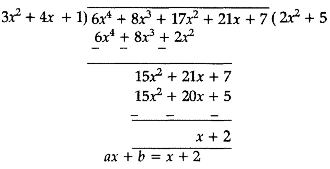
Posted by Shashank Shekhar 7 years, 5 months ago
- 0 answers

myCBSEguide
Trusted by 1 Crore+ Students

Test Generator
Create papers online. It's FREE.

CUET Mock Tests
75,000+ questions to practice only on myCBSEguide app

Akshay Singh 7 years, 5 months ago
1Thank You