
Ask questions which are clear, concise and easy to understand.
Ask QuestionPosted by Vaibhav Sagar 6 years, 6 months ago
- 1 answers
Posted by Jaya Gupta 5 years, 8 months ago
- 1 answers
Posted by ☆ Pranal Rewatkar ☆ 7 years, 5 months ago
- 1 answers
Mahanta Bhagat 7 years, 5 months ago
Posted by Hemant Kumar 7 years, 5 months ago
- 0 answers
Posted by Hemant Kumar 7 years, 5 months ago
- 0 answers
Posted by Jugal Jain 7 years, 5 months ago
- 0 answers
Posted by Gopika Chandran 7 years, 5 months ago
- 0 answers
Posted by Manvith Devadiga 7 years, 5 months ago
- 1 answers
Posted by Harvir Singh 7 years, 5 months ago
- 0 answers
Posted by Aryan Vats 7 years, 5 months ago
- 1 answers
Angel Chaubey 7 years, 5 months ago
Posted by Ayush Shivam 7 years, 5 months ago
- 2 answers
Yogita Ingle 7 years, 5 months ago
Given √2 is irrational number.
Let √2 = a / b wher a,b are integers b ≠ 0
we also suppose that a / b is written in the simplest form
Now √2 = a / b
⇒ 2 = a2 / b2
⇒ 2b2 = a2
∴ 2b2 is divisible by 2
⇒ a2 is divisible by 2
⇒ a is divisible by 2
∴ let a = 2c
a2 = 4c2
⇒ 2b2 = 4c2
⇒ b2 = 2c2
∴ 2c2 is divisible by 2
∴ b2 is divisible by 2
∴ b is divisible by 2
∴ a are b are divisible by 2 .
This contradicts our supposition that a/b is written in the simplest form.
Hence our supposition is wrong
∴ √2 is irrational number.
Posted by Sathwik Vm 7 years, 5 months ago
- 1 answers
Posted by Jaskaran Sandhu 7 years, 5 months ago
- 0 answers
Posted by Eakasnh Meena 7 years, 5 months ago
- 0 answers
Posted by Ujjwal Kumar 7 years, 5 months ago
- 6 answers
Posted by Navdep Ghosh 7 years, 5 months ago
- 1 answers
Posted by Charumathi Mathi 7 years, 5 months ago
- 0 answers
Posted by Ayush Singh 7 years, 5 months ago
- 0 answers
Posted by Kunal Singh 7 years, 5 months ago
- 2 answers
Kannu Kranti Yadav 7 years, 5 months ago
Posted by Amit Kumar 7 years, 5 months ago
- 1 answers
Posted by Mahek Rawat 7 years, 5 months ago
- 0 answers
Posted by Logadharshini Logadharshini 7 years, 5 months ago
- 0 answers
Posted by Nachiketh Neelaraddi 6 years, 6 months ago
- 1 answers
Sia ? 6 years, 6 months ago
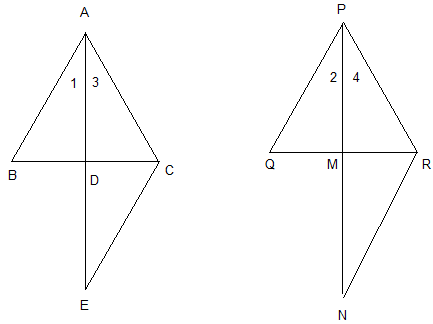
Given : In {tex}\Delta A B C \text { and } \Delta P Q R{/tex} The AD and PM are their medians,
such that {tex}\frac { A B } { P Q } = \frac { A D } { P M } = \frac { A C } { P R }{/tex}
To prove : {tex}\Delta A B C \sim \Delta P Q R{/tex}
Construction : Produce AD to E such that AD = DE and produce PM to N such that PM = MN. Join CE and RN.
Proof : In {tex}\Delta A B D \text { and } \Delta E D C{/tex}
{tex}AD=DE{/tex}
{tex}\angle A D B = \angle E D C{/tex} (vertically opposite angles)
{tex}BD=DC\text{(as AD is a median)}{/tex}
{tex}\therefore \quad \Delta A B D \equiv \Delta E D C{/tex} (By SAS congruency)
or, {tex}AB=CE{/tex} (By CPCT)
Similarly, PQ = RN {tex}{/tex}
{tex}\frac { A B } { P Q } = \frac { A D } { P M } = \frac { A C } { P R }{/tex} (Given)
or, {tex}\frac { C E } { R N } = \frac { 2 A D } { 2 P M } = \frac { A C } { P R }{/tex}
or {tex}\frac{CE}{RN}=\frac{AE}{PN}=\frac{AC}{PR}{/tex}
So {tex}∆ACE \sim ∆PRN{/tex}
{tex}\angle 3=\angle 4{/tex}
Similarly {tex}\angle 1=\angle 2{/tex}
{tex}\angle 1+\angle3=\angle2+\angle4{/tex}
So {tex}\angle A=\angle P\text{ and}{/tex}
{tex}\frac{AB}{PQ}=\frac{AC}{PR}\text{(given)} {/tex}
Hence {tex}∆ABC\sim ∆PQR{/tex}
Posted by Navjot Kaur 7 years, 5 months ago
- 1 answers
R T 7 years, 5 months ago
Posted by Sara Khan 7 years, 5 months ago
- 2 answers
Posted by Pawan Singh 7 years, 5 months ago
- 0 answers
Posted by Bhushan Bhushan 7 years, 5 months ago
- 0 answers
Posted by Subhash Chandra 7 years, 5 months ago
- 0 answers

myCBSEguide
Trusted by 1 Crore+ Students

Test Generator
Create papers online. It's FREE.

CUET Mock Tests
75,000+ questions to practice only on myCBSEguide app

Sia ? 6 years, 6 months ago
composite two digit number = 99
and coprime two digit number are 12 and 13
0Thank You