
Ask questions which are clear, concise and easy to understand.
Ask QuestionPosted by Anurag Maurya 7 years, 5 months ago
- 2 answers
Posted by Manshi Heda 7 years, 5 months ago
- 3 answers
Siddhu Kumar 7 years, 5 months ago
Posted by Devansh Tiwari 7 years, 5 months ago
- 1 answers
Posted by Sanyam Jain 7 years, 5 months ago
- 1 answers
Posted by Srijit Sarkar 6 years, 6 months ago
- 1 answers
Sia ? 6 years, 6 months ago
Given numbers are 184, 230, and 276.
Applying Euclid's division lemma to 184 and 230, we get
230 = 184 {tex}\times{/tex} 1 + 46
184 = 46 {tex}\times{/tex} 4 + 0
The remainder at this stage is zero.
So, the divisor at this or the remainder at the previous stage i.e., 46 is the HCF of 184 and 230.
Also,
276 = 46 {tex}\times{/tex} 6 + 0
∴ HCF of 276 and 46 is 46
HCF (184, 230, 276) = 46
Hence, the required HCF of 184, 230 and 276 is 46.
Posted by Sandeep Kumar 7 years, 5 months ago
- 0 answers
Posted by Arshdeep Deep 7 years, 5 months ago
- 1 answers
Sia ? 6 years, 6 months ago
Get formulae in revision notes : <a href="https://mycbseguide.com/cbse-revision-notes.html">https://mycbseguide.com/cbse-revision-notes.html</a>
Posted by Arshdeep Deep 6 years, 6 months ago
- 1 answers
Sia ? 6 years, 6 months ago
an = a + (n - 1)d
a7 = a + (7 - 1)d
a + 6d = 4
a + 6(-4) = 4
{tex}\Rightarrow{/tex} a = 28
Posted by Br Raaghu 7 years, 5 months ago
- 1 answers
Priyan Agrawal 7 years, 5 months ago
Posted by Saketh Reddy Koli 7 years, 5 months ago
- 0 answers
Posted by Prajwal Biradar 7 years, 5 months ago
- 1 answers
Posted by Naaz Khatoon 7 years, 5 months ago
- 0 answers
Posted by Vaishali Jain 7 years, 5 months ago
- 2 answers
Jhasketan Behera 7 years, 5 months ago
Jhasketan Behera 7 years, 5 months ago
Posted by Keshav Kumar 7 years, 5 months ago
- 1 answers
Prabjeet Singh 7 years, 5 months ago
{tex}\text {Let when } p(x) \text { is divided by } (x-2)(x-3) \text { it leaves a remainder } (ax-b) \text { quotient } g(x),{/tex}
{tex}\therefore p(x) = (x-2)(x-3)g(x)+(ax+b){/tex} {tex}...(1){/tex}
{tex}\text {Now, when } p(x) \text {is divided by } (x-2) \text {it leaves a remainder 1,}{/tex}
{tex}\therefore \text {putting value } x=2 \text { in eqn. (1), we get}{/tex}
{tex}p(2) = (2-2)(2-3)g(2)+[a(2)+b]{/tex}
{tex}\Rightarrow 1 = 0+2a+b{/tex}
{tex}\Rightarrow 2a+b=1{/tex} {tex}...(2){/tex}
{tex}\text {And, when } p(x) \text { is divided by } (x-3) \text { it leaves a remainder 3},{/tex}
{tex}\therefore \text { putting value } x = 3 \text { in eqn. (1), we get}{/tex}
{tex}p(3) = (3-2)(3-3)g(3)+[a(3)+b]{/tex}
{tex}\Rightarrow 3 = 0 + 3a +b{/tex}
{tex}\Rightarrow 3a+b=3{/tex} {tex}...(3){/tex}
{tex}\text {On solving, eqn. (2) and (3), we get}{/tex}
{tex}a=2 \text { and } b = -3{/tex}
{tex}\text {Putting values of } a \text { and } b \text { in eqn. (1), we get}{/tex}
{tex}p(x) = (x-2)(x-3)+(2x-3){/tex}
{tex}\text {Thus, the required remainder is }(2x-3).{/tex}
Posted by Ujjwal Juneja 5 years, 8 months ago
- 2 answers
Prabjeet Singh 7 years, 5 months ago
HCF = 16,
Product of Numbers = 3072
According to formula, if a and b are two given numbers, then
{tex}HCF(a, b) \times LCM(a, b) = a \times b{/tex}
{tex}16 \times LCM(a,b)=3072{/tex}
{tex}LCM(a,b)=\cfrac {3072}{16}{/tex}
{tex}LCM(a,b)=192{/tex}
Posted by Fatima Shaikh 7 years, 5 months ago
- 1 answers
Posted by Sandeep Saini 7 years, 5 months ago
- 5 answers
Posted by Ritul Rajput 7 years, 5 months ago
- 0 answers
Posted by Dibyanshu Rawat 6 years, 6 months ago
- 1 answers
Sia ? 6 years, 6 months ago
Let the denominator be y, then numerators = y - 3
So the fraction be {tex}\frac { y - 3 } { y }{/tex}
By the given condition, new fraction = {tex}\frac { y - 3 + 2 } { y + 2 }{/tex}
{tex}= \frac { y- 1 } { y+ 2 }{/tex}
{tex}\frac { y - 3 } { y } + \frac { y - 1 } { y + 2 } = \frac { 29 } { 20 }{/tex}
{tex}\frac {( y - 3 ) ( y + 2 ) + y ( y - 1 ) }{y(y+2)}= \frac{29}{20}{/tex}
{tex}\ 20 [ ( y - 3 ) ( y + 2 ) + y ( y - 1 ) ] = 29 \left( y ^ { 2 } + 2 y \right){/tex}
{tex}\ 20 [ ( y^2-3y+2y-6)+(y^2-y)] = 29 \left( y ^ { 2 } + 2 y \right){/tex}
{tex}20 \left( y ^ { 2 } - y - 6 + y ^ { 2 } - y \right) = 29 y ^ { 2 } + 58 y{/tex}
{tex}20 \left( 2y^2-2y-6 \right) = 29 y ^ { 2 } + 58 y{/tex}
{tex}11 y ^ { 2 } - 98 y - 120 = 0{/tex}
{tex}11 y ^ { 2 } - 110 y + 12 y - 120 = 0{/tex}
{tex}( 11 y + 12 ) ( y - 10 ) = 0 {/tex}
{tex} \therefore y = 10{/tex}
{tex}\therefore {/tex} The fraction is {tex}\frac { 7 } { 10 }{/tex}
Posted by Sanjay Eswar 7 years, 5 months ago
- 1 answers
Tanishka Gautam 7 years, 5 months ago
Posted by Ritika Rathore 7 years, 5 months ago
- 2 answers
Dibyanshu Rawat 7 years, 5 months ago
Posted by Pratik Sharma 7 years, 5 months ago
- 4 answers
Ankita ?? Arpita☺️ 7 years, 5 months ago
Posted by Chetan Chauhan 7 years, 5 months ago
- 0 answers
Posted by Ayodhya Prasad Azad 7 years, 5 months ago
- 3 answers
Posted by Fatima Shaikh 6 years, 6 months ago
- 1 answers
Sia ? 6 years, 6 months ago
Given, 99x + 101y = 499 ....(i)
101x + 99y = 501... (ii)
Adding eqn. (i) and (ii),
( 99x + 101y ) + (101x + 99y ) = 499 + 501
99x + 101y + 101x + 99y = 1000
200x + 200y = 1000
x + y = 5 ...(iii)
Subtracting eqn. (ii) from eqn. (i), we get
( 99x + 101y ) - (101x + 99y ) = 499 - 501
99x + 101y - 101x - 99y = -2
-2x + 2y = - 2
or, x - y= 1 ........ (iv)
Adding equations (iii) and (iv)
x + y + x - y = 5 + 1
2x = 6
{tex}\therefore {/tex} x = 3
Substituting the value of x in eqn. (iii), we get
3 + y = 5
y = 2
Hence the value of x and y of given equation are 3 and 4 respectively.
Posted by Bharti Bharti 7 years, 5 months ago
- 0 answers
Posted by Jitendra Kumawat 7 years, 5 months ago
- 1 answers
Yogita Ingle 7 years, 5 months ago
a = 3, d = 5
Now, 253 = a + (n + 1) d
⇒ 253 = 3 + (n -1) x 5
⇒ 253 = 3 + 5n – 5 = – 2
⇒ 5n = 253 + 2 = 255
⇒ n = 255/5 = 51
Therefore, 19th term from the last term = 51 – 18 = 33
a33 = a + 32d
= 3 + 32 x 5
= 3 + 160 = 163
Thus, required term is 163
Posted by Yukthi 5Th 7 years, 5 months ago
- 0 answers
Posted by Dhan Jeet 6 years, 6 months ago
- 1 answers
Sia ? 6 years, 6 months ago
Let f(x) = 6y5+ 15y4 + 16y3 + 4y2 + 10y - 35
and g(x) =3y2+ 5
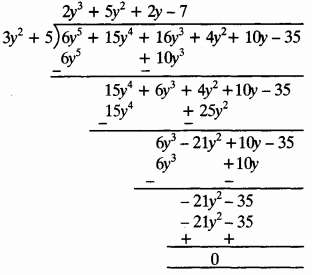
{tex}\because{/tex} Remainder = 0
Hence, 3y2+ 5 is a factor of 6y5+ 15y4 + 16y3 + 4y2 + 10y - 35.

myCBSEguide
Trusted by 1 Crore+ Students

Test Generator
Create papers online. It's FREE.

CUET Mock Tests
75,000+ questions to practice only on myCBSEguide app

Mumaiz Peer 7 years, 5 months ago
1Thank You