
Ask questions which are clear, concise and easy to understand.
Ask QuestionPosted by Raja Raj 7 years, 5 months ago
- 0 answers
Posted by Rishabh Singh 7 years, 5 months ago
- 0 answers
Posted by Vivek Choudhary 7 years, 5 months ago
- 0 answers
Posted by Tanish Jain 7 years, 5 months ago
- 1 answers
Posted by Akriti Kumari 5 years, 8 months ago
- 0 answers
Posted by Ramanujan Mondal 7 years, 5 months ago
- 1 answers
Elsa B 7 years, 5 months ago
Posted by Shailesh Kumar 6 years, 6 months ago
- 1 answers
Sia ? 6 years, 6 months ago
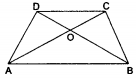
We know that the diagonals of a trapezium divide each other proportionally.
So, {tex}\frac { A O } { O C } = \frac { D O } { O B }{/tex}
{tex}\Rightarrow \frac { 5 x - 7 } { 2 x + 1 } = \frac { 7 x - 5 } { 7 x + 1 }{/tex}
By cross multiplication method we have
{tex} 35 x ^ { 2 } - 49 x + 5 x - 7{/tex}{tex}= 14 x ^ { 2 } + 7 x - 10 x - 5{/tex}
{tex}\Rightarrow 21 x ^ { 2 } - 41 x - 2 = 0{/tex}
Factorise the given quadratic equation we have
{tex} 21 x ^ { 2 } - 42 x + x - 2 = 0{/tex}
{tex}\Rightarrow 21 x ( x - 2 ) + 1 ( x - 2 ) = 0{/tex}
{tex}\Rightarrow ( 21 x + 1 ) ( x - 2 ) = 0{/tex}
Either {tex} x - 2 = 0 {/tex} or {tex}21 x + 1 = 0{/tex}
{tex}\Rightarrow x = 2 {/tex} or {tex}x = \frac { - 1 } { 21 }{/tex}
{tex}x = \frac { - 1 } { 21 } {/tex} is Rejected.
Therefore {tex}x = 2{/tex}
Posted by Jaya Gupta 6 years, 6 months ago
- 1 answers
Sia ? 6 years, 6 months ago
Let there be n terms in the given A.P.
We have, First term = a, second term = b
{tex}\therefore{/tex} Common difference d = b - a
It is given that the last term is c i.e. nth term an = c.
an = a + (n - 1)d
{tex}\therefore{/tex} c = a + (n - 1)d
{tex}\Rightarrow{/tex} c = a + (n - 1) (b - a)
{tex}\Rightarrow{/tex} (c - a) = (n - 1) (b - a)
{tex}\Rightarrow \quad n - 1 = \frac { c - a } { b - a } {/tex}
{tex}\Rightarrow \quad n = \frac { c - a } { b - a } {/tex}+ 1
{tex}\Rightarrow n = \frac { c -a + b -a } { b - a }{/tex}
{tex}\Rightarrow n = \frac { b + c - 2 a } { b - a }{/tex}...(1)
Let Sn be the sum of n terms of the A.P.
Then,
{tex}S _ { n } = \frac { n } { 2 } ( a + c ) = \frac { ( b + c - 2 a ) ( a + c ) } { 2 ( b - a ) }{/tex}[Using (1)]
Posted by Akanksha Singh 7 years, 5 months ago
- 1 answers
Shiva Yadav Shiva Yadav 7 years, 5 months ago
Posted by Manish Kumar 7 years, 5 months ago
- 3 answers
Posted by Ratnesh Kumar 7 years, 5 months ago
- 1 answers
Dipanshi Garg 7 years, 5 months ago
Posted by Deepak Kumar Pradhan 5 years, 8 months ago
- 4 answers
Posted by Nima Tamang 7 years, 5 months ago
- 1 answers
Yogita Ingle 7 years, 5 months ago
Let the prize of one book be Rs. x
Let the no. of books be y
so total amount spent = xy
300 = xy
now changed price of book = Rs. (x -5)
no. of books bought = y + 5
so total amount spent = (x - 5)(y + 5)
300 = xy +5x -5y -25
325 = 300 + 5(x - y)
25 = 5(x - y)
x - y = 5
y = x - 5
now putting this in xy = 300
(x - 5)x = 300
x2 -5x - 300 = 0
x2 -20x + 15x -300 = 0
(x - 20) ( x + 15) = 0
x = 20 or x = -15
Price of book cannot be negative so x is not equal to -15
so actual cost of book is x= Rs. 20
Posted by Nivesh Chauhan Nivesh Chauhan 7 years, 5 months ago
- 4 answers
Yug Dangi 7 years, 5 months ago
Posted by Aastha Pandit 5 years, 8 months ago
- 0 answers
Posted by Zakiahemad Patel 7 years, 5 months ago
- 3 answers
Posted by Goutam Sachdev 7 years, 5 months ago
- 0 answers
Posted by Rishabh Sharma 6 years, 6 months ago
- 1 answers
Sia ? 6 years, 6 months ago
Suppose x and y be two cars starting from points A and B respectively.
Let the speed of the car X be x km/hr and that of the car Y be y km/hr.
Case I: When two cars move in the same directions:
Suppose two cars meet at point Q, then,
Distance travelled by car X = {tex}AQ{/tex}
Distance travelled by car Y = {tex}BQ{/tex}
Distance travelled by car X in 8 hours = 8x km.
{tex}AQ = 8x{/tex}
Distance travelled by car Yin 8 hours = 8y km.
{tex}BQ = 8y{/tex}
Clearly {tex}AQ - BQ = AB{/tex}
{tex}8x - 8y = 80{/tex}
{tex}\Rightarrow {/tex} {tex}x - y = 10{/tex} ...(i)
Case II: When two cars move in opposite direction
Suppose two cars meet at point P, then,
Distance travelled by X car X = AP
Distance travelled by Y car Y = BP
we can write it as 1 hour = {tex}\frac{{20}}{{60}}{/tex}hours.
Therefore, Distance travelled by a car Y in {tex}\frac{4}{3}{/tex}hrs = {tex}\frac{4}{3}{/tex}x km.
AP + BP = AB
{tex}\frac{4}{3}x{/tex} km + {tex}\frac{4}{3} y{/tex} km = 80
{tex}\frac{4}{3}{/tex}{tex}(x + y) = 80{/tex}
{tex}( x + y ) = 80{/tex} × {tex}\frac{3}{4}{/tex}
{tex}x + y = 60{/tex} ...(ii)
By solving equations (i) and (ii), we get, {tex}x = 35.{/tex}
By substituting x = 35 in equation (ii), we get
{tex}x + y = 60{/tex}
{tex}35 + y = 60{/tex}
{tex}y = 60 - 35{/tex}
{tex}y = 25.{/tex}
Hence, speed of car X {tex}= 35\ km/hr.{/tex}
Speed of car Y ={tex} 25\ km/hr.{/tex}
Posted by Bhawan Kumar 7 years, 5 months ago
- 1 answers
Posted by Pinky Pinky 7 years, 5 months ago
- 0 answers
Posted by Shubham Kumar 7 years, 5 months ago
- 1 answers
Posted by Vijay Prajapati 6 years, 6 months ago
- 1 answers
Sia ? 6 years, 6 months ago
Given linear equation is 4x + py + 8 = 0 and 2x + 2y + 2 = 0.
So, 4x + py + 8 = 0 ...(1)
and 2x + 2y + 2 = 0 ...(2)
a1 = 4, b1 = p, c1 = 8, a2= 2 , b2 = 2 and c2 = 2
The condition of unique solution, {tex}\frac { a _ { 1 } } { a _ { 2 } } \neq \frac { b _ { 1 } } { b _ { 2 } }{/tex}
Hence,{tex}\frac { 4 } { 2 } \neq \frac { p } { 2 } \text { or } \frac { 2 } { 1 } \neq \frac { p } { 2 }{/tex}
{tex}p \neq 4{/tex}
The value of p is other than 4 it may be 1,2,3, - 4 ,.... etc.
Posted by Suraj Mal Kabra 7 years, 5 months ago
- 0 answers
Posted by Prince Kumar 7 years, 5 months ago
- 1 answers
Prabjeet Singh 7 years, 5 months ago
{tex}\text {Circumferece of circle = 8}\pi{/tex}
{tex}\text {Also, circumference of circle = 2} \pi \text {r}{/tex}
{tex}\therefore 2\pi r=8\pi{/tex}
{tex}\Rightarrow r=4{/tex}
{tex}\text {Area of circle = }\pi r^2{/tex}
{tex}\Rightarrow \text {Area of circle =} \pi (4)^2=16\pi \text { sq.units}{/tex}

myCBSEguide
Trusted by 1 Crore+ Students

Test Generator
Create papers online. It's FREE.

CUET Mock Tests
75,000+ questions to practice only on myCBSEguide app
