
Ask questions which are clear, concise and easy to understand.
Ask QuestionPosted by Raj Gupta 7 years, 5 months ago
- 0 answers
Posted by Bhawan Kumar 7 years, 5 months ago
- 1 answers
Posted by Khushi Jindal 7 years, 5 months ago
- 2 answers
Posted by Chetna Gupta 7 years, 5 months ago
- 3 answers
Raja Raj 7 years, 5 months ago
Posted by Xyz Abc 7 years, 5 months ago
- 0 answers
Posted by Kushal Kushal 7 years, 5 months ago
- 1 answers
Posted by Sneha Agrawal 6 years, 6 months ago
- 1 answers
Sia ? 6 years, 6 months ago
{tex}5x + 2y = 2k{/tex}
{tex}2(k + 1)x + ky = (3k + 4){/tex}
These are of the form
{tex}a_1x + b_1y + c_1 = 0 , a_2x + b_2y + c_2 = 0{/tex}
where,
{tex}a_1= 5 ,b_1= 2, c_1 = -2k,{/tex}
{tex}a_2= 2(k +1) ,b_2= k ,c_2 = -(3k + 4){/tex}
For infinitely many solutions, we must have
{tex}\frac { a _ { 1 } } { a _ { 2 } } = \frac { b _ { 1 } } { b _ { 2 } } = \frac { c _ { 1 } } { c _ { 2 } }{/tex}
This holds only when
{tex}\frac { 5 } { 2 ( k + 1 ) } = \frac { 2 } { k } = \frac { - 2 k } { - ( 3 k + 4 ) }{/tex}
{tex}\Rightarrow \frac { 5 } { 2 ( k + 1 ) } = \frac { 2 } { k } = \frac { 2 k } { ( 3 k + 4 ) }{/tex}
Now, the following cases arises:
Case 1:
{tex}\frac { 5 } { 2 ( k + 1 ) } = \frac { 2 } { k }{/tex}[Taking I and II]
{tex}\Rightarrow 5 k = 4 ( k + 1 ) \Rightarrow 5 k = 4 k + 4{/tex}
k = 4
Case 2:
{tex}\frac { 2 } { k } = \frac { 2 k } { ( 3 k + 4 ) }{/tex}[Taking II and III]
{tex}\Rightarrow{/tex}2(3k + 4) = 2k2 {tex}\Rightarrow{/tex}6k + 8 = 2k2
{tex}\Rightarrow{/tex} {tex}2k^2 - 6k + 8 = 0{/tex}
{tex}\Rightarrow{/tex} {tex}2(k^2 - 3k + 4)= 0{/tex}
{tex}\Rightarrow{/tex}{tex}k^2 - 3k - 4 = 0{/tex}
{tex}\Rightarrow{/tex}{tex}k^2 - 4k + k - 4 = 0{/tex}
{tex}\Rightarrow{/tex}k(k - 4) + 1(k - 4) = 0
{tex}\Rightarrow{/tex}(k - 4)(k + 1) = 0
(k - 4) = 0 or k + 1 = 0
{tex}\Rightarrow{/tex} k = 4 or k = -1
Case 3:
{tex}\frac { 5 } { 2 ( k + 1 ) } = \frac { 2 k } { ( 3 k + 4 ) }{/tex}[Taking I and II]
{tex}\Rightarrow 15 k + 20 = 4 k ^ { 2 } = 4 k{/tex}
{tex}\Rightarrow{/tex}4k2 + 4k - 15k - 20 = 0
{tex}\Rightarrow{/tex} 4k2 - 11k - 20 = 0
{tex}\Rightarrow{/tex}4k2 - 16k + 5k - 20 =0
{tex}\Rightarrow{/tex}4k(k - 4) + 5(k - 4) = 0
{tex}\Rightarrow{/tex}(k - 4)(4k + 5) = 0
{tex}\Rightarrow k = 4 \text { or } k = \frac { - 5 } { 4 }{/tex}
Thus, k = 4, is the common value of which there are infinitely many solutions.
Posted by Aarti Prajapati 7 years, 5 months ago
- 1 answers
Posted by Kritika Gupta 7 years, 5 months ago
- 0 answers
Posted by Abhishek Kumar 7 years, 5 months ago
- 1 answers
Gifty Rose Simon 7 years, 5 months ago
Posted by Akash Kumar 7 years, 5 months ago
- 0 answers
Posted by Nk Nk 6 years, 6 months ago
- 1 answers
Sia ? 6 years, 6 months ago
{tex}{\frac{1}{{2x}} + \frac{1}{{3y}} = 2}{/tex} ... (1)
{tex}\frac{1}{{3x}} + \frac{1}{{2y}} = \frac{{13}}{6}{/tex} ...(2)
Let {tex}\frac{1}{x}{/tex}= p and {tex}\frac{1}{y}{/tex}= q
Putting this in equation (1) and (2), we get
{tex}\frac{p}{2} + \frac{q}{3} = 2{/tex} and {tex}\;\frac{p}{3} + \frac{q}{2} = \frac{{13}}{6}{/tex}
{tex}\Rightarrow{/tex} 3p + 2q = 12 and 6(2p +3q) = 13 (6)
{tex}\Rightarrow{/tex} 3p + 2q = 12 and 2p + 3q = 13
{tex}\Rightarrow{/tex} 3p + 2q - 12 = 0 .................. (3) and
2p + 3q - 13 = 0 ................. (4)
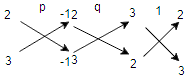
{tex}\frac{p}{{2( - 13) - 3( - 12)}} = \frac{q}{{( - 12)2 - ( - 13)3}}{/tex}{tex} = \frac{1}{{3 \times 3 - 2 \times 2}}{/tex}
{tex}\Rightarrow \frac{p}{{ - 26 + 36}} = \frac{q}{{ - 24 + 39}} = \frac{1}{{9 - 4}}{/tex}
{tex} \Rightarrow \frac{p}{{10}} = \frac{q}{{15}} = \frac{1}{5} \Rightarrow \frac{p}{{10}} = \frac{1}{5}\,{\text{and}}\,\frac{q}{{15}} = \frac{1}{5}{/tex}
{tex}\Rightarrow{/tex} p = 2 and q = 3
But {tex}\frac{1}{x}{/tex} = p and {tex}\frac{1}{y}{/tex} = q
Putting value of p and q in this we get,
x = {tex}\frac{1}{2}{/tex}and y = {tex}\frac{1}{2}{/tex}
Posted by Dipendra Singh 7 years, 5 months ago
- 0 answers
Posted by Bittu Nayak 7 years, 5 months ago
- 1 answers
Pratiksha Kiran 7 years, 5 months ago
Posted by Ashish Sharma 7 years, 5 months ago
- 1 answers
Posted by Rohit Jha 7 years, 5 months ago
- 0 answers
Posted by Utkarsh Dwivedi 7 years, 5 months ago
- 0 answers
Posted by Urvashi Akotkar 7 years, 5 months ago
- 1 answers
Rohit Jha 7 years, 5 months ago
Posted by Naina K 7 years, 5 months ago
- 0 answers
Posted by Rishabh Raj Harsh 7 years, 5 months ago
- 0 answers
Posted by Sanyam Golu 7 years, 5 months ago
- 0 answers
Posted by Satveer Kaur 7 years, 5 months ago
- 2 answers
Saurabh Vishwakarma 7 years, 5 months ago
Posted by Swati S 7 years, 5 months ago
- 0 answers
Posted by Anand Karadia 5 years, 8 months ago
- 0 answers
Posted by Abhi Raj 7 years, 5 months ago
- 0 answers
Posted by Susmita Mandal 7 years, 5 months ago
- 1 answers
Posted by Susmita Mandal 7 years, 5 months ago
- 0 answers

myCBSEguide
Trusted by 1 Crore+ Students

Test Generator
Create papers online. It's FREE.

CUET Mock Tests
75,000+ questions to practice only on myCBSEguide app
