
Ask questions which are clear, concise and easy to understand.
Ask QuestionPosted by Veena Kamdar 7 years, 5 months ago
- 2 answers
Sahil Wadhwa 7 years, 5 months ago
Posted by Radhen Savaliya 7 years, 5 months ago
- 3 answers
Posted by Aashish Keshri 7 years, 5 months ago
- 1 answers
Astitva Astitva 7 years, 5 months ago
Posted by Rishivar Kumar Jha 5 years, 8 months ago
- 1 answers
Sia ? 6 years, 6 months ago
We have, {tex}ad^2x ({a \over b}x + {2c \over d}) + c^2b =0{/tex}
{tex}\implies {a^2d^2 \over b}x^2 + 2acdx + c^2b = 0{/tex}
{tex}\implies {a^2d^2 \over b}x^2 + acdx +acdx + c^2b = 0{/tex}
{tex}\implies adx({ad \over b}x+c) + bc({ad \over b}x + c) = 0{/tex}
{tex}\implies (adx+ bc) ({ad \over b}x + c) = 0{/tex}
Either adx + bc =0 or {tex}({ad \over b}x + c) = 0{/tex}
{tex}\implies x = -{bc \over ad}{/tex}
Hence, {tex}x = -{bc \over ad}{/tex} is the requirreed solution.
Posted by Pragyan Jain 7 years, 5 months ago
- 4 answers
Posted by Rahul Mishra 7 years, 5 months ago
- 0 answers
Posted by Neel Tyagi 7 years, 5 months ago
- 1 answers
Posted by Sarang Baghele 6 years, 6 months ago
- 1 answers
Sia ? 6 years, 6 months ago
p(y) = ky2 + 2y - 3k
Compare p(y) with standard form ax2 + bx + c
a = k, b = 2, c = -3k
According to question,
Sum of zeroes = 2(Product of zeroes)
{tex}\Rightarrow \quad \frac { - b } { a } = 2 \times \frac { c } { a }{/tex}
{tex}\Rightarrow \frac { - 2 } { k } = 2 \times \frac { - 3 k } { k }{/tex}
{tex}\Rightarrow \quad \frac { 2 } { k } = 6{/tex}
{tex} \Rightarrow k = \frac { 1 } { 3 }{/tex}
Posted by Prabhjot Kaur 7 years, 5 months ago
- 0 answers
Posted by Rakesh Kumar 7 years, 5 months ago
- 1 answers
Posted by Mayank Parauha 7 years, 5 months ago
- 1 answers
Diksha Goyal 7 years, 5 months ago
Posted by Rupal ???? 6 years, 6 months ago
- 1 answers
Sia ? 6 years, 6 months ago
According to the question, {tex}\triangle ABC {/tex} is an equilateral triangle.
In {tex}\triangle{/tex}ABD, using Pythagoras theorem,
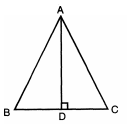
{tex}\Rightarrow{/tex} AB2 = AD2 + BD2
{tex}\Rightarrow{/tex} BC2 = AD2 + BD2, (as AB = BC = CA)
{tex}\Rightarrow{/tex} (2 BD)2 = AD2 + BD2, (perpendicular is the median in an equilateral triangle)
{tex}\Rightarrow{/tex} 4BD2 - BD2 = AD2
{tex}\therefore{/tex} AD2 =3BD2
Posted by S Beak 7 years, 5 months ago
- 0 answers
Posted by Kpd Bhatt 7 years, 5 months ago
- 1 answers
Posted by Vicky Kumar 7 years, 5 months ago
- 1 answers
Posted by Sumina Chakma 7 years, 5 months ago
- 0 answers
Posted by Charan Cherry 7 years, 5 months ago
- 0 answers
Posted by Alisha Khan 7 years, 5 months ago
- 1 answers
Posted by Amritjot Singh 7 years, 5 months ago
- 0 answers
Posted by Aryan Chaudhary 7 years, 5 months ago
- 1 answers
Posted by Maths Maths 7 years, 5 months ago
- 3 answers
Posted by Pratik Mishra 7 years, 5 months ago
- 0 answers
Posted by Farhan Alam 7 years, 5 months ago
- 1 answers
Posted by Ashi Aravindan 7 years, 5 months ago
- 1 answers
Sagar Gupta 7 years, 5 months ago
Posted by Sagar Gupta 6 years, 6 months ago
- 1 answers
Sia ? 6 years, 6 months ago
Length of the courtyard = 18 m 72 cm = 1800 cm + 72 cm = 1872 cm (therefore, 1 m = 100 cm)
Breadth of the courtyard = 13 in 20 cm = 1300 cm + 20 cm = 1320 cm
To find the square tile of maximum side we take the HCF of 1872 and 1320
Prime factorization of 1872 = 24 {tex}\times{/tex} 32 {tex}\times{/tex} 13
Prime factorization of 1320 = 23 {tex}\times{/tex} 3 {tex}\times{/tex} 5 {tex}\times{/tex} 11
HCF of 1872 and 1320 = 23 {tex}\times{/tex} 3 = 24
Therefore, Length of side of the square tile = 24 cm
Number of tiles required = Area of the courtyard / Area of each tile = (Length {tex}\times{/tex} Breadth) /Side2
= (1872 cm {tex}\times{/tex} 1320 cm) ÷ (24 cm {tex}\times{/tex} 24 cm) = 4290.
Hence 4290 tiles are required.
Posted by Aman Sidhu 7 years, 5 months ago
- 5 answers

myCBSEguide
Trusted by 1 Crore+ Students

Test Generator
Create papers online. It's FREE.

CUET Mock Tests
75,000+ questions to practice only on myCBSEguide app

Akshita Gupta 7 years, 5 months ago
1Thank You