
Ask questions which are clear, concise and easy to understand.
Ask QuestionPosted by Sanjay Sen 6 years, 6 months ago
- 1 answers
Posted by Shivendra Tripathi 7 years, 5 months ago
- 1 answers
Sagar Gupta 7 years, 5 months ago
Posted by Ankush Patel 7 years, 5 months ago
- 0 answers
Posted by Kundan Parmar 7 years, 5 months ago
- 1 answers
Brijesh Adhikari 7 years, 5 months ago
you have not written question properly so this is my answer to you
Posted by Abhishek Gupta 6 years, 6 months ago
- 1 answers
Sia ? 6 years, 6 months ago
Given A radius OP of a circle C (O, r) and a line APB, perpendicular to OP.
To Prove AB is a tangent to the circle at the point P.
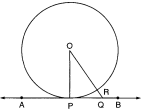
PROOF Take a point Q, different from P, on the line AB.since radius through the point of contact of tangent is perpendicular to it. Therefore,
{tex} O P \perp A B{/tex}.
{tex}{/tex}We know that among all the line segments joining O to a point on AB, OP is the shortest one. Therefore,
{tex}{/tex} OP < <oq>OQ
{tex}{/tex}{tex}\Rightarrow{/tex} OQ > OP</oq>
{tex}\Rightarrow{/tex}Q <oq>lies outside the circle.
Therefore, every point on AB, other than P, lies outside the circle. This implies that AB meets the circle only at the point P.
Hence, AB is a tangent to the circle at P.</oq>
Posted by Vivek Bavaskar 5 years, 8 months ago
- 0 answers
Posted by Shikayna Panday 7 years, 5 months ago
- 1 answers
Posted by Anam Sheikh 7 years, 5 months ago
- 3 answers
Muskan Malik 7 years, 5 months ago
Shivendra Tripathi 7 years, 5 months ago
Shivam Mishra 7 years, 5 months ago
Posted by Sumit Singh 7 years, 5 months ago
- 2 answers
Posted by Janvi Shivhare 7 years, 5 months ago
- 1 answers
Sia ? 6 years, 6 months ago
Check sample papers here : <a href="https://mycbseguide.com/cbse-sample-papers.html">https://mycbseguide.com/cbse-sample-papers.html</a>
Posted by Shalu Gupta 7 years, 5 months ago
- 0 answers
Posted by Diksha Singh 7 years, 5 months ago
- 1 answers
Posted by Ansh Kushwaha 7 years, 5 months ago
- 1 answers
Sagar Gupta 7 years, 5 months ago
Posted by Muskan Rajan 7 years, 5 months ago
- 1 answers
Posted by Mumaiz Peer 7 years, 5 months ago
- 2 answers
Posted by Shreyas G 7 years, 5 months ago
- 1 answers
Posted by Goumsi Dhingra 7 years, 5 months ago
- 1 answers
Posted by Suraj Jat 7 years, 5 months ago
- 3 answers
Posted by Jareed Mumavvir 7 years, 5 months ago
- 2 answers
Ashutosh Navade 7 years, 5 months ago
Posted by Sanskar . Sanskar 7 years, 5 months ago
- 0 answers
Posted by Shravan Kapadia 7 years, 5 months ago
- 2 answers
Posted by Noora Fathima 6 years, 6 months ago
- 1 answers
Sia ? 6 years, 6 months ago
Let the speed of the train be x km/hr and that of the car be y km/hr.
Case I Distance covered by train = 250 km.
Distance covered by car = (370 - 250) km = 120 km.
Time taken to cover 250 km by train = {tex}\frac { 250 } { x }{/tex} hours
Time taken to cover 120 km by car = {tex}\frac { 120 } { y }{/tex}hours
Total time taken =4 hours
{tex}\therefore \quad \frac { 250 } { x } + \frac { 120 } { y } = 4 \Rightarrow \frac { 125 } { x } + \frac { 60 } { y } = 2{/tex}.......(i)
Case II Distance covered by train = 130 km.
Distance covered by car = (370 -130) km = 240 km.
Time taken to cover 130 km by train = {tex}\frac { 130 } { x }{/tex} hours
Time taken to cover 240 km by car ={tex} \frac { 240 } { y }{/tex} hours
Total time taken = {tex}4 \frac { 18 } { 60 } \text { hours } = 4 \frac { 3 } { 10 } \text { hours } = \frac { 43 } { 10 }{/tex}hours
{tex}\therefore \quad \frac { 130 } { x } + \frac { 240 } { y } = \frac { 43 } { 10 } \Rightarrow \frac { 1300 } { x } + \frac { 2400 } { y } = 43{/tex}......(ii)
Putting {tex}\frac 1x{/tex}= u and {tex}\frac 1y{/tex}=v, equations (i) and (ii) become
{tex}125u + 60v = 2{/tex} ... (iii) and {tex}1300u + 2400v = 43{/tex}. ... (iv)
On multiplying (iii) by 40 and subtracting (iv) from the result, we get
5000u - 1300v = 80 - 43 {tex}\Rightarrow{/tex} 3700u = 37
{tex}\Rightarrow u = \frac { 37 } { 3700 } = \frac { 1 } { 100 } \Rightarrow \frac { 1 } { x } = \frac { 1 } { 100 } \Rightarrow x = 100{/tex}
Putting u = {tex}\frac{1}{100}{/tex} in (iv), we get
{tex}\left( 1300 \times \frac { 1 } { 100 } \right) + 2400 v = 43 \Rightarrow 2400 v = 43 - 13 = 30{/tex}
{tex}\Rightarrow v = \frac { 30 } { 2400 } = \frac { 1 } { 80 } \Rightarrow \frac { 1 } { y } = \frac { 1 } { 80 } \Rightarrow y = 80{/tex}
{tex}\therefore{/tex} x = 100 and y = 80.
Hence, the speed of the train is 100 km/hr and that of the car is 80 km/hr
Posted by Anurag Ojha 7 years, 5 months ago
- 0 answers

myCBSEguide
Trusted by 1 Crore+ Students

Test Generator
Create papers online. It's FREE.

CUET Mock Tests
75,000+ questions to practice only on myCBSEguide app

Sia ? 6 years, 6 months ago
On dividing n by 3, let q be the quotient and r be the remainder.
Then, {tex}n = 3q + r{/tex}, where {tex}0 \leq r < 3{/tex}
{tex}\Rightarrow\;n = 3q + r{/tex} , where r = 0,1 or 2
{tex}\Rightarrow{/tex} {tex}n = 3q \;or \;n = (3q + 1) \;or\; n = (3q + 2){/tex}.
Case I If n = 3q then n is clearly divisible by 3.
Case II If {tex}\;n = (3q + 1)\; {/tex} then {tex} (n + 2)= (3q + 1 + 2) = (3q + 3) = 3(q + 1){/tex}, which is clearly divisible by 3.
In this case, {tex}(n + 2){/tex} is divisible by 3.
Case III If n = {tex}(3q + 2){/tex} then {tex}(n + 1) = (3q + 2 + 1) = (3q + 3) = 3(q + 1){/tex}, which is clearly divisible by 3.
In this case,{tex} (n + 1){/tex} is divisible by 3.
Hence, one and only one out of {tex}n, (n + 1){/tex} and {tex}(n + 2){/tex} is divisible by 3.
0Thank You