
Ask questions which are clear, concise and easy to understand.
Ask QuestionPosted by Ayaz Ahmad Pathan 7 years, 4 months ago
- 0 answers
Posted by Jitesh Singh 6 years, 6 months ago
- 1 answers
Sia ? 6 years, 6 months ago
We have,
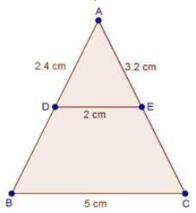
DE || BC
Now, In {tex}\triangle{/tex}ADE and {tex}\triangle {/tex}ABC
{tex}\angle A = \angle A{/tex} [common]
{tex}\angle A D E = \angle A B C{/tex} [{tex}\because{/tex} DE || BC {tex}\Rightarrow{/tex} Corresponding angles are equal]
{tex}\Rightarrow \triangle A D E= \triangle A B C{/tex} [By AA criteria]
{tex}\Rightarrow \frac { A B } { B C } = \frac { A D } { D E }{/tex} [{tex}\because{/tex} Corresponding sides of similar triangles are proportional]
{tex}\Rightarrow \frac { A B } { 5 } = \frac { 2.4 } { 2 }{/tex}
{tex}\Rightarrow A B = \frac { 2.4 \times 5 } { 2 }{/tex}
{tex}\Rightarrow{/tex} AB = 1.2 {tex}\times{/tex} 5
= 6.0 cm
{tex}\Rightarrow{/tex} AB = 6 cm
{tex}\therefore{/tex} BD = AB - AD
= 6 - 2.4
= 3.6 cm
{tex}\Rightarrow{/tex} DB = 3.6 cm
Now,
{tex}\frac { A C } { B C } = \frac { A E } { D E }{/tex} [{tex}\because{/tex} Corresponding sides of similar triangles are equal]
{tex}\Rightarrow \frac { A C } { 5 } = \frac { 3.2 } { 2 }{/tex}
{tex}\Rightarrow A C = \frac { 3.2 \times 5 } { 2 }{/tex}
= 1.6 {tex}\times{/tex} 5
= 8.0 cm
{tex}\Rightarrow{/tex} AC = 8 cm
{tex}\therefore{/tex} CE = AC - AE
= 8 - 3.2
= 4.8 cm
Hence, BD = 3.6 cm and CE = 4.8 cm
Posted by Lucky? Dangi 6 years, 6 months ago
- 1 answers
Sia ? 6 years, 6 months ago
Assume digit at ten’s place = x and digit at unit’s place = y
Therefore number = 10x + y
Also xy = 15 {tex}\Rightarrow{/tex} x = {tex}\frac{15}{y}{/tex} ...(i)
According to given situation we have,
10x + y + 18 = 10y + x
{tex}\Rightarrow{/tex}9x - 9y + 18 = 0
{tex}\Rightarrow{/tex}x - y + 2 = 0
{tex}\Rightarrow{/tex}{tex}\frac{15}{y}{/tex} - y + 2 = 0 (From (i))
{tex}\Rightarrow{/tex}15 - y2 + 2y = 0
{tex}\Rightarrow{/tex}y2 - 2y - 15 = 0
On factorizing the above quadratic equation we get
(y - 5) (y + 3) = 0
{tex}\Rightarrow{/tex}y = 5, y = -3 [ y = -3 is rejected]
Put the value of y = 5 in equation (i), we obtain
x = {tex}\frac{15}{5}{/tex} = 3
{tex}\therefore{/tex} Number = 3 {tex}\times{/tex} 10 + 5 = 35.
Posted by Saurabh Bramhankar 7 years, 4 months ago
- 1 answers
Posted by Yogendra Thakre 7 years, 4 months ago
- 1 answers
Jiya Kardam 7 years, 4 months ago
Posted by Samriddh Sahu 6 years, 6 months ago
- 1 answers
Sia ? 6 years, 6 months ago
Let the number of sides of polygon be  The interior angles of the polygon form an A.P.
Here, a = 120o and d = 5o
Since Sum of interior angles of a polygon with n sides is {tex}( n - 2 ) \times 180 ^ { \circ }{/tex}
{tex}\therefore \mathrm { S } _ { n } = ( n - 2 ) \times 180 ^ { \circ }{/tex}
{tex}\Rightarrow \frac { n } { 2 } [ 2 \times 120 + ( n - 1 ) \times 5 ] = 180 n - 360{/tex}
{tex}\Rightarrow 120 n + \frac { 5 n ^ { 2 } - 5 n } { 2 } = 180 n - 360{/tex}
{tex}\Rightarrow{/tex} 240n + 5n2 - 5n = 360n - 720
{tex}\Rightarrow{/tex} 5n2 - 125n + 720 = 0
divide by 5, we get
{tex}\Rightarrow{/tex} n2 - 25n + 144 = 0
{tex}\Rightarrow{/tex} (n - 16) (n - 9) = 0
{tex}\Rightarrow{/tex} n = 16 or n = 9
But n = 16 not possible because a16 = a + 15d = 120 + 15 {tex}\times{/tex} 5 = 195o > 180o
Therefore, number of sides of the polygon are 9.
Posted by Priyanahu Khandelwal 6 years, 6 months ago
- 1 answers
Sia ? 6 years, 6 months ago
On dividing x4 - 6x3 - 16x2 - 25x + 10 by x2 - 2x + k
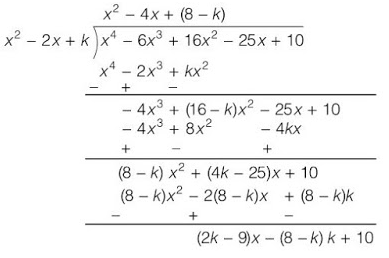
{tex}\therefore{/tex} Remainder = (2k - 9)x - (8 - k)k + 10
But the remainder is given as x+a.
On comparing their coefficients,
2k - 9 = 1
{tex}\Rightarrow{/tex} k = 10
{tex}\Rightarrow{/tex} k = 5 and,
-(8 - k)k + 10 = a
{tex}\Rightarrow{/tex} a = -(8 - 5)5 + 10 = -15 + 10 = -5
Hence, k = 5 and a = -5
Posted by Yash Ameriya 7 years, 4 months ago
- 1 answers
Posted by Kuldeep Kuldeep Pal 7 years, 4 months ago
- 3 answers
The Devil Prince 7 years, 4 months ago
Posted by Raja Yadav 7 years, 4 months ago
- 2 answers
Rajat Ranjan 7 years, 4 months ago
The Degree (for a polynomial with one variable, like <i>x</i>) is:
the <a href="https://www.mathsisfun.com/exponent.html">largest exponent</a> of that variable.

Posted by Bhanu Pratap Pratap 7 years, 4 months ago
- 1 answers
Nisha Sangwan 7 years, 4 months ago
Posted by Divya Borra 7 years, 4 months ago
- 1 answers
Posted by Ankush Singh 7 years, 4 months ago
- 0 answers
Posted by Dhara Singh Meena 7 years, 4 months ago
- 1 answers
Posted by Salman Khan 7 years, 4 months ago
- 1 answers
Posted by Ayush Karagwal 5 years, 8 months ago
- 1 answers
Sia ? 6 years, 4 months ago
{tex}\frac { 1 } { x + 4 } - \frac { 1 } { x - 7 } = \frac { 11 } { 30 }{/tex} where {tex}x \neq - 4,7{/tex}
{tex}\Rightarrow \frac { ( x - 7 ) - ( x + 4 ) } { ( x + 4 ) ( x - 7 ) } = \frac { 11 } { 30 }{/tex}
{tex}\Rightarrow \frac { - 11 } { ( x + 4 ) ( x - 7 ) } = \frac { 11 } { 30 }{/tex}
{tex}\Rightarrow{/tex} x2 - 7x + 4x - 28 = -30
{tex}\Rightarrow{/tex} x2 - 3x + 2= 0
Comparing equation x2 - 3x + 2 = 0 with general form ax2 + bx + c = 0,
We get a = 1, b = -3 and c = 2
Using quadratic formula {tex}x = {-b \pm \sqrt{b^2-4ac} \over 2a}{/tex}to solve equation,
{tex}x = \frac { 3 \pm \sqrt { ( - 3 ) ^ { 2 } - 4 ( 1 ) ( 2 ) } } { 2 \times 1 }{/tex}
{tex}\Rightarrow x = \frac { 3 \pm \sqrt { 1 } } { 2 }{/tex}
{tex}\Rightarrow x = \frac { 3 + \sqrt { 1 } } { 2 } , \frac { 3 - \sqrt { 1 } } { 2 }{/tex} {tex}\Rightarrow{/tex} x = 2, 1
Posted by Abhay Raj 7 years, 4 months ago
- 1 answers
Posted by Shikayna Panday 7 years, 4 months ago
- 3 answers
Posted by Harjot Kaur 7 years, 4 months ago
- 1 answers
Posted by Ramireddy Vyshanvi 7 years, 4 months ago
- 1 answers
Posted by Meraj Khan 7 years, 4 months ago
- 1 answers
Shikhar Maheshwari 7 years, 4 months ago
Posted by Kavish Gumber 7 years, 4 months ago
- 0 answers
Posted by Jujhar Singh 7 years, 4 months ago
- 1 answers
Posted by Naina Chauhan 7 years, 4 months ago
- 1 answers
Maitreyee Dave 7 years, 4 months ago
Posted by Amatullah Baroda 5 years, 8 months ago
- 1 answers
Shikhar Maheshwari 7 years, 4 months ago
Posted by Ashish Sen 7 years, 4 months ago
- 1 answers
Posted by Abhishek Deswal 5 years, 8 months ago
- 6 answers

myCBSEguide
Trusted by 1 Crore+ Students

Test Generator
Create papers online. It's FREE.

CUET Mock Tests
75,000+ questions to practice only on myCBSEguide app
